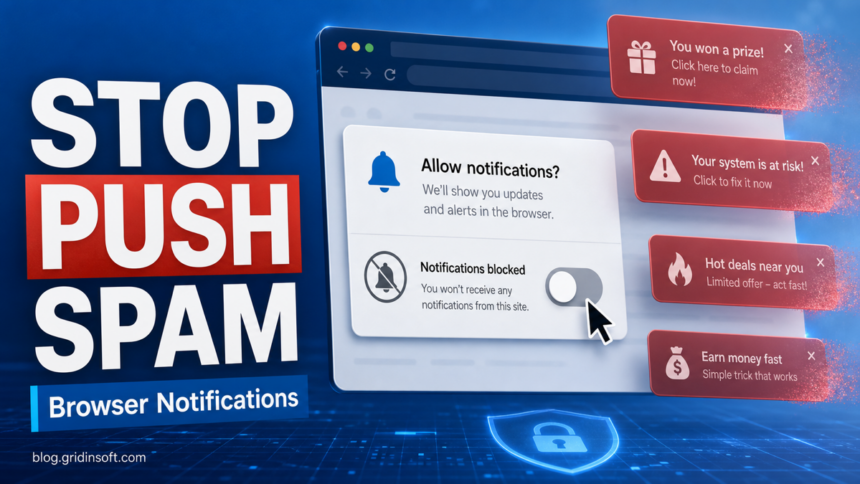
If a website keeps sending alerts from Chrome, Edge, Firefox, Safari, or your phone, remove that site from the browser’s notification permissions first. Browser push notifications are opt-in: a site can only send them after you click Allow. Open the notification settings, delete or block the suspicious site, then disable future notification requests if you do not use web alerts. If the same warnings return after permissions are removed, treat it as a browser hijacker or adware symptom and scan the device.
If a notification cleanup also exposes a suspicious exact domain, use the matching guide: Firefox.vg fake browser notifications for fake Firefox-themed alerts, or the Travel-now.cc Chrome cleanup guide for changed search settings.
Random fake-CAPTCHA senders such as bigcaptchahere.top, ovinspecutions.com, grakorte.com, getadvnp.com, or snconor.vg should be handled the same way: remove the site permission first, then check why that domain was allowed if the alerts return.
After removing spam notifications, review your broader browser security settings so Safe Browsing, extensions, downloads, and saved passwords are not left exposed.
Fast Fix
- Open your browser’s notification settings.
- Find unknown, adult, streaming, fake prize, fake antivirus, or random-looking domains in the Allowed list.
- Change each suspicious site to Block or remove it.
- Turn off future notification prompts if you do not need them.
- If alerts still appear, check extensions, reset the browser, and scan for adware.
Why Spam Browser Notifications Appear
Website notifications are not the same as pop-up windows. A pop-up opens a new tab or window. A push notification is a browser permission that lets a website display alerts later, sometimes even when the site is no longer open. Google notes that Chrome can automatically block intrusive or misleading notifications and recommends keeping those blocked [1]. Microsoft also separates website notifications from unwanted pop-ups in Edge [3].
That distinction matters because many scam pages abuse the permission prompt. They show messages like “click Allow to continue,” “verify that you are not a robot,” “watch the video,” or “claim your prize.” Once allowed, the site can send fake antivirus warnings, adult-site alerts, giveaways, and download offers. These alerts usually do not mean the browser itself is infected, but they can lead to malware, phishing, or unwanted software.
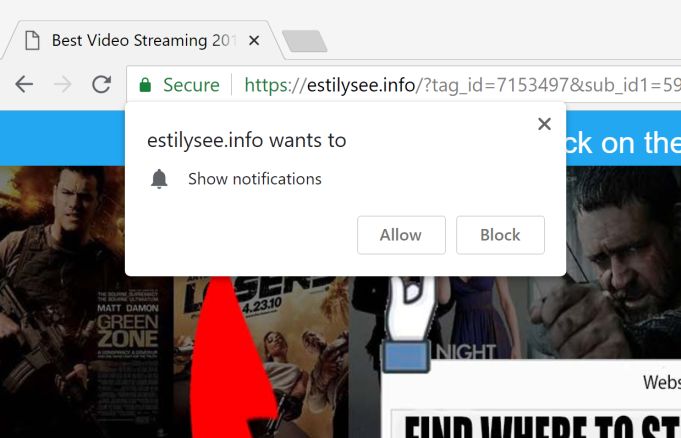
Chrome: Disable Push Notifications
Use this path on desktop Chrome:
- Open Chrome and click the three-dot menu.
- Go to Settings → Privacy and security → Site settings → Notifications.
- Under Allowed to send notifications, remove or block every suspicious domain.
- Set the default behavior to block notification requests, or use quieter notification prompts if you still want trusted sites to ask.
For a single site, open that site, click the icon to the left of the address bar, open site permissions, and set Notifications to Block. Chrome’s current help page also separates notification settings from pop-up and redirect settings, so check both if the site opens new tabs as well as alerts [1].
Remove Fake CAPTCHA Notification Domains in Chrome
Fake CAPTCHA and video-gate pages often use random domains instead of a recognizable brand name. If Chrome notifications name a sender such as bigcaptchahere.top, ovinspecutions.com, grakorte.com, getadvnp.com, snconor.vg, or another site you do not remember allowing, clean the permission before interacting with the alert.
- Open
chrome://settings/content/notifications. - Search the Allowed to send notifications list for the suspicious domain and other sites allowed on the same day.
- Use the three-dot menu to remove or block each unwanted sender.
- Open
chrome://settings/content/popupsand block the same domain if it also opens tabs or redirects. - Check
chrome://extensionsfor unknown extensions, especially ones installed around the time the alerts started.
Chrome keeps site permissions inside each browser profile, so the same computer can have different allowed domains in different Chrome profiles. Use Chrome settings first; do not hand-edit the profile Preferences file unless you are recovering a damaged profile and have a backup.
| What you see | What to check next |
|---|---|
| The domain disappears after removal | No extra app cleanup is usually needed. Keep notification prompts blocked for unknown sites. |
| The same domain returns | Review extensions, Chrome Sync, and chrome://policy for managed settings that restore permissions. |
| Alerts open fake antivirus, downloads, or support pages | Inspect recently installed apps, startup entries, scheduled tasks, and run an adware scan before using the browser normally. |
Edge: Stop Website Notifications
Modern Microsoft Edge no longer uses the old “Advanced settings” path. Use the current route:
- Open Edge and click Settings and more.
- Go to Settings → Cookies and site permissions → Notifications.
- Remove suspicious sites from the allow list or move them to Block.
- For a site you are visiting now, click the site information icon near the address bar and set Notifications to Block.
Microsoft’s support page also points out that Edge website notifications can appear in the Windows notification area, which is why the alert may look like a system message even though it came from a browser permission [3].
Firefox: Block Push Notifications
In Firefox, notifications are controlled from the Permissions section:
- Open Firefox settings.
- Select Privacy & Security.
- Scroll to Permissions and click Settings… next to Notifications.
- Select suspicious websites and click Remove Website, or change their status to Block.
- Check Block new requests asking to allow notifications if you want Firefox to deny future prompts automatically.
Mozilla describes Web Push as an opt-in feature: sites cannot send push messages until permission is granted, and Firefox lets you remove all websites or block new notification requests from the same settings window [2].
Safari: Turn Off Website Notifications
On Safari for Mac:
- Open Safari → Settings.
- Click Websites.
- Select Notifications.
- Deny or remove suspicious websites.
- Deselect Allow websites to ask for permission to send notifications if you want to stop future prompts.
If the website still appears in macOS notification settings, open System Settings → Notifications, select the website, and turn off Allow Notifications. Apple notes that Safari website notifications can appear even when Safari is not open, so checking macOS notification settings is useful when alerts seem to come from the system [4].
Android: Stop Chrome Notification Spam
On Android, many unwanted alerts come from Chrome site permissions rather than from a normal app notification:
- Open Chrome on Android.
- Tap the three-dot menu → Settings.
- Tap Site settings → Notifications.
- Turn notifications off for all sites or block the suspicious site.
- If a spam notification is visible, swipe down the notification shade and use Unsubscribe when Chrome offers it.
Google’s Android instructions also include Report spam to Chrome for deceptive notifications after unsubscribing, which is useful when a site is clearly abusing the feature [5].
When Removing Permissions Is Not Enough
Permission cleanup should stop ordinary website notification spam. If it does not, check for a broader browser or adware issue:
If Marowhome.com keeps opening on an Infinix, Tecno, or itel phone after its site data is removed, use the default-browser and Safe Mode tests to check whether another Android component is launching the URL.
If the alerts began after a visit to XVideos, use our XVideos safety decision guide to separate a permission-only case from a risky download or executed file.
- Unknown extensions reappear after removal.
- The homepage, search engine, or new-tab page changes by itself.
- Notifications open download pages, fake antivirus warnings, or tech-support scams.
- New browser windows appear even after all notification permissions are blocked.
- Multiple browsers show the same unwanted ads.
For suspicious browser behavior, remove unknown extensions and follow our browser reset guide. If the alerts imitate a known brand, the fake McAfee pop-ups cleanup checklist shows how to separate browser permissions from scareware. If the blocked endpoint is api.rainbowblocker.com, use the Rainbow Blocker adware cleanup guide because the source may be an extension, not only a notification permission. Adult or streaming pages often use “Allow to continue” tricks; our porn-site malware risk guide explains when the risk is only a permission and when a scan is safer. If the warning says “You May Have Viruses On After Visiting An Adult Website”, treat it as a named fake pop-up scam and avoid the Protect or install buttons.
On Windows, if notification spam returns after you remove the allowed sites, the visible alert may be only one part of the cleanup. A browser extension, managed policy, startup entry, scheduled task, or bundled adware module can restore the permission or reopen the same scam pages after reboot.
If alerts or unwanted browser windows return after you block the sending sites on Windows, scan for adware. Check for software reopening the browser instead of repeatedly clearing the same notification permission.
Check Windows for adwareOn Android, blocking the site’s notification permission remains the main fix. If an installed APK or unfamiliar app keeps showing ads outside Chrome, use Trojan Scanner for Android to scan, review findings and confirm unwanted-app removal. See the Android cleanup guide for controls.
How to Avoid Notification Traps
- Do not click Allow to prove you are human, start a video, download a file, or close a warning.
- Only allow notifications for sites where alerts have clear value, such as mail, work tools, banking alerts, or trusted news.
- Use quieter prompts in Chrome if you want fewer interruptions without blocking every legitimate request.
- Review notification permissions every few months, especially on shared computers.
- Scan the device if notification spam appears together with redirects, unwanted extensions, or blocked security-tool alerts.
If notifications are disabled but the browser still opens multiple unwanted tabs by itself, inspect extensions, startup pages, browser shortcuts, Task Scheduler, and recently installed apps for adware persistence.
FAQ
Are browser push notifications a virus?
No. Push notifications are a browser feature. They become risky when a deceptive site tricks you into clicking Allow and then uses the permission to send fake warnings, scam offers, or malware links.
Why do notifications appear when the website is closed?
Web push is designed to work after you grant permission. Depending on the browser and operating system, notifications can appear even when the original tab is closed.
Should I block all notification requests?
Yes, if you do not rely on website alerts. Most users can safely block future notification prompts and allow only specific trusted sites later if needed.
Do I also need to block pop-ups?
Often, yes. Notifications and pop-ups are separate settings. If a site opens new tabs or redirects you, block pop-ups and redirects for that site as well.
If a notification sender uses a technical update-style name such as microservice-updatehub.cc, remove the permission first, then follow the Microservice-updatehub.cc alert cleanup checklist when the browser opens by itself or a file was run.
For a current named-domain example, see our Hosting-explorer.cc notification cleanup guide, which shows how one allowed site can become recurring browser spam.
If a notification source is a suspicious file-sharing domain such as Fileshare.vg, start with the exact-domain cleanup in our Fileshare.vg pop-up removal guide.
If a notification source is a suspicious redirect domain such as Flowtracker.vg, start with the exact-domain cleanup in our Flowtracker.vg pop-up removal guide.
References
- Google Chrome Help. “Use notifications to get alerts – Computer.” Google, accessed June 1, 2026. https://support.google.com/chrome/answer/3220216?hl=en
- Mozilla Support. “Web Push notifications in Firefox.” Mozilla, updated May 2026, accessed June 1, 2026. https://support.mozilla.org/en-US/kb/push-notifications-firefox
- Microsoft Support. “Manage website notifications in Microsoft Edge.” Microsoft, accessed June 1, 2026. https://support.microsoft.com/en-US/edge/manage-website-notifications-in-microsoft-edge
- Apple Support. “Customize website notifications in Safari on Mac.” Safari User Guide, Apple, accessed June 1, 2026. https://support.apple.com/guide/safari/customize-website-notifications-sfri40734/mac
- Google Chrome Help. “Use notifications to get alerts – Android.” Google, accessed June 1, 2026. https://support.google.com/chrome/answer/3220216?co=GENIE.Platform%3DAndroid&hl=en
If the allowed site is an exact spam domain such as Matrixgrowthforge.com, use the domain-specific cleanup flow in our Matrixgrowthforge.com notification removal guide after blocking the permission.
If the sender is ellinfituns.com, follow the Ellinfituns.com ads removal guide for the same permission cleanup plus extension and adware checks.