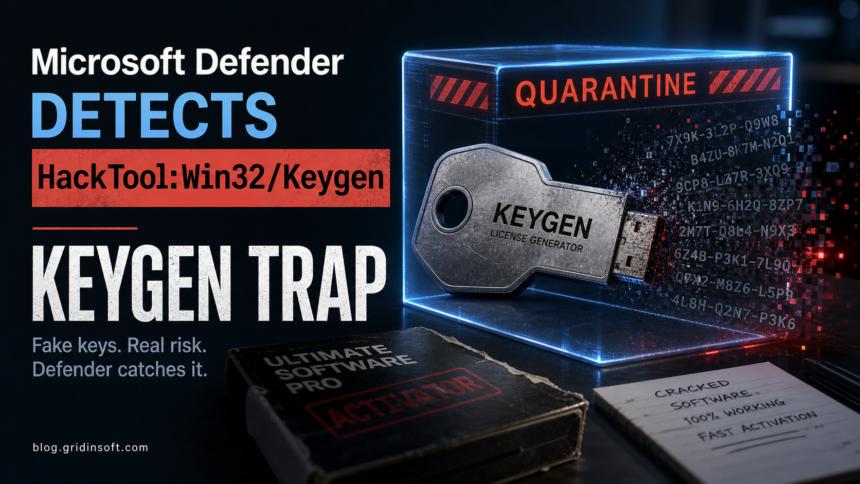
HackTool:Win32/Keygen is a Microsoft Defender detection for key generators and license-bypass tools. A keygen may look like a small utility that only creates serial numbers, but Microsoft warns that malware is often installed together with these tools. Treat the alert as unsafe unless you are analyzing the file in an isolated malware lab.
Is HackTool:Win32/Keygen dangerous?
- Yes, treat it as risky. Keygens are illegal license-bypass tools and are commonly bundled with trojans, stealers, miners, downloaders, or backdoors.
- Do not restore it from quarantine just to keep cracked software working.
- Delete the original archive or installer that contained the keygen, not only the quarantined file.
- Run a full malware scan if the keygen was executed; the cleanup steps below cover bundled components as well as the visible file.
- Protect accounts from a separate trusted device if you ran the tool or see account misuse: change exposed passwords and revoke sessions while local cleanup proceeds.
Some keygens and cracks are promoted through repack-download sites. If your alert followed that route, compare this guide with the exact-domain Repack-Games.com cleanup checklist.
What to do next
| Your situation | Risk level | Best action |
| Defender blocked the keygen before you opened it | Lower, but not zero | Remove the detection, delete the archive or installer, and run a full scan. |
| You ran the keygen or disabled protection | High | Assume the bundle may have dropped a stealer, miner, or downloader. Scan fully; use a separate trusted device for password changes and session revocation in parallel. |
| The alert keeps coming back | High | Compare the newest event time, status, and affected path with the earlier alert; investigate a fresh unresolved detection before assuming persistence. |
| This happened on a work computer | Incident-level | Stop using sensitive accounts on the device and notify your IT or security team. |
Defender detection context: This guide is part of our Microsoft Defender detection reference. For HackTool:Win32/Keygen, the source of the file matters as much as the detection name.
| Detection | HackTool:Win32/Keygen |
| Detected by | Microsoft Defender Antivirus |
| Type | Hack tool / key generator / software piracy utility |
| Common sources | Torrents, cracked games, warez sites, fake activators, repacked installers, password-protected archives |
| Main risk | The keygen itself may be unwanted, and the package around it often carries real malware. |
| Best first action | Do not restore it for cracked software. Delete the source archive, scan fully, protect accounts if it was executed, and avoid Defender exclusions. |
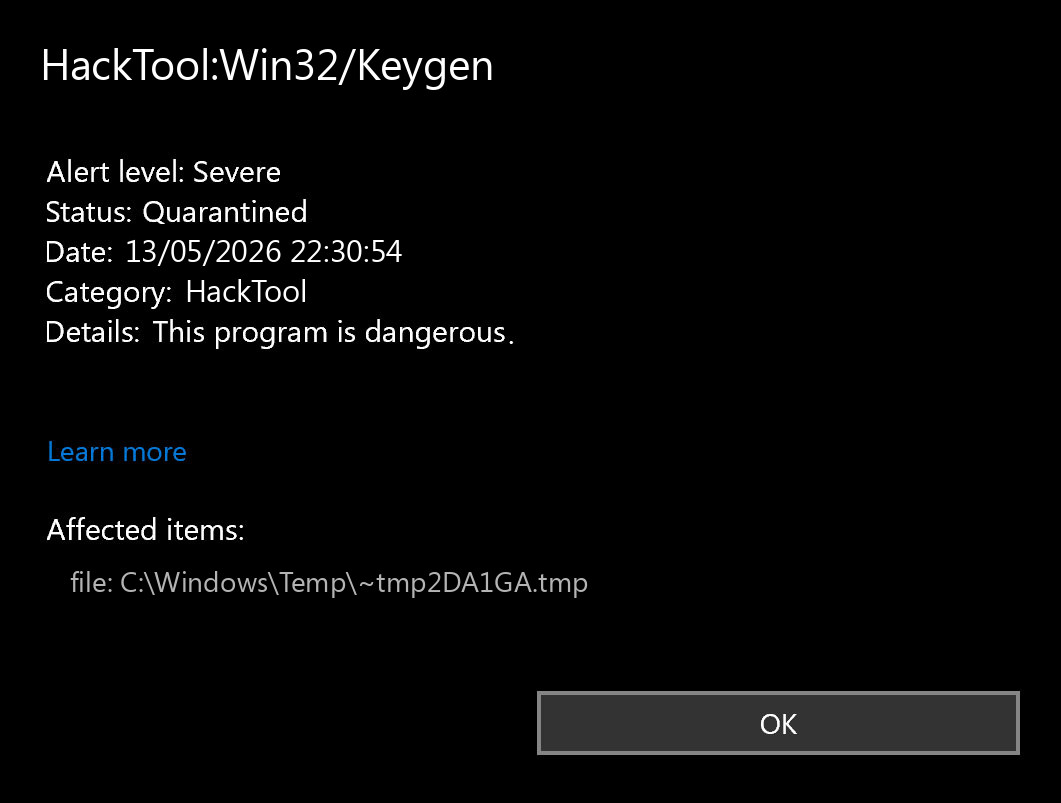
HackTool:Win32/Keygen showing the exact detection name users should check before deciding whether to remove, quarantine, or investigate the file.What is HackTool:Win32/Keygen?
HackTool:Win32/Keygen is the Microsoft Defender name for a keygen detection. Check that the name in your Windows Security alert matches this label. A separate crack alert should be handled with the broader crack guide.
HackTool:Win32/Keygen is a Defender detection for software key generators. These tools are designed to generate fake license keys or serial numbers for paid software. Microsoft’s official threat description [1] says the tool creates license keys for illegal software registration and warns that malware is often installed along with it.
That point matters. Some users assume Defender is only objecting to piracy and that the file is otherwise harmless. In real cases, the keygen archive may also contain a downloader, password stealer, miner, browser hijacker, proxy malware, or a backdoor. The detection name does not tell you every payload that may have been included.
Why does Microsoft Defender detect keygens?
Defender detects keygens because they are built to bypass software licensing and are distributed through the same channels that spread malware. Microsoft has historically linked Win32/Keygen detections with other threats on affected computers, including autorun malware, exploit kits, worms, and obfuscated payloads.
A clean-looking keygen window does not prove the file is safe. The visible program can be a decoy while another component changes startup entries, drops files into AppData, disables security settings, or opens a connection to download more malware.
Keygen vs crack vs AutoKMS
Crack warnings are not limited to key generators. VFX and 3D software packages can use similar loader and DLL side-loading tricks; the VFXmed virus warning covers that exact cracked-software lane.
If the alert followed Adobe GenP or a file named AdobeGenP.exe, use the GenP safety and post-run cleanup guide to separate expected patcher behavior from a bundled downloader, stealer, or recurring payload before restoring anything.
If a package claimed to activate CorelDRAW or included CorelDRAW.KeyGen.exe, follow the CorelDRAW crack and keygen after-run checklist to distinguish a blocked archive from an executed tool, undo exclusions, and check for persistence.
These detections overlap, but they are not identical:
- HackTool:Win32/Keygen usually points to a program that generates fake serial keys or license data.
- HackTool:Win32/Crack is broader and can include patched binaries, loaders, DLL modifications, and license checks bypassed inside the program.
- HackTool:Win32/AutoKMS is tied to unofficial KMS activators for Windows or Office.
If Defender found more than one of these names, clean them together. They often come from the same cracked package.
How to check the alert safely
- Open Windows Security.
- Go to Virus & threat protection → Protection history.
- Open the newest HackTool:Win32/Keygen event; Microsoft explains the available status and actions in its Protection history guide [2].
- Record the event time, affected item or archive member, full path, and threat status. Preserve these details for IT before cleanup on a managed PC.
- Do not click Allow or create an exclusion for the folder.
The path helps locate the affected object; it does not establish what ran or prove credential theft. Compare it with the download and execution history.
| Detected path | Likely source | Recommended action |
Downloads, torrent folder, archive, ISO, ZIP, RAR |
Crack/keygen package | Delete the identified untrusted package, not the whole Downloads or torrent folder. Do not extract it again. |
| Game folder or repack installer folder | Cracked game or patcher | Uninstall the cracked software and scan the system. |
AppData, Temp, random folder |
Dropped payload or unpacked component | Run a full scan; inspect related startup entries or tasks only if a fresh alert or continuing activity warrants it. Do not delete all of AppData or Temp. |
| USB drive | Copied keygen or autorun-style spread | Scan the USB and avoid copying files back to the PC. |
| Work computer | Policy/security incident | Disconnect from sensitive accounts and notify IT/security. |
How to remove HackTool:Win32/Keygen
On a work PC, stop and notify IT/security before deleting evidence. If you ran the tool or see unauthorized account activity, start the clean-device account steps below immediately; do not wait for a scan to finish.
- Keep the detection quarantined or choose Remove in Protection history. Do not restore, allow, or exclude it to make the crack work.
- Remove the identified untrusted source package: the specific archive, installer, ISO, or extracted keygen files. Uninstall its cracked application. Do not erase an entire download folder, user profile, or unrelated files; do not re-extract a quarantined member to test it.
- Install and update Gridinsoft Anti-Malware from its official site, then run a Full Scan. Review the detected items and paths, apply the recommended quarantine or removal, and restart if requested.
- Verify after restart: run an updated scan and compare the latest Protection history event time, status, and affected object with your saved details. An old resolved card does not by itself show a new infection.
If a new event still names an unchanged source archive, remove that specific untrusted package. If a file reappears after removal, distinguish a fresh download or extraction from unexplained recreation; only then use targeted persistence checks. A clean scan cannot prove that no data was stolen earlier.
When to use Gridinsoft Anti-Malware
Quarantining the visible keygen may leave a bundled loader, startup task, browser change, or other component behind. If you ran the package, disabled protection, or still see suspicious activity, Gridinsoft Anti-Malware provides the full scan and cleanup route above. Keep protection enabled; you do not need to complete two other scanners before following it.
Cracks, repacks, and activators can add Defender exclusions, startup tasks, services, browser changes, stealers, or miners outside the folder you meant to install. Scan for those changes before trusting the PC.
Check what changed outside the game folderReview the results instead of assuming every unfamiliar file is malicious. Scanning and quarantine address detected local items; account recovery remains a separate task on a trusted device.
Manual cleanup checklist
These checks are optional follow-up when fresh detections or suspicious activity continue after cleanup. Use the affected path, timing, and application ownership to identify related entries; a random-looking name alone is not grounds to delete one. If unsure, preserve the details for IT or support.
- Startup apps: Task Manager → Startup apps.
- Scheduled tasks: Task Scheduler Library, especially random names or scripts in user folders.
- Browser extensions: remove unfamiliar extensions, coupon tools, download helpers, or search hijackers.
- Proxy and DNS settings: check for unexpected proxy servers or DNS changes.
- Hosts file: look for entries blocking security or activation domains.
- Installed apps: uninstall cracked software and unknown programs installed on the same date.
Should you change passwords?
If Defender blocked the download before execution and there is no account misuse, the alert alone does not establish credential exposure. If you ran the keygen, granted administrator permission, disabled protection, or see account misuse, use a separate trusted device to change potentially exposed passwords immediately, alongside local cleanup.
Start with email and password-manager accounts, then other accounts used on the PC. Revoke unfamiliar or exposed sessions using each service’s controls, review recovery details, and enable multifactor authentication. For work accounts, follow IT’s incident process. Do not enter replacement passwords on the affected PC while its condition remains uncertain.
Could HackTool:Win32/Keygen be a false positive?
A pure key generator can be detected even if it does not contain a separate stealer or backdoor, but that does not make it safe. The tool is still designed to bypass licensing, and the surrounding package is the bigger risk. Creating a Defender exclusion for a crack folder is one of the worst possible responses because it gives the bundle a protected hiding place.
If Defender flagged a file from a legitimate security lab, malware analysis VM, or controlled test collection, keep it isolated from your normal PC. If this is a home or work machine, remove it.
Real-world scenarios
- Cracked game stops working after quarantine: this usually means the game relied on the keygen or crack. Do not restore it. Remove the cracked copy.
- Ableton, Adobe, Office, or Windows activator was flagged: treat the whole activator package as untrusted and scan for extra payloads.
- Employee installed pirated software on a work PC: notify IT/security, preserve event details, and let the incident response assess account exposure. Clean scan results cannot prove that credentials were never accessed.
- Defender keeps detecting it after removal: compare the newest time, status, and object with the old event before investigating an unchanged source package or unexplained recreation.
How to avoid it next time
Use official installers, free trials, open-source alternatives, or legitimate student/work licenses. If you are tempted by a crack because software is expensive, remember that the “free” copy can cost more in stolen accounts, compromised files, and wasted cleanup time.
For a broader look at the risks of pirated software, see our guide to cracked games and malware.
Another HackTool case: Defender may also flag dual-use network tools. Our HackTool:Win32/NetCat article explains how to evaluate nc.exe, nc64.exe, and Ncat when they appear outside a known lab folder.
FAQ
Is HackTool:Win32/Keygen always a virus?
It is a hack tool detection, not always a self-spreading virus. The danger is that keygens are illegal license-bypass tools and are frequently bundled with real malware.
Can I allow it if I trust the crack?
No. Trusting a crack source is not a security control. Do not allow or exclude the file on a normal PC.
Why did Defender remove the keygen but not the cracked program?
Defender may detect the keygen file first because it matches known behavior or signatures. The cracked program can still be modified or unsafe, so remove the whole package.
Can Gridinsoft Anti-Malware remove the risk?
It can scan for detected malware and related components: install and update it, run a Full Scan, review and apply cleanup, restart if requested, and check for fresh detections. No scan guarantees that every risk is gone or reverses earlier account theft; perform urgent account recovery from a separate trusted device in parallel.
For KMSPico and AutoKMS activators rather than key generators, start with the KMSPico risks and removal guide.
References
- Microsoft Security Intelligence. “HackTool:Win32/Keygen threat description.” Microsoft, updated September 15, 2017; accessed October 15, 2026. https://www.microsoft.com/en-us/wdsi/threats/malware-encyclopedia-description?Name=HackTool%3AWin32%2FKeygen
- Microsoft Support. “Protection History in the Windows Security App.” Accessed October 15, 2026. Protection history actions and status
Related Microsoft Defender guides