

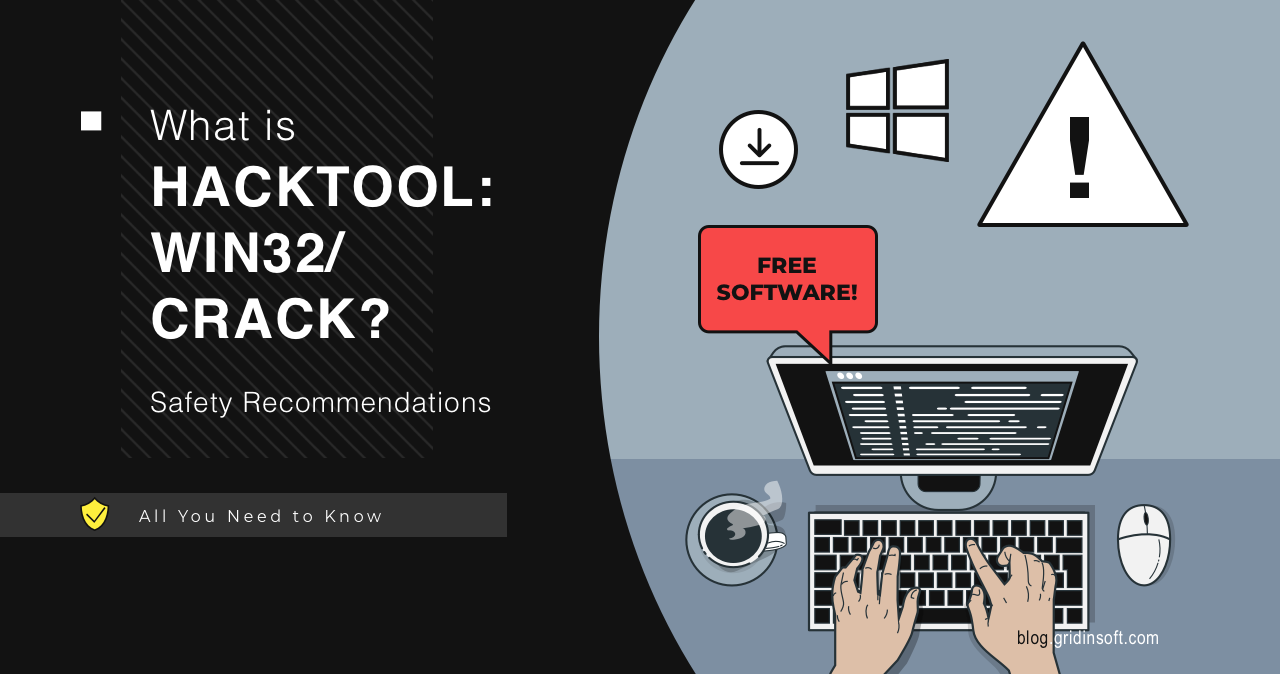
HackTool:Win32/Crack is a Microsoft Defender detection for cracks, patched installers, loaders, activators, and other license-bypass tools. On a normal home or work PC, treat it as unsafe. The alert does not always mean a self-spreading virus is already active, but it does mean the file is designed to modify software behavior and often arrives with stealers, miners, browser hijackers, or remote-access malware.
If this detection appeared after a FitGirl download, use the FitGirl Repacks virus and HackTool risk guide to check fake mirrors, installer behavior, and account-safety steps before restoring anything.
If Defender names a game-cheat family rather than a license crack, compare the exact alert with the HackTool:Win64/GameHack!rfn guide before deciding whether the file is a crack component, trainer, or unsafe cheat loader.
Should you remove HackTool:Win32/Crack?
- Yes, remove it on a normal PC. Cracks and license-bypass tools are high-risk even when they are not self-spreading viruses.
- Do not allow it in Defender just to keep cracked software working.
- Delete the source archive or installer, not only the quarantined file.
- If you ran it, scan fully and change passwords for browser, email, gaming, crypto, and banking accounts.
Microsoft has a public threat entry for variants such as HackTool:Win32/Crack!pz in its Security Intelligence entry. Microsoft Defender says it detects and removes the threat, but also warns that malware can leave remnant files and system changes. That is why the cleanup below focuses on both the detected file and the surrounding persistence points.
The useful question is not whether one cracked EXE still works. It is whether the crack changed Windows outside its own folder: exclusions, startup tasks, services, browser settings, miners, stealers, or bundled installers. Check that before you restore anything to keep the program running.
Defender may quarantine the detected crack without reversing exclusions, patched executables, scheduled tasks, or a loader it already started. If you ran it, scan this Windows PC before signing back into email, Steam, Discord, banking, or crypto accounts.
Check changes made by the crackDefender detection context: This guide is part of our Microsoft Defender detection reference. The detection name matters, but the file path, source, signature, and Defender action status matter even more. If Defender names a modified EXE or DLL as Trojan:Win32/Patched instead of a hacktool, use the Trojan:Win32/Patched removal guide.
| Detection name | HackTool:Win32/Crack |
| Common variants | Crack!MTB, Crack!MSR, Crack!PZ, and related suffixes |
| Usually means | A crack, patched executable, loader, activator, modified DLL, or license-bypass component |
| False positive chance | Possible in controlled software testing, but uncommon for downloaded cracks, repacks, or activators |
| Best first action | Remove it, delete the source package, scan fully, and avoid Defender exclusions |
HackTool:Win32/Crack!MTB, Crack!MSR, or Crack!PZ: what does the suffix mean?
The part after the exclamation mark is a Microsoft Defender variant or detection suffix. It can change as Defender signatures and cloud models classify files. For a user, the important part is the base name: HackTool:Win32/Crack. It points to a license-bypass or tampering tool, not a normal Windows component.
| Alert wording | How to read it |
HackTool:Win32/Crack!MTB |
A Defender crack/hacktool detection. Do not assume it is safe because it came from a game or app repack. |
HackTool:Win32/Crack!MSR |
A Microsoft security research/cloud suffix. Treat the same way: remove, scan, and check persistence. |
HackTool:Win32/Crack!PZ |
A documented Microsoft Defender variant. Microsoft recommends updated definitions and a full scan for remnants. |
HackTool:Win32/Keygen |
Use the separate keygen detection guide. |
HackTool:Win32/AutoKMS |
Use the separate AutoKMS detection guide. |
Is HackTool:Win32/Crack a virus or a false positive?
It is best understood as a high-risk hacktool detection. The crack itself may be a patcher or loader rather than a self-spreading virus. The practical risk is that cracks routinely disable security controls, modify trusted programs, install extra payloads, or come from download chains where users cannot verify what was added.
A false positive is possible only if you can prove the file is part of a controlled internal test, a known signed tool, or a malware-lab sample you intentionally collected. If the file came from a torrent, warez site, “free premium software” page, game repack, password-protected archive, or YouTube/Discord download link, do not treat it as a clean false positive. If Defender names the file Trojan:Win32/Occamy.C, keep quarantine and use the Occamy.C false-positive versus compromise checklist before restoring a crack DLL.
Quick check: should you allow it?
| Situation | Recommended action |
| Defender blocked it before it ran | Remove it, delete the original archive/installer, then run a full scan. |
| You already ran the crack | Scan offline, check startup/tasks/services, then change passwords from a clean device. |
| Defender says remediation incomplete | Run Microsoft Defender Offline or Microsoft Safety Scanner and inspect persistence points. |
| Only Protection History still shows it | If repeated full scans are clean, it may be stale history. Do not restore the original crack. |
| You need the cracked program to work | Do not create an exclusion. Remove the cracked package and use a legitimate installer or a safe alternative. |
Why Microsoft Defender detects cracks
Cracks are not normal installers. They may patch executable code, replace DLLs, emulate activation servers, alter firewall or hosts-file behavior, inject code into another process, or disable parts of Windows security. Defender detects them because these behaviors overlap with real malware techniques.
Common filenames and locations include:
crack.exe
patch.exe
activator.exe
loader.exe
keygen.exe
setup_patch.exe
AppData\Local\Temp...
Downloads...
DesktopCrack...
One warning sign is a crack that asks you to turn off antivirus, add exclusions, run as administrator, block the app in the firewall, or disconnect from the internet. Those instructions are common in piracy circles, but from a security perspective they remove the protections that would stop a bundled payload.
How to check the file safely
Do not run the crack to “see what happens.” Check the file from quarantine or from a copy in an isolated environment.
- Open Windows Security → Virus & threat protection → Protection history. Record the exact detection name, affected item path, status, and action taken.
- Check the source. Official vendor site, Microsoft Store, Steam, Adobe, Autodesk, and other trusted channels are different from torrents, repacks, Telegram links, and password-protected archives.
- Check the digital signature. Right-click the file → Properties → Digital Signatures. Missing, broken, or unknown signatures increase the risk.
- Scan the file without executing it. Use Defender, Microsoft Safety Scanner, or a second-opinion scanner. You can also check suspicious files and URLs with the GridinSoft online scanner.
- Do not create a Defender exclusion unless this is a controlled malware lab. Exclusions can hide the next payload too.
How to remove HackTool:Win32/Crack
1. Let Defender quarantine or remove it
Open Windows Security, review the alert, and choose Remove or Quarantine. If Defender already blocked the file before execution, that is the best case. Do not restore it.
2. Delete the original source package
Remove the archive, ISO, installer, repack folder, and downloaded password-protected ZIP/RAR that contained the crack. Otherwise the same detection will return when you extract or run it again.
3. Run a full Microsoft Defender scan
Use a full scan, not a quick scan. If the crack was executed or Defender reports remediation incomplete, follow with Microsoft Defender Offline. You can also download the current Microsoft Safety Scanner from Microsoft and run a full scan.
4. Check Defender exclusions
Some cracks instruct users to exclude the folder before running the tool. Review Windows Security → Virus & threat protection → Manage settings → Exclusions. Remove exclusions that point to Downloads, Desktop, Temp, game folders, cracked software folders, or unknown paths.
5. Check startup entries, scheduled tasks, and services
If the alert keeps returning, the detected file may be recreated by another component. Check Task Scheduler, Startup Apps, Services, and these common registry locations. If the suspicious task is named AutoPico Daily Restart, use the dedicated removal checklist for that KMS activator task.
HKEY_CURRENT_USER\Software\Microsoft\Windows\CurrentVersion\Run
HKEY_LOCAL_MACHINE\Software\Microsoft\Windows\CurrentVersion\Run
%APPDATA%MicrosoftWindowsStart MenuProgramsStartup
%PROGRAMDATA%MicrosoftWindowsStart MenuProgramsStartUp
Look for entries with random names, recently added files, Temp/AppData paths, unknown publishers, or commands that launch PowerShell, scripts, or hidden executables.
6. Check browser and network settings
Crack bundles can install browser extensions, notification spam, proxy settings, DNS changes, or hijackers. Reset suspicious extensions, remove unknown notification permissions, and check Windows proxy settings. If your browser opens ads, fake search pages, or download sites after cleanup, scan for bundled adware too.
7. Rotate passwords after the system is clean
If you ran the crack, assume credentials may have been exposed until scans and persistence checks are clean. Change passwords for email, Microsoft/Google accounts, banking, crypto wallets, Discord, Steam, Telegram, and work accounts from a clean device.
What if HackTool:Win32/Crack keeps coming back?
Repeated alerts usually mean one of three things: the original archive is still being extracted, another process is restoring the file, or Defender history is showing an old event. Check the affected item path and timestamp. If the timestamp is new, inspect the parent folder, scheduled tasks, startup entries, and recently installed software. If the timestamp is old and full scans are clean, it may be a stale Protection History entry.
Crack vs keygen vs AutoKMS: avoid the wrong guide
These detections overlap, but they are not identical. This page is for HackTool:Win32/Crack, patched installers, loaders, modified DLL/EXE files, and crack/patch packages. If Defender names a serial-number generator, read the HackTool:Win32/Keygen guide. If the alert is about a Windows or Office KMS activator, read the HackTool:Win32/AutoKMS guide.
FAQ
Is HackTool:Win32/Crack always malware?
Not always in the strict self-spreading-virus sense, but it is unsafe on a normal PC. A crack is designed to bypass licensing or modify software behavior and is commonly bundled with malware.
Can I allow HackTool:Win32/Crack if I trust the repack?
No. Trusting a download source is not a security control. Do not restore or exclude the file unless you are analyzing it in an isolated malware lab.
Why did Defender remove the crack but the program stopped working?
The cracked program may depend on the patched file or loader Defender removed. That does not make the detection wrong. Remove the cracked package and reinstall from a legitimate source.
What does remediation incomplete mean?
It means Defender could not fully remove the threat or could not confirm that all components were cleaned. Run Defender Offline or Microsoft Safety Scanner and inspect startup entries, scheduled tasks, and exclusions.
Do I need to reinstall Windows?
Usually no. Reinstalling becomes reasonable if the PC still shows suspicious behavior after full/offline scans, persistence checks, browser cleanup, and password rotation.
Related Microsoft Defender guides
If the crack was KMSPico or an Office/Windows activator, use the KMSPico cleanup guide to check tasks, services, and stealer risk.
If the crack or loader was described as SteamTools, use the SteamTools malware risk checklist as the exact-tool follow-up before allowing, restoring, or signing back into Steam.


A very engaging read! Thanks for the detailed explanation.