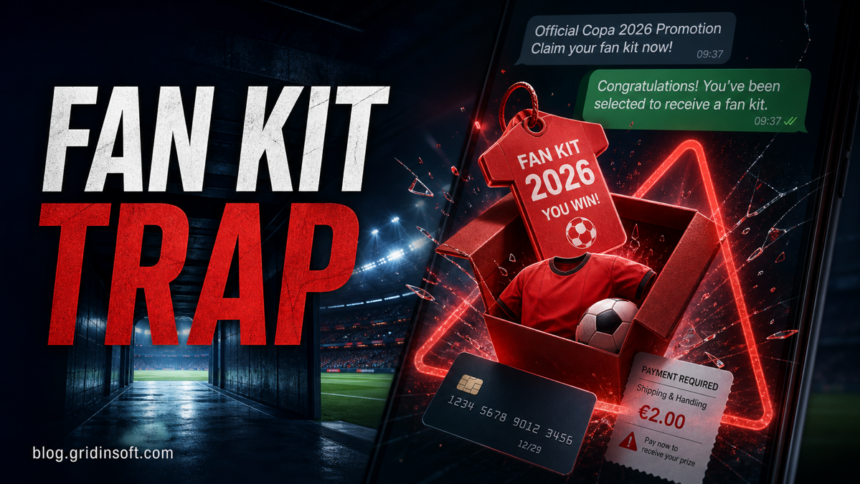
“Adidas Fan Kit 2026” or “Promocion Oficial Adidas Copa 2026” WhatsApp links should be treated as unsafe when they lead to msgdeal.cc, offerwa.cc, promokit.cc, dealgo.cc, or other short-lived .cc reward pages. These are not official Adidas domains. The pages usually promise a national-team fan kit, football boots, a training jacket, or a EUR 250-300 gift card after a short quiz, then push the visitor toward personal data, WhatsApp forwarding, and a small “shipping” or “service” payment.
If you searched whether msgdeal.cc, offerwa.cc, or promokit.cc is legit, the safe answer is no: do not pay, do not enter card details or one-time codes, and do not forward the link to contacts. Check the final domain with Website Reputation Checker, then verify any real Adidas campaign by typing the official Adidas website address yourself instead of following the message link.
The important part is the payment step. A EUR 2 fee may look harmless, but it can expose the full card number, CVV, phone number, address, and consent to follow-up charges or subscriptions. A similar low-entry-price pattern appears in the Scavenger.ai penny-deal subscription warning, where the risk is not the first small charge but the recurring payment that follows.
Football-themed fraud is also moving beyond giveaway pages into ticket and hospitality lures. The FBI has warned that threat actors are spoofing World Cup 2026 websites to collect personal information and sell fake tickets or hospitality products.[1] If a page claims to sell FIFA or World Cup 2026 tickets, compare it with our World Cup 2026 ticket scam checklist before entering card or account details.
What This Fake Adidas Page Claims
The screenshot presents the page as an “official” Adidas Copa 2026 promotion for fans of the Spanish national team. It claims participants can receive a Spain 2026 shirt, Adidas Predator League boots, a Spain 2026 training jacket, or an Adidas EUR 250 gift card. The visitor is then asked to answer four eligibility questions.
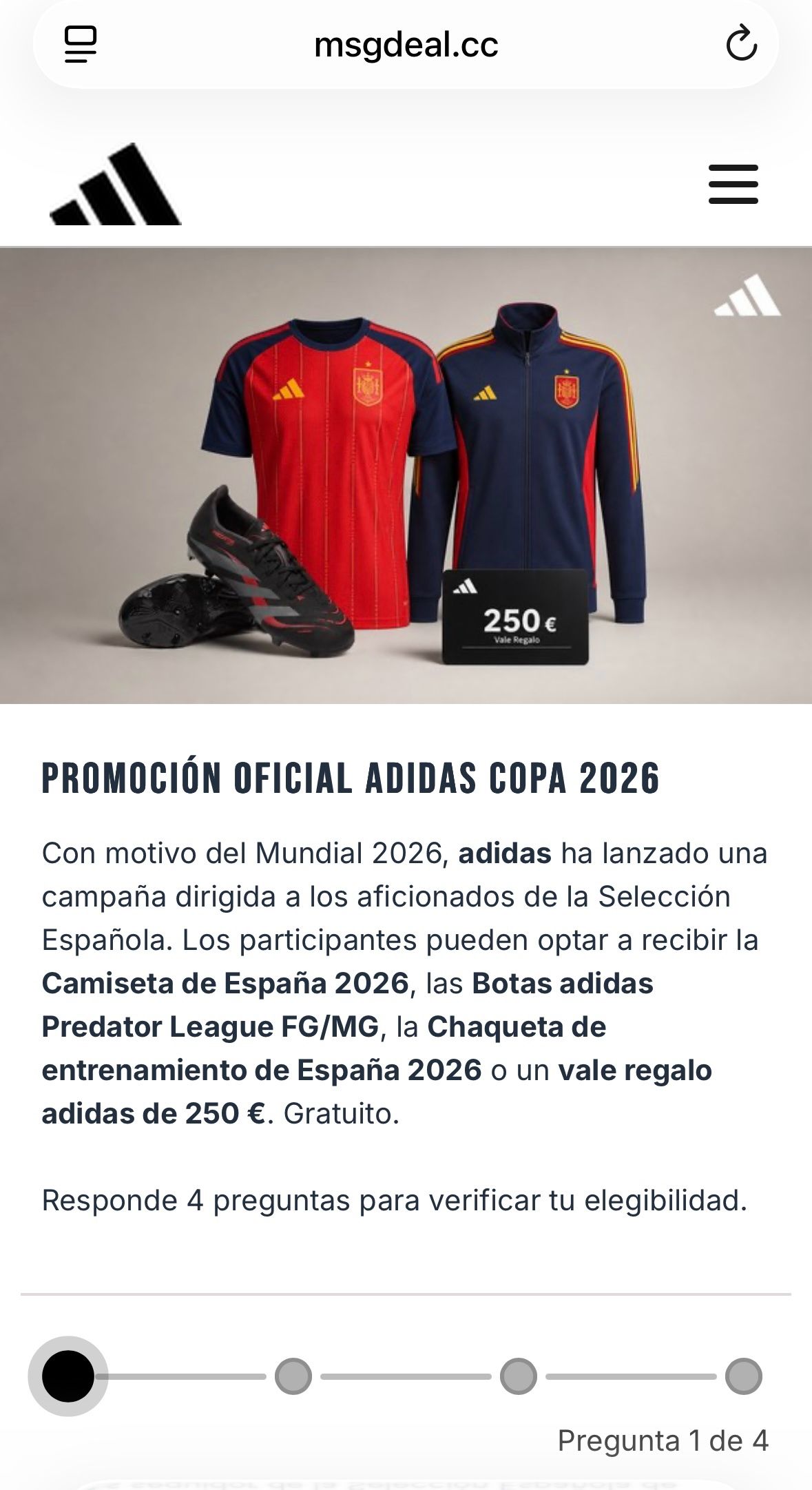
msgdeal.cc, not an Adidas domain. Click the image to view it full size.Fresh German-language variants use similar wording around Deutschland Fan-Kit 2026, a EUR 300 voucher, and domains such as offerwa.cc or msgdeal.cc. The country, prize value, and brand theme can rotate, but the mechanism is the same: a familiar sports brand, a simple quiz, forced sharing, and a payment page.
That first step is deliberately low-friction. A short quiz makes the offer feel interactive and personal, while the brand imagery makes the prize feel more credible. The later steps are more dangerous: the page asks for personal data, requires the user to distribute the link to WhatsApp contacts, and asks for a small transfer payment to obtain the supposed prize.
Red Flags In The Screenshot
- The domain is not Adidas. The visible address is
msgdeal.cc, notadidas.comor a country-specific Adidas domain. - The page uses brand trust as the hook. The visual design leans on familiar Adidas-style branding and football merchandise instead of proving sponsorship through official terms.
- The reward is high-value and vague. A EUR 250 gift card or new kit after a short quiz is a common lure in fake reward funnels.
- The quiz is not meaningful eligibility. Four simple questions do not verify whether someone legitimately won a promotion.
- WhatsApp sharing is part of the flow. Requiring the user to send the link to many contacts is a viral distribution tactic, not normal prize fulfillment.
- A small payment breaks the prize story. If a “free” prize requires a transfer, fee, gift card, or shipping payment through an unknown page, treat it as a scam signal.
The Brand Theme Can Change
The Adidas page is one version of the lure, but the same infrastructure can swap the brand and prize theme. A separate screenshot shows offerpilot.cc presenting a German-language Krombacher summer giveaway for a cooler box with 24 cans. That supports the safer conclusion: do not judge these pages only by the brand shown in the image. Judge the domain, the sharing/payment flow, and the reputation signals behind it.
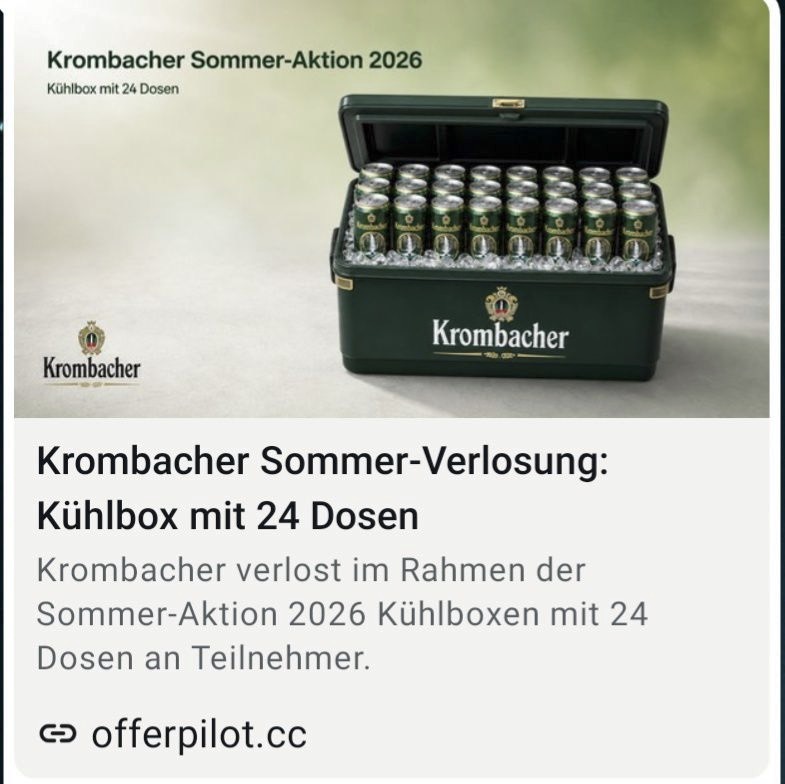
offerpilot.cc shows a Krombacher summer giveaway instead of Adidas. Click the image to view it full size.Are msgdeal.cc, offerwa.cc, and promokit.cc Legit?
No. Treat these domains as unsafe in the Adidas Fan Kit 2026 context. Gridinsoft Website Reputation Checker shows the same risk pattern across the related .cc domains we reviewed: very low trust scores, very young or recently registered domains, limited reputation history, and blacklist/provider-warning signals. In other words, these are not separate official Adidas promotions; they look like variants of the same short-lived reward-page infrastructure.
Observed domains in this cluster:
Do not read a single score as the only reason to avoid the page. The stronger conclusion comes from the combined evidence: non-official domain, copied brand theme, high-value prize, quiz flow, WhatsApp forwarding requirement, personal-data collection, and a payment request.
Why WhatsApp Sharing Makes The Scam Spread Fast
WhatsApp scams work because the link often arrives from someone the victim already knows. The sender may not be endorsing the page; they may simply be following the page’s instruction to share the link with a required number of contacts. That turns each victim into a distribution channel.
This structure is not random. The scam borrows trust from a major sports brand, adds a World Cup 2026 theme, and then uses a friend-to-friend channel to make the link feel safer than an ordinary ad. That is why a fake Adidas page can keep spreading even after individual domains are blocked or abandoned.
For more examples of how this works inside chats, see our WhatsApp scams guide. If the page later behaves like a sponsored reward funnel, compare it with the fake Walmart gift-card reward breakdown.
The 2-Euro Payment Trap
The small fee is the part many victims underestimate. A prize page can call it shipping, service price, transfer cost, age verification, or card validation. The label changes, but the goal is the same: make the payment feel too small to question while collecting usable card details.
- It proves the card works. Even a tiny successful charge confirms the card number, expiry date, and CVV are valid.
- It can hide subscription consent. Scam funnels often bury recurring charges in pale, small, or pre-checked terms near the payment button.
- It gives criminals stronger follow-up data. Name, phone, address, and card details can be reused for later delivery-fee, refund, or account-verification phishing.
If any supposed Adidas prize asks for a EUR 2 fee before delivery, stop. A real brand giveaway should not require card details through an unknown .cc reward page.
What To Do If You Opened The Link
If You Only Viewed The Page
Close the tab. Do not answer the quiz, do not allow notifications, and do not forward the link. If the site asked for browser notification permission, remove that site from allowed notifications in your browser settings.
If You Entered Personal Data
Expect follow-up phishing by SMS, WhatsApp, email, or phone. Watch for messages that mention delivery fees, prize verification, Adidas vouchers, shipping payments, or account checks. Do not send identity documents, one-time codes, or card details in a follow-up conversation.
If You Shared The Link
Send a short correction to the same contacts or group: tell them not to open the link, not to enter data, and not to forward it. This is uncomfortable, but it cuts the campaign’s reach quickly.
If You Paid A Small Fee
Contact your bank or payment provider immediately. Tell them the payment was connected to a suspected phishing/prize scam, ask about blocking follow-up charges, and consider replacing the card if the page collected full card details. Save the transaction record, the domain, screenshots, chat messages, and any phone numbers or account names used in the payment request.
If You Downloaded Anything
Do not open the file again. Delete the download, check browser extensions and notification permissions, and review recently installed apps. If popups, redirects, unwanted extensions, suspicious startup items, or repeated security warnings appeared afterward, scan the device before signing in to banking, email, or shopping accounts.
Gridinsoft Anti-Malware is useful in this exact situation because it checks more than the visible download: detections, bundled apps, hidden files, startup entries, scheduled tasks, browser changes, and persistence that can bring symptoms back after a simple delete.
If the page or email made you download an invoice, coupon, tracking app, browser extension, or support tool, scan the PC before opening it again or logging into sensitive accounts.
Scan after a fake Adidas promo downloadHow To Verify A Real Adidas Promotion
- Type the official address yourself. Use the official Adidas website or app for your country, instead of a link from WhatsApp or social media.
- Check the domain before the design. A logo, product image, or football kit does not prove ownership. The address bar is the source that matters.
- Look for official terms. Real promotions usually have rules, sponsor information, eligibility dates, privacy terms, and a stable official domain.
- Reject forwarding requirements. A real brand campaign should not require you to spam contacts before you can claim a prize.
- Reject payment-to-claim logic. The FTC warns that scammers often say a victim has won a prize but must first pay fees or charges; honest businesses do not make people buy gift cards or pay suspicious fees to claim a prize.[2]
- Use a reputation checker. Paste the final domain, not just the first shortened link, into Website Reputation Checker before entering data.
How To Report The Fake Adidas Link
- Report the message inside WhatsApp and block the sender if it came from an unknown number.
- Forward SMS phishing to your mobile carrier’s spam-reporting channel where available.
- Report phishing to national consumer-protection or cybercrime channels in your country.
- If you are in the United States, the FTC recommends reporting phishing attempts at
ReportFraud.ftc.govand forwarding phishing text messages to SPAM (7726).[3] - Submit the domain to Website Reputation Checker or leave a review on the Gridinsoft report page if you have first-hand evidence.
FAQ
Is the Adidas Fan Kit 2026 WhatsApp promotion real?
Based on the visible evidence, treat it as fake or at least unsafe. Observed pages use domains such as msgdeal.cc and offerwa.cc, not official Adidas domains, and the flow asks for personal data, WhatsApp sharing, and a small payment.
Can a real Adidas giveaway use WhatsApp?
A brand can communicate through many channels, but a WhatsApp link by itself is not proof. Verify the promotion through the official Adidas website, app, verified social accounts, or customer-support channel before entering data.
Why do scammers ask me to share the link with contacts?
It makes the campaign look trusted because the next victim receives the link from someone they know. It also lets the scam spread quickly without paid ads.
Why do these pages ask for 2 euros?
The tiny amount makes the payment feel harmless, but it still captures valid card details and may hide follow-up subscription charges. Do not pay a shipping, service, or verification fee on an unknown prize page.
What personal data is at risk?
Name, phone number, email, address, payment details, identity documents, and one-time verification codes are all valuable. Even an email or phone number can be used for follow-up phishing and spam.
Should I scan my phone or PC after opening the page?
If you only viewed the page, the main risk is social engineering. If you downloaded a file, allowed notifications, installed an app or extension, or started seeing popups and redirects, scan the device and review browser permissions.
References
- Federal Bureau of Investigation. “Threat Actors Spoofing FIFA Websites in Advance of the 2026 World Cup.” Internet Crime Complaint Center, May 27, 2026, accessed June 15, 2026. https://www.ic3.gov/PSA/2026/PSA260527
- Federal Trade Commission. “Avoiding and Reporting Gift Card Scams.” FTC Consumer Advice, accessed May 31, 2026. https://consumer.ftc.gov/articles/avoiding-and-reporting-gift-card-scams
- Federal Trade Commission. “How To Recognize and Avoid Phishing Scams.” FTC Consumer Advice, September 2022, accessed May 31, 2026. https://consumer.ftc.gov/articles/how-recognize-avoid-phishing-scams