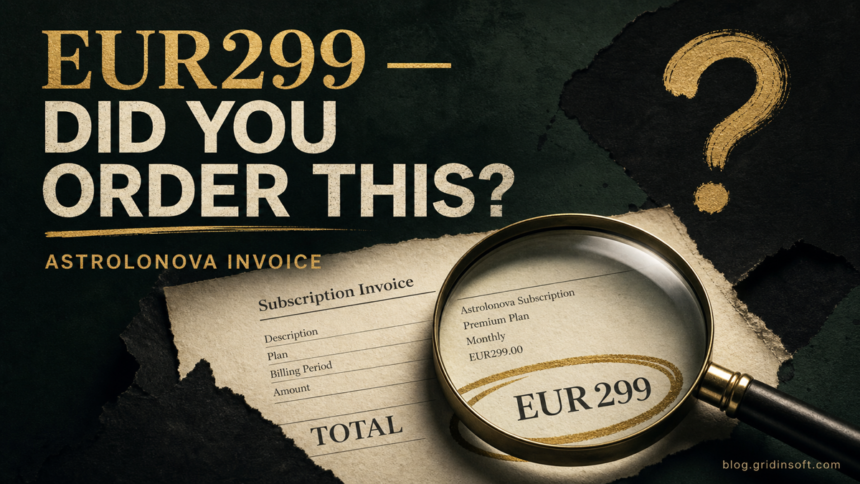
An unexpected Astrolonova invoice for EUR299 does not, by itself, prove that you entered a valid paid subscription. Do not pay simply because the message uses a short deadline or mentions collection. Save the invoice and email headers, check whether you actually placed an order, and dispute an unrecognized claim in writing through a channel you can document. If a real German court payment order arrives, however, treat it as a separate urgent document and get qualified help before its response period expires.
What to do first:
- Do not use the invoice’s payment button while you are still verifying the claim.
- Save the message, full sender details, invoice, envelope, and every reminder.
- Check your records for any Astrolonova, Fitnovaness, Novavitalia, or Bongochat signup.
- If you do not recognize a paid order, dispute the claim in writing and keep delivery proof.
- Check bank and card activity for an actual debit; an invoice is not the same as a completed payment.
- Do not ignore court mail, especially a German Mahnbescheid.
What is Astrolonova, and why does the invoice say EUR299?
Astrolonova presents itself as a paid horoscope service. Its registration copy indexed in July 2026 advertised a EUR299 annual plan. That advertised price explains the amount shown in current invoice reports; it does not prove that a particular recipient completed the order.
The German Verbraucherzentrale network reported complaints from people who received invoices or reminders for Astrolonova, Fitnovaness, Novavitalia, and Bongochat, often without remembering a signup. Its July 29 guidance identifies Margot Brands Limited in Hong Kong as the operator behind all four names and says the demands can be for several hundred euros.[1]
Keep the four brands in one verification process. A new sender name does not necessarily mean a new case, and a different service label should not make you restart from zero. Compare the operator, invoice number, dates, recipient details, and claimed order evidence across every message.
What an Astrolonova invoice email may look like
The message below is an illustrative, de-identified reconstruction. Real wording, sender domains, order numbers, deadlines, and delivery methods can differ. Use it to recognize the decision points, not as proof that a message is genuine or false.
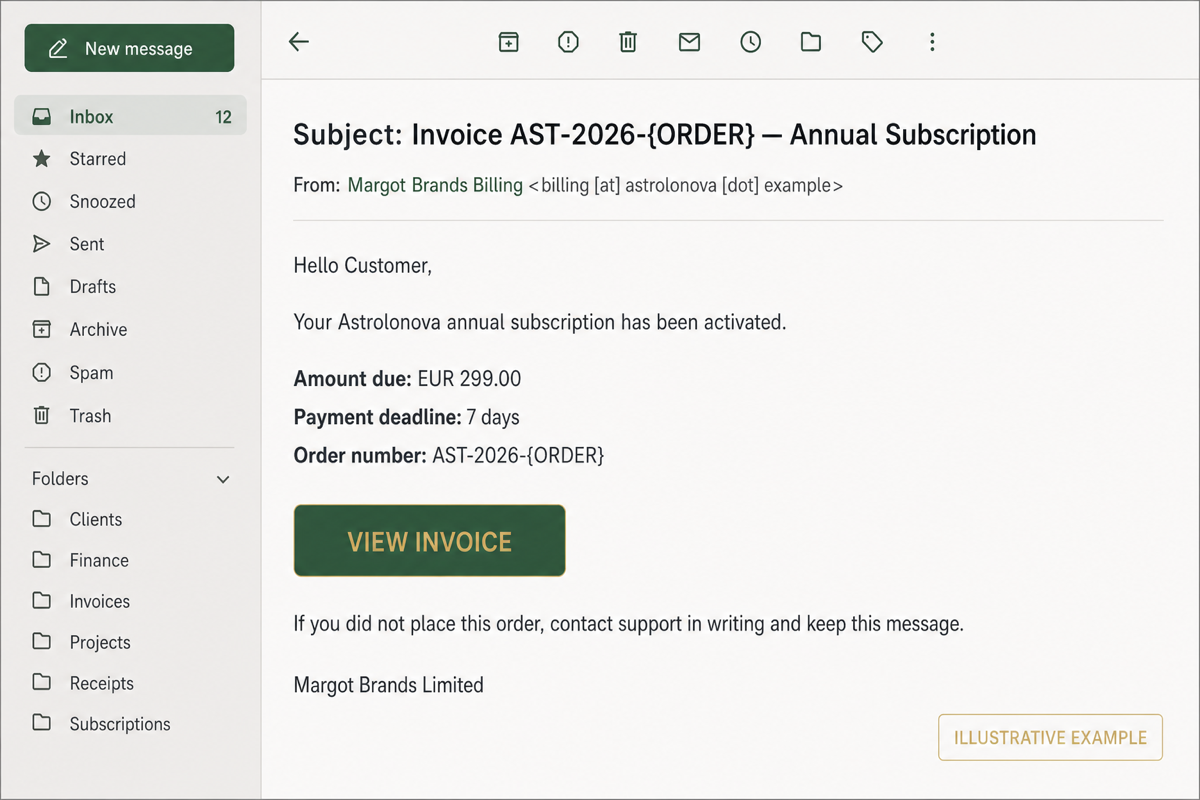
Example
Subject: Invoice AST-2026-{ORDER} — Annual Subscription
From: Margot Brands Billing <billing [at] astrolonova [dot] example>
Greeting: Hello Customer,
Body: Your Astrolonova annual subscription has been activated. Amount due: EUR 299.00. Payment deadline: 7 days. Order number: AST-2026-{ORDER}.
Button: VIEW INVOICE
Closing line: If you did not place this order, contact support in writing and keep this message.
Signature: Margot Brands Limited
A generic greeting, unfamiliar order number, unexpected deadline, or payment button is a reason to verify—not a legal conclusion on its own. Expand the sender, inspect the reply-to field, and compare the exact domain with records you already have. The broader phishing email checklist explains how to inspect sender and link details without trusting the display name.
Does the invoice prove that you agreed to a subscription?
No. An invoice records what a sender claims is owed; it is not proof that you saw clear pricing and deliberately completed a paid order. The Verbraucherzentrale guidance says a German online contract requires costs and conditions to be clearly disclosed before ordering, including an unambiguous paid-order button. It recommends written objection when the recipient does not recognize a valid paid contract.[1]
Start with facts you can verify:
- Did you visit one of the four service websites?
- Did you provide the name, postal address, or email printed on the invoice?
- Did you see EUR299, the contract length, and a clearly labeled paid-order button before submitting?
- Did you receive an order confirmation, contract text, or account access at the time?
- Does the claimed order date match your browser history, password manager, mailbox, or payment records?
If you may have signed up, do not delete the evidence or assume the answer. Ask for the order record and the terms shown at checkout, then take the documents to a local Verbraucherzentrale or qualified lawyer if the amount or legal position remains disputed. This article provides general safety information, not individualized legal advice.
Invoice, reminder, collection letter, or Mahnbescheid?
These documents do not have the same meaning. Classify what arrived before deciding how to respond.
| Document | What it means and what to do |
|---|---|
| Rechnung (invoice) | A company claims payment. Preserve it, verify the alleged order, and dispute an unrecognized claim in writing. Do not treat the invoice itself as proof of a contract or debit. |
| Mahnung (reminder) | The company repeats or escalates its claim. Keep your earlier objection and proof of delivery; respond with the case details if the claim remains disputed. |
| Inkasso (collection demand) | A collection company is pursuing the claim. Verify the collector and amount, refer to your documented dispute, and use consumer/legal help for a contested debt. |
| Mahnbescheid (court payment order) | Formal court mail, commonly delivered in a yellow envelope in Germany. The court does not first decide whether the claim is valid. Do not ignore it; review the included form and deadline and get qualified help immediately. |
Verbraucherzentrale explains that a court can issue a Mahnbescheid after a formal check without testing the evidence behind the debt. Its guidance says a recipient who considers the claim unjustified must normally object within two weeks of service; failure to respond can lead to a later enforcement order.[2] Follow the instructions on the document and local professional advice, because your facts and jurisdiction matter.
How to dispute an unrecognized Astrolonova invoice
- Create an evidence folder. Keep the original email or letter, headers, envelope, PDF, invoice number, dates, amount, sender addresses, and screenshots. Do not edit the originals.
- Write a clear objection. State that you do not recognize a paid contract and dispute the claim. Ask for the alleged order date, checkout record, pricing disclosure, confirmation, and basis for using your personal data.
- Use a documentable channel. Save the sent message and delivery evidence. For email, keep the sent copy and headers; for postal mail, use a tracked method appropriate to your country.
- Do not include extra identity data. Use the reference details already on the invoice. Do not send a passport, full card image, password, or one-time code merely because the sender requests it.
- Keep one timeline. Record each invoice, reminder, collection letter, response, call, bank event, and deadline.
- Escalate appropriately. Use a local consumer center or qualified legal adviser when the sender provides alleged order evidence, the amount changes, a collector contacts you, or court mail arrives.
Do not call a number in a suspicious attachment and disclose more information before checking the destination independently. If the message sends you to a different domain, check that exact URL with Gridinsoft’s Astrolonova.cc website report before visiting it. The current report classifies that domain as suspicious; a domain verdict is a website-risk signal, not a ruling on any contract.
What if money was already debited or charged?
First distinguish a paper or email demand from a completed transaction. Open your bank or card account independently and find the exact merchant descriptor, amount, date, and payment method. Do not rely on a screenshot supplied by the sender.
- Save the transaction record and the invoice before contacting anyone.
- Use the bank or card issuer’s official app, website, or number printed on the card.
- Explain whether you do not recognize the merchant, dispute the subscription authorization, or tried to cancel.
- Ask which dispute, direct-debit return, merchant block, or card-replacement process applies to that payment method and jurisdiction.
- Continue monitoring for repeat charges and preserve every cancellation or objection attempt.
Consumer-center guidance notes that German direct-debit and card remedies have deadlines and evidence requirements, so act promptly and obtain local advice instead of assuming a guaranteed refund.[1] A broader scam recovery checklist can help organize payment, account, and evidence steps, while the Astrolonova contract question remains separate.
When is a malware scan or password change relevant?
Receiving or reading a plain invoice does not automatically infect a device. A security response becomes relevant if you opened an attachment, downloaded or ran a file, installed an app or extension, allowed browser notifications, entered a password or card number on an unknown site, or developed persistent redirects and security alerts.
- Opened only: preserve the message and verify the claim; no malware conclusion follows from reading it.
- Clicked a link: close the page, save the URL, and check browser history and downloads. Change credentials from a clean device if you entered them.
- Downloaded but did not run: keep the file unopened and scan it or remove it safely.
- Ran a file or installed something: disconnect the device if suspicious activity starts, run a full security scan, review installed apps and browser extensions, and secure important accounts from a clean device.
For ordinary subscription disputes, malware software cannot decide whether a contract exists. Use security tools only for the device and account part of the incident.
Mistakes to avoid
- Do not pay only to stop a threatening deadline before checking the claim.
- Do not throw away the invoice, reminder, envelope, or your written objection.
- Do not assume every collector or every Astrolonova invoice is automatically invalid.
- Do not send identity documents, passwords, one-time codes, or complete card details to prove you are the recipient.
- Do not hire an unsolicited recovery agent who promises a guaranteed refund for an upfront fee. Subscription disputes can attract a second scam.
- Do not ignore formal court mail or miss the date printed on it.
FAQ
Are Astrolonova, Fitnovaness, Novavitalia, and Bongochat related?
Yes. The German Verbraucherzentrale network identifies Margot Brands Limited in Hong Kong as the operator behind all four service names in its current warning.
Does an Astrolonova invoice mean my bank account was charged?
No. An invoice is a payment demand. Check your bank or card activity independently to determine whether a transaction actually posted.
Should I ignore an Astrolonova reminder?
Do not pay reflexively or discard the evidence. If you do not recognize a valid contract, preserve the documents and dispute the claim in writing. Treat formal court mail as a separate urgent matter.
What is different about a German Mahnbescheid?
It is a formal court payment order, not an ordinary company reminder. The court does not first decide whether the debt is valid. Review the included response form and deadline and get qualified local help promptly.
Can the invoice email infect my computer?
Reading a plain message does not by itself prove infection. Risk increases if you opened an attachment, ran a download, installed software, granted permissions, or entered credentials on an unknown page.
References
- Verbraucherzentrale. “Rechnung von Astrolonova, Fitnovaness, Novavitalia oder Bongochat? Das müssen Sie wissen!” Verbraucherzentrale network, updated July 29, 2026; accessed July 31, 2026. verbraucherzentrale.de
- Verbraucherzentrale. “Gerichtliches Mahnverfahren: Was tun bei einem Mahnbescheid?” Verbraucherzentrale network, updated July 18, 2025; accessed July 31, 2026. verbraucherzentrale.de