

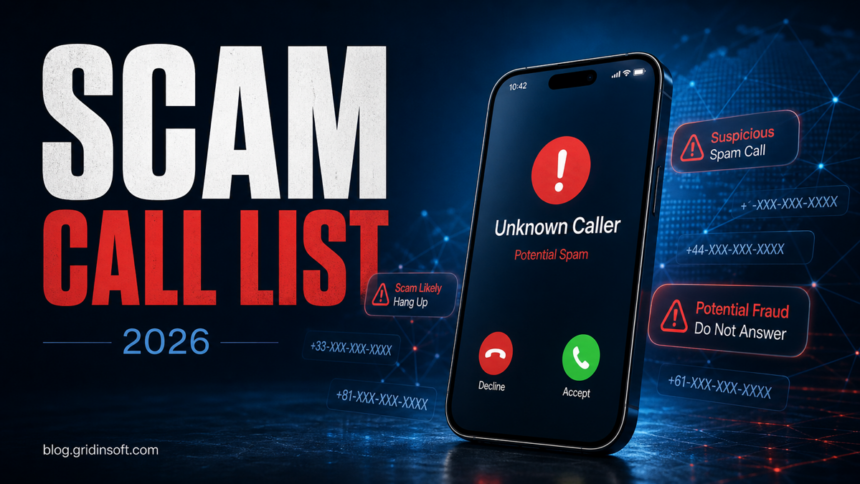
Scammer phone numbers change fast, but the patterns behind them are easier to recognize. Use this 2026 scammer phone numbers list and active-call pattern guide as a risk check, not as proof that one displayed number is guilty. Fraud callers spoof caller ID, rotate toll-free and mobile numbers, and sometimes make a real company or innocent person’s number appear on your screen. If an unexpected caller asks for money, verification codes, gift cards, cryptocurrency, remote access, or urgent account action, hang up and verify through an official number.
What to do if a scammer phone number calls
- Do not call back a missed one-ring call or a robocall number.
- Do not press keypad options such as “1 to speak to support” or “9 to stop calls”.
- Never share one-time codes, passwords, payment-card data, gift-card codes, crypto-wallet details, or remote access.
- Verify independently by opening the official app, card, statement, or website and calling the number listed there.
- Report the number to your carrier, the FTC/FCC, or local authority when money or personal data is involved. For broader device and carrier blocking, use the spam-call blocking guide.
| Main risk | Caller ID spoofing, robocalls, refund scams, bank/code theft, fake support, debt threats, romance/investment calls |
| Safest response | Hang up, verify through an official channel, block, report, and scan your device if remote access or downloads were involved |
| Important limitation | A number shown below may have been spoofed. Treat it as a warning signal, not as a public accusation against the number owner. |
Reported scammer phone numbers in 2026
The numbers below are examples reported in public complaints, reader comments, or common scam patterns. They are useful because they show the kind of caller ID, callback number, or country code a victim may see. They are not a permanent blacklist: scammers can abandon a number within hours, and spoofed caller ID can point to someone who had nothing to do with the call.
Number or pattern — Why it is risky and what to do
- +1 912-642-9003, +1 912-225-6831, +1 682-977-9782
Reported in debt-collection and court-threat calls. Do not pay by phone. Ask for written validation, then verify the company and debt through official records. - +1 844-699-2400, +1 866-760-5261
Toll-free callback numbers reported in “law department”, refund, or urgent account scripts. Toll-free numbers are not automatically fake, but scammers use them heavily because they look professional. - +1 404-461-9352
Reported in an Xfinity impersonation context. If a caller claims to be from an ISP, hang up and use the provider app or billing statement to reach support. - +44 7407 394404
Reported in a dating-app and investment-scam context. Treat any caller who moves a relationship into crypto, trading apps, or “guaranteed profit” as high risk. - +371 25956648
Reported as a police-authority impersonation attempt. Real law enforcement will not demand passwords, crypto, gift cards, or remote access over an unexpected call. - +30 210 964 9429
Reported in a fake Green Card / immigration-program call. Verify immigration matters only through official government websites and case portals. - Unknown local number that rings twice and stops
Often a callback trap or lead-validation call. Do not return the call; wait for a voicemail and verify the organization independently. - Voicemail with “document number”, “case number”, or “final notice”
Common in debt, tax, legal, and fake support scams. Search the company name separately, avoid the callback number in the message, and keep the voicemail as evidence.
Active scammer number patterns people search for
Searchers often look for exact groups such as 1-844 scammer numbers, 24/7 scammer numbers, Indian scammer numbers, or UK/USA lists. Treat those searches as pattern checks, not as a reason to call the number. Calling back can confirm your line is active, create charges, or pull you into a longer social-engineering script.
Search or caller pattern — How to treat it safely
- 1-844, 855, 866, 877, or 888 callback numbers
Toll-free numbers are common in support, refund, bank, debt, and subscription scams. Verify through the official company app, card, statement, or website before calling back. - 24/7 support scammer numbers
Scammers use round-the-clock support wording to look professional. Do not trust a phone number from a pop-up, invoice PDF, voicemail, or sponsored search result without independent verification. - Indian scammer numbers or call-center scripts
Do not judge risk by country alone. Judge the script: remote access, gift cards, crypto, one-time codes, fake refunds, or pressure to stay on the line are the danger signs. - UK scammer phone number list 2026
UK-looking mobile numbers, +44 7… formats, and WhatsApp callbacks can be used in romance, courier, HMRC, bank, and investment scams. Verify through the real organization, not the caller. - USA scammer phone number list 2026
Neighbor spoofing can make a US number look local. A familiar area code is not proof that the call is safe. - Active scammer phone numbers
Active lists go stale quickly because scammers rotate and spoof numbers. Use recent reports as clues, then evaluate the story and requested action. - Scammer numbers to call for fun
Do not call scammers for entertainment or revenge. It can confirm your number, expose you to recording or harassment, and does not help victims. Report the number instead.
If you are checking a number from a suspicious SMS or voicemail, compare the full message with our guide to smishing and vishing. If the call was labelled by your carrier, use the separate steps in our Scam Likely calls guide. For a full filtering setup, use our practical guide on how to stop spam calls.
Scam area codes and phone-number patterns to treat carefully
No area code is “owned” by scammers. Legitimate people and companies use the same prefixes every day. The risk comes from the combination of caller ID, script, urgency, and requested action. These patterns deserve extra caution in 2026.
Area code or prefix — Common scam pattern
- 844, 855, 866, 877, 888
Toll-free refund, support, fake invoice, bank, debt-collection, and subscription-cancellation callbacks. Verify the organization before calling back. - 202
Government, grant, court, police, tax, or “federal agency” impersonation. Real agencies do not demand gift cards, crypto, or verification codes by phone. - 917 and other familiar local codes
Neighbor-spoofing calls that look local to increase answer rates. A familiar area code is not proof that the caller is nearby. - 876, 809, 829, 849, 473, 268, 284, 649, 664, 767
International one-ring or prize/lottery calls. Some are normal international numbers; the danger is calling back an unknown urgent missed call and creating charges or a conversation with a fraud operator. - +44 7… mobile-looking numbers
Romance, investment, WhatsApp, courier, and callback scams. Verify through the platform where the contact began and never move money based on a phone-only relationship. - Private, Unknown, No Caller ID
Not automatically malicious, but risky when paired with urgent threats, payment requests, or pressure to stay on the line.
How to check if a phone number is a scammer
- Search the exact number in quotes. Look for recent complaints, but remember that public reports can be wrong or outdated.
- Check the story, not only the number. Scam scripts usually create urgency and ask for money, codes, remote access, identity documents, or secrecy.
- Call the organization through an official source. Use the number on a bank card, invoice, official app, or government website, not the number from the incoming call.
- Ask for written proof. Debt, legal, insurance, tax, and delivery issues should have a verifiable written trail.
- Check linked websites before opening them. If the caller sends a payment or login URL by SMS, verify the domain with the Gridinsoft Website Reputation Checker.
- Scan if the call led to remote access or downloads. If you installed AnyDesk, TeamViewer, a “support tool”, APK, browser extension, or invoice attachment, disconnect the device and run a security scan with Gridinsoft Online Virus Scanner or Gridinsoft Anti-Malware.
Common scam call scripts in 2026
Script — Red flag and safer response
- Bank fraud department
The caller asks for a one-time code, card PIN, or “test transfer”. Hang up and open the bank app or call the number on your card. - Delivery, toll road, or customs fee
The caller pushes a small urgent payment. Check the courier or toll account directly; do not use a link or callback number from the call. - Tech support or antivirus warning
The caller says your computer is infected and asks for remote access. End the call. Real security vendors do not cold-call you to fix a hidden infection. - Fake invoice or refund
A call follows a PDF invoice or email receipt and offers cancellation. This is common in fake Norton, PayPal, and subscription-refund scams; see our Norton invoice refund scam breakdown. - Police, court, tax, or immigration threat
The caller threatens arrest, deportation, account seizure, or a lawsuit. Real agencies do not resolve these issues through gift cards, crypto, or secrecy. - Family emergency or romance/investment story
The caller uses panic or emotional pressure to move money. Verify the person through another channel and pause before sending funds.
What if you answered, paid, or shared information?
The quick checklist below covers urgent actions. For the fuller after-call safety flow and why calling back or revenge can backfire, use Spam Phone Calls: What to Do and Why Revenge Backfires.
- If you only answered: hang up, block the number, and expect more spam. Do not call back to argue or confirm your identity.
- If you shared a one-time code: change the account password, revoke sessions, and enable stronger two-factor authentication.
- If you gave card or bank details: call the bank using the number on your card, ask for fraud monitoring, and dispute unauthorized transactions.
- If you paid by gift card, wire, crypto, or payment app: contact the payment provider immediately, save receipts and wallet addresses, and file reports. Recovery is not guaranteed, but fast reporting helps.
- If you installed remote-access software: disconnect from the internet, uninstall the tool, run a malware scan, check startup items, and rotate passwords from a clean device.
- If the scam involved PayPal or invoices: verify activity inside the real PayPal app or Resolution Center, not through a callback number. Our PayPal scams guide covers invoice and money-request red flags.
Where to report scammer phone numbers
- Your mobile carrier: forward suspicious texts to 7726 where supported and use the carrier’s call-reporting tool.
- FTC ReportFraud: report US fraud attempts, money loss, and impersonation details.
- FCC complaints: report unwanted calls, robocalls, spoofing, and caller ID abuse.
- IC3: report serious internet-enabled fraud, account compromise, or business-payment fraud.
- Local law enforcement or consumer-protection office: use this when threats, identity documents, or significant financial loss are involved.
Some callback scams start before the phone rings: a fake receipt in an order-tracking app can place the scammer’s number directly where a worried buyer expects support details.
FAQ
Is there a real list of scammer phone numbers?
There are useful reported-number lists, but no permanent official list catches every scammer. Fraud groups rotate numbers, rent VoIP lines, and spoof caller ID, so the script and requested action matter more than the number alone.
Can a scammer use a real company number?
Yes. Caller ID spoofing can make the call appear to come from a bank, carrier, government office, or local business. Hang up and contact the organization through its official website, card, app, or statement.
Should I call a scammer number back?
No. Calling back can confirm that your line is active, expose you to more pressure, or trigger international charges. If the call might be real, find the official number independently.
What can a scammer do with my phone number?
A phone number alone is usually not enough to steal an account, but it can be used for spam, phishing, SIM-swap attempts, password-reset targeting, and social-engineering calls. Protect accounts with app-based 2FA where possible and keep recovery information current.
Can blocking one scam number stop scam calls?
Blocking helps with repeats from the same caller ID, but it will not stop spoofed or rotating numbers. Combine blocking with carrier spam protection, Silence Unknown Callers or Android spam filtering, and careful reporting.
Are 844, 855, 866, 877, and 888 numbers scams?
No. Many legitimate organizations use toll-free numbers. Treat them as suspicious only when the call is unexpected, urgent, secretive, or asks for payment, codes, remote access, or personal data.
For PayPal-themed callback fraud, the safest first step is to ignore the number in the email and verify Activity directly. Our PayPal Unauthorized Transaction email scam guide explains that exact charge-alert pattern.
A caller who asks you to install an Android app and tap a bank card to the phone is using a more dangerous form of impersonation. The WindRelay and SpyNote NFC relay case shows how one call can combine remote access with a live card transaction.
References
- Federal Trade Commission. “Phone Scams.” Consumer Advice, accessed May 31, 2026. https://consumer.ftc.gov/articles/phone-scams
- Federal Communications Commission. “Advanced Methods to Target and Eliminate Unlawful Robocalls, Third Report and Order, Order on Reconsideration, and Fourth Further Notice of Proposed Rulemaking.” FCC 20-42, March 31, 2020. https://docs.fcc.gov/public/attachments/FCC-20-42A1.pdf
- Federal Communications Commission. “Consumer Complaints Data – Unwanted Calls.” FCC Open Data, updated May 22, 2026, accessed June 1, 2026. https://opendata.fcc.gov/Consumer/Consumer-Complaints-Data-Unwanted-Calls/vakf-fz8e
- Federal Trade Commission. “ReportFraud.ftc.gov.” Federal Trade Commission, accessed May 31, 2026. https://reportfraud.ftc.gov/
- Federal Bureau of Investigation. “Internet Crime Complaint Center (IC3).” FBI, accessed May 31, 2026. https://www.ic3.gov/

Hi ma’am are sir I’m writing to you because someone is using my full name on telegram and my notification show up on my phone screen… with this number 229-429-0701I’ve just recently bought this iphone from t mobile sprint and I’ve never seen this number store onto my phone before it’s 229-429-0701 and every time I try to make calls this number pops up saying my name “stella stover mobile i don’t know where are who it’s trying to scam me but it’s a local number from my county.. and I’d try calling this number but it ring twice and goes to a voicemail and it ring twice and hung up can you please help should I call the law enforcement about this ? Thank you please let me know if you can help.
+447407394404
This number is from a scammer using dating apps. Dating fraud
They will try and convince you they are making an obscene amount of money to tempt you into using a fake application.
316-512-1437 is a google number being used to impersonate a US Marine named Kagan Dunlap. I’m the scammer has used his photos to roll on a dating site. And then claims he needs money to continue Internet access at Bagram airbase in Afghanistan.
820-300-9292 is this a scam number
1-404-461-9352 is an active x-finity scam phone number. I checked , so it isn’t some one innocent.
Hi there, Richard Alexander and ms. Daniels called me with threatening information saying they are from a private investigation co. Needing me to settle a 2015 credit card debt of 20k. The amount they wanted was 300.00 or 1000.00 right away so my case will not go to court. I never had a credit card. They said the police authorities will contact me because i refused to corporate. Here are the number they called from: 912-225-6831; 912-642-9003 and 443-391-9462
They would not give verification or secured documentation to me in details. I requested them to mail the paperwork or email with notary stamped but they didn’t say anything.
Please help, it’s horrible how someone can call to threaten you😥
I just had the same call Ms. Daniels saying I owed money from a credit card debt which I didnt even have. They wouldnt send me documents or proof said if I didnt pay I would be taking to court . The number she called from was 912-6429-003 and a Todd Bowens called from 1-844-699-2400 said he was with William Associates DONT FALL FOR IT !!! SCAMMM!
I got the same call!!! They had all my information which made it so convincing, but once I said I would like to dispute it and to send me paperwork she was so mad!!! She would get mad when I would ask her to confirm information or when I doubted something she said. She said she was Ms Daniels and was going to take me to court and have the sheriff come out to serve me. She threatened to have all my properties seized and bank accounts. These people must be stopped. They called from +1 (912) 642-9003 and +1 (682) 977-9782.
I got the same call just now. I didn’t even let them talk. As soon as he started his pitchI recognized it as a scam call.
I just hung up.on him mid sentence. Very satisfying. 🙂
Not sure about this call. The man had an Australian accent and he said that we needed to call 866-760-5261. He also left a document number but when I called this number the man answered as a Law Department. So I am not sure if it’s real or not??? Frighten for my son, he has never hurt or done anything unlawful. Why are they doing this???
Watch for 202 area codes also 917
I was scammed by some scammers that said they were with the FTC they are not with the government at all
But they sound convincing
Also another scam stating they are with prize money
+371 25956648
Be aware of this number (scammer call center) they pretend to be police authorities to fish out your personal data, etc.
+30 2109649429
Scammers pretending to call from the US Green card program.
I spent too much time scrolling through for the most part USELESS blather I a vain attempt to report a SCAM toll free number using PREDATOR.
Something too ignorant to leave a message solicited from SCAM 833-357-4123.