

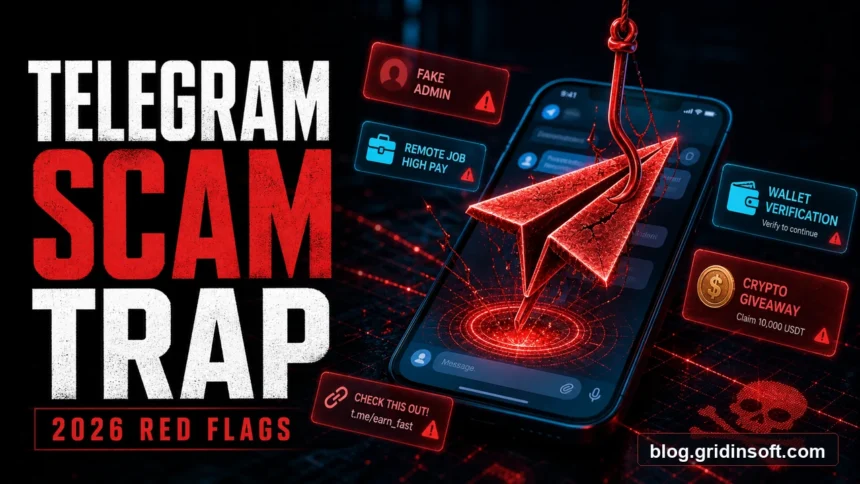
Telegram scams are fake conversations, groups, bots, and links that use Telegram’s speed and trust signals to steal money, logins, identity documents, crypto wallets, or remote access to a device. The app itself is legitimate, but scammers abuse public groups, usernames, bots, invite links, and crypto communities because a victim can be moved from first message to payment very quickly.
Fast check: is this a Telegram scam?
- A stranger, “admin,” recruiter, investor, romantic contact, or support agent DMs first.
- You are asked for a login code, password, seed phrase, wallet signature, ID photo, or remote-access app.
- The profile copies a real company or crypto project but uses a slightly different username.
- The group shows fake profit screenshots, fake withdrawals, or members pressuring you to act now.
- You must pay a fee to unlock a job, prize, withdrawal, verification, tax, or “recovery” service.
Telegram scammer list or fake account checker?
A public Telegram scammer list can be outdated, incomplete, or abused to accuse the wrong person. Use names, handles, and group links as clues, not proof. A safer check is to compare the account’s behavior, links, and payment requests before you reply, click, or send money.
| Signal to check | Why it matters |
| Username and display name do not match | Fake admins often copy a brand name in the display field but use a random, hidden, or slightly misspelled @username. |
| New or empty profile | A fresh profile, generic avatar, low activity, and no verifiable public channel history are weak trust signals. |
| Admin/support DM arrives first | Real support should not ask for a Telegram login code, password, seed phrase, wallet signature, ID photo, or remote-access app. |
| Payment, tax, gas, unlock, or recovery fee | These are common advance-fee hooks. Stop before paying again, even if the group shows fake screenshots of successful withdrawals. |
| Shortened link, lookalike domain, APK, or extension | Check the URL outside Telegram before opening it. A fake login page or app download can turn the scam into account theft or malware. |
If a message contains a domain, shortened URL, fake login page, or app download, check the link with the Gridinsoft website reputation checker. It can help evaluate the link or domain, but it cannot prove that a Telegram profile is a real person.
Why Telegram scams work in 2026
Victims usually do not search for “Telegram scams” out of curiosity. They search after a fake admin contacted them, a task job blocked a withdrawal, a crypto group asked for another fee, or a wallet bot requested a signature. That is why the safest answer is not only “watch for scams.” It is: stop the conversation, preserve evidence, secure accounts, and report the account before sending anything else.
Fresh fraud data explains why this matters. The FTC reported that social media remains a major starting point for fraud and that investment scams created the largest reported social-media scam losses in 2025 [1]. The FBI’s 2025 Internet Crime Report found nearly $21 billion in reported cyber-enabled losses, with cryptocurrency complaints producing the highest losses at more than $11 billion [2]. Telegram is often part of that funnel: it may be the first contact, the “support” channel, the group where fake proof is shown, or the place where the victim is told to send crypto.
Common Telegram scams to watch for
| Scam type | How to spot it |
| Fake admin or support DM | An “admin” contacts you first after you post in a public group. They ask for a code, wallet connection, fee, or private troubleshooting link. Real support should not need your password, seed phrase, or one-time code. |
| Crypto investment group | The group promises guaranteed returns, shows staged screenshots, and says withdrawals require tax, gas, verification, or a larger deposit. If you cannot withdraw without paying more, treat the dashboard as fake. |
| Wallet verification bot | A bot claims you must bind, verify, or “activate” a wallet. The dangerous moment is a seed phrase request, token approval, unlimited allowance, or signature you do not fully understand. |
| Task or remote job scam | A recruiter offers easy pay for likes, reviews, translations, crypto tasks, or app testing, then asks for a recharge, deposit, training fee, ID upload, or crypto payment to unlock earnings. |
| Giveaway or airdrop scam | You are told to send a small payment, connect a wallet, upload ID, or pay gas to claim free crypto, Telegram Premium, a prize, or access to a private group. |
| Recovery scam | After the first loss, a “recovery expert,” hacker, lawyer, exchange employee, or investigator says they can get funds back for an upfront fee or wallet access. This is usually a second scam. |
| Romance or pig-butchering funnel | A friendly stranger builds trust, moves the conversation to investing or crypto, and introduces a platform that looks profitable until withdrawals fail. |
| Phishing link or malware file | A message asks you to open a shortened link, fake login page, APK, browser extension, trading app, meeting tool, or “security update.” If you opened or installed it, scan the device before logging in again. |
How to check a fake Telegram account, group, or bot
- Check the username character by character. Display names and avatars are easy to copy. Usernames, invite links, and domains are harder to fake perfectly.
- Start from the official website, not from the chat. If a crypto wallet, exchange, job board, or brand is real, its official site should list the correct support channel.
- Be careful with “broadcast only” groups. If only admins can post, fake testimonials and withdrawal screenshots are easy to stage.
- Do not trust pressure from other members. Scammers use fake group members to make a deal, job, or investment look active.
- Search the exact username, domain, wallet address, and message text. Add words like scam, complaint, withdrawal, or recovery.
- Check suspicious links before opening them. Use the Gridinsoft website reputation checker for unknown domains, fake login pages, and shortened URLs.
- Treat bots as strangers. A bot can collect whatever you type into it. Never send passwords, MFA codes, seed phrases, ID photos, or private keys to a bot.
What to do if you were scammed on Telegram
- Stop sending money or documents. Do not pay a new “tax,” “gas,” “unlock,” “verification,” or “recovery” fee.
- Preserve evidence. Save usernames, t.me links, group names, domains, wallet addresses, transaction hashes, screenshots, payment receipts, and dates.
- Report the account or group in Telegram. Telegram’s FAQ says users can report public content in the app and can include Telegram links when contacting abuse channels. It also notes @NoToScam for impersonation cases [3].
- Contact the payment provider fast. Call the bank, card issuer, payment app, exchange, or wallet provider. Ask whether the transfer can be stopped, reversed, frozen, or flagged.
- Secure accounts. Change passwords, enable two-factor authentication, check active sessions, revoke unknown connected apps, and log out devices you do not recognize.
- Revoke wallet permissions if crypto was involved. Move remaining funds to a clean wallet if you exposed a seed phrase. If you signed an unknown approval, review and revoke suspicious token allowances before reconnecting.
- Scan the device if you clicked or installed anything. A Telegram scam can turn into malware when it asks you to install an APK, meeting app, trading tool, browser extension, or “security” utility.
- File official reports. For U.S. victims, the FBI advises submitting complaints to IC3 and documenting the scammer name, contact method, payment method, destination of funds, dates, and interaction details [2].
After uninstalling the suspicious app or deleting the visible threat, use Gridinsoft Anti-Malware to check hidden files, startup entries, scheduled tasks, bundled apps, browser changes, and other persistence points that can restore malware.
Download Anti-MalwarePhrases Telegram scammers use
- “I am the admin, DM me for support.”
- “You need to verify your wallet before withdrawal.”
- “Pay the tax/gas fee and the balance will unlock.”
- “This job requires a small recharge to continue tasks.”
- “Your account will be banned unless you confirm the code.”
- “Do not tell anyone, the offer is private.”
- “A recovery expert can get your crypto back today.”
- “Install this app before the interview.”
How to prevent the next Telegram scam
- Keep your phone number hidden from strangers where possible.
- Use two-step verification in Telegram and never share login codes.
- Limit who can add you to groups and who can call you.
- Do not store seed phrases, exchange passwords, or ID scans in chat history.
- Use bookmarks for exchanges and wallets instead of links from groups.
- Separate high-risk crypto browsing from your everyday phone or work computer.
- Teach family members that “easy task jobs,” “guaranteed crypto returns,” and “recovery agents” are red flags, not opportunities.
A familiar sender does not settle the question either. Ukraine’s September 21 warning about fake children’s drawing votes shows how a contest link can turn into a Telegram login request, then spread through the compromised account’s contacts.
FAQ
Is there a real Telegram scammer list?
No public Telegram scammer list is complete or reliable enough to trust by itself. Scammers change usernames, buy accounts, clone profile photos, and reuse scripts across many groups. Treat a list as a lead only, then verify the account behavior, links, payment requests, and official support channels.
Can I check a Telegram account online?
You can check links, domains, usernames, and message text, but no online checker can prove that a Telegram account is safe. If the account asks for money, login codes, wallet access, seed phrases, ID photos, or app installs, treat it as high risk even if the profile looks active.
Is Telegram a scam app?
No. Telegram is a legitimate messaging app. The risk comes from scammers who abuse usernames, public groups, bots, invite links, and fast private messaging.
Can a Telegram admin DM me first?
A real community admin may be able to message you, but a safe admin should not ask for passwords, one-time codes, seed phrases, wallet signatures, or upfront payments. Treat unsolicited admin DMs as suspicious until verified through the official website or channel.
What is the biggest Telegram crypto scam sign?
The biggest sign is a fee or wallet action required before you can withdraw, claim, verify, or recover money. Seed phrase requests, unlimited token approvals, guaranteed profit, and private “support” DMs are also major red flags.
Can I recover crypto lost through Telegram?
Recovery is difficult once a blockchain transaction is confirmed. Preserve transaction hashes, report to the exchange and IC3 where relevant, and avoid anyone asking for an upfront recovery fee.
What should I do if I clicked a Telegram scam link?
Close the page, do not enter more information, change passwords from a clean device, revoke sessions, check the URL with a reputation tool, and run a malware scan if you downloaded a file or installed an app.
Related scam guides
References
- Federal Bureau of Investigation Internet Crime Complaint Center. “2025 IC3 Annual Report.” FBI/IC3, 2026, accessed June 7, 2026. https://www.ic3.gov/AnnualReport/Reports/2025_IC3Report.pdf
- Telegram. “Telegram FAQ.” Telegram, accessed June 7, 2026. https://telegram.org/faq


@sTraderAbbas and his group @Crypto_Signals_Org
Scammers and thie*f
Crypto_Signals_Org
sTraderAbbas
I have been in contact if an Asian woman who has immigrated to the United States from Singapore. She’s attempting to have me invest in spot gold, XAU through Crypto.com and a trading platform known as Vipro Market. I fear that my account information with Vipro, MT5 may have been compromised. Is this the beginning of a scam? Refers to trading spot gold, XSU, on the Forex Market. Please advise 🙏
This keeps happening and how many millions are going to be lost before they create a lasting solution? Please do not fall for fake ICO’s or people who promise to triple your investment. You can recover everything you lost just google Spirassp. Back in 2015 Quadriga was never listed but started selling shares and stopped publishing audits. They were later banned from selling shares after BCSC issued a cease trade order (CTO) for not submitting audit. What kind of entity operates like this? I asked myself. Being a victim of the quadriga scam myself but was able to recover all luckily.
When you get your BTC in a situation like this, you are definitely in limbo. In contrast, victims of Bitcoin theft can call the merchants or banks to reverse transaction or even report to the authorities but there is almost nothing they can do about it. However, with Bitcoin you have nowhere to go and fraudulent cases like this might take years to get resolved. This makes it very appealing to scammers because they got a form of protection. They get to hide behind encryption protocol.
Victims, what can do to report someone active now???