A fake crypto casino scam is not just a risky gambling site. It is usually a staged platform built to make a bonus balance look real, then block withdrawals until the victim sends a cryptocurrency “verification” deposit. If a casino link came from Discord, Facebook, TikTok, YouTube Shorts, a hacked friend, or a celebrity promo screenshot, do not register, do not connect a wallet, and do not pay a fee to unlock winnings.
This is not a one-off bad casino domain. KrebsOnSecurity’s reporting on Gambler Panel describes the same scambling model at network scale: polished casino domains, fake promo credits, crypto “verification deposits,” social traffic playbooks, live-chat scripts, and infrastructure that can support more than 1,200 disposable scam sites [1].
What the evidence shows
KrebsOnSecurity describes the victim flow in a way that matches the current Gridinsoft scanner captures: social posts or hijacked accounts advertise a supposed celebrity partnership, the site offers a $2,500-style promo credit, the user registers, and the casino interface shows polished games and a fake balance. The money loss starts only when the victim tries to cash out [1].
At withdrawal time, the platform rejects the payout and demands a cryptocurrency “verification deposit,” often around $100 in the Krebs examples [1]. After the first payment, victims are pushed into more deposits or more wagering. Krebs also reported that each gaming domain may generate a unique Bitcoin wallet, while live support is handled through a mix of AI and human operators who eventually block users instead of paying them [1].
The same reporting explains why these sites look more professional than ordinary scam pages: Gambler Panel reportedly provides a fake casino engine, affiliate onboarding, social-traffic playbooks, and live-chat rules. That makes the network scalable: many domains, many visual themes, the same payout trap [1].
The repeatability matters more than any one domain
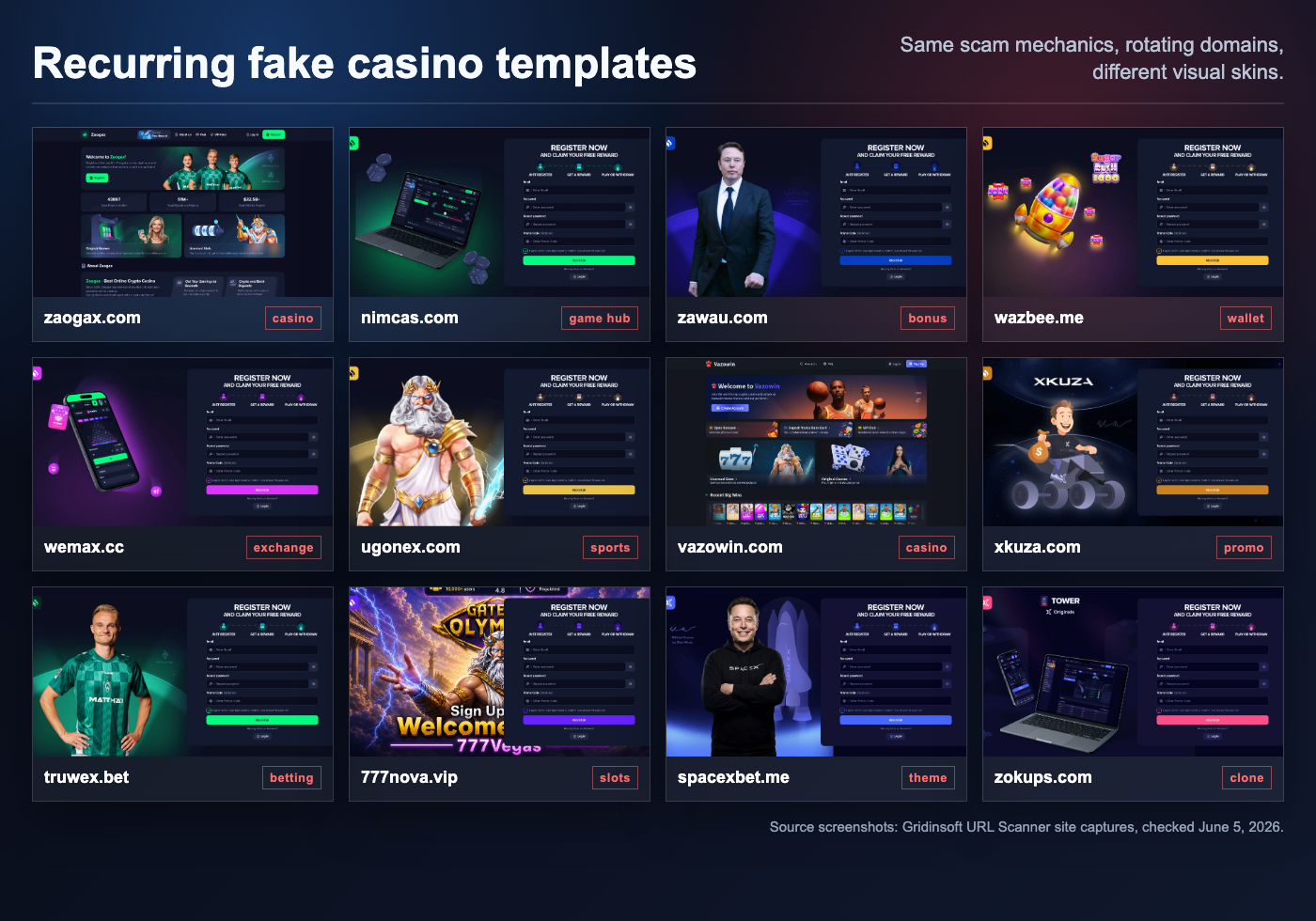
The real evidence is not that one casino page looks suspicious. A single domain can always be dismissed as a new brand, a copycat, or an isolated fake. The useful signal is repetition: rotating domain names, the same registration-first casino flow, the same fake balance and withdrawal-pressure mechanics, and the same fingerprints appearing across many reports.
Gridinsoft’s database has this as a cluster-level problem, not a small blocklist. The domains mentioned in this article are examples from recent reports, not the boundary of the network.
How Gridinsoft pivots from one domain to the cluster
The Gridinsoft Web Reputation Checker is useful here because it can flag the exact URL a reader is looking at, while the Gridinsoft Inspector can pivot from a report fingerprint to related domains in the database. That matters for scambling sites because the operators can replace domains quickly, but they cannot easily hide reuse across the whole operation.
Useful Inspector pivots from the reports checked for this article:
- iowa-juliet-golf-texas
- table-venus-winner-vegan
- eighteen-river-island-november
- high-lamp-queen-wyoming
- sweet-romeo-washington-lion
- victor-alabama-rugby-earth
For a reader, the workflow is simple: check the suspicious casino URL, then use the fingerprint link from the report to see whether the same pattern appears elsewhere. If it does, treat the site as part of a repeatable scambling cluster, not as a standalone casino that merely needs more “reviews.”
Sample Gridinsoft reports used as anchors for this article include Pearwex.com, Tasowin.com, Bozawin.com, Zaogax.com, and Zokups.com. They are anchors for the pattern, not a complete list.
Current fake casino domains to check
Checked August 16, 2026. These are rotating examples, not permanent brand names. Each link opens the current Gridinsoft URL Scanner report; the score can change as new evidence appears.
- 1/100 trust-score reports: Topazwin.com, Zaemux.com, Nuopux.com, Foldwin.com, Kauvux.com, and Haudux.com.
- More 1/100 reports: Vuotux.com, Monkwin.com, Gousax.com, Hetowin.com, Taetox.com, Ceuhux.com, and Saehex.com.
- Recently reported giveaway names: Winlore.cc and Prizedice.com were both rated 1/100 when checked.
- Other current warnings: Capetreward.com was rated 10/100, while Toowers.com was rated 43/100 as a new domain. A higher score is not proof that a site is licensed or that a withdrawal request is legitimate.
Topazwin and Hetowin were still serving public crypto-casino pages during this check and used casino or blockchain marketing language. Several other domains returned access-denied responses or did not load, so availability alone is not a safety signal.
If a casino asks for a verification deposit, tax, unlocking charge, or any other payment before releasing a withdrawal, stop. Do not send more money. Check the exact domain rather than trusting a familiar-looking name, bonus balance, or celebrity video.
What to do if you already used one of these sites
- Visited only: close the page. No password or wallet change is needed unless you entered data, connected a wallet, allowed notifications, or installed something.
- Created an account or reused a password: change that password on the real services where it was reused, secure the email account first, and enable two-factor authentication.
- Sent cryptocurrency: stop paying, save the domain, chat, wallet address, and transaction hash, then report the transfer to the exchange or wallet provider. Ignore anyone asking for another fee to release or recover the funds.
- Uploaded an ID: preserve evidence, contact the document issuer or appropriate identity-reporting service, and watch for account-recovery, loan, or impersonation attempts.
- Connected a wallet or signed a token approval: disconnect the site and review or revoke approvals through the wallet’s known interface or a trusted chain explorer. If you entered a seed or recovery phrase, move assets from a clean device to a fresh wallet; never enter that phrase into a “revocation” link.
- Allowed notifications only: remove the suspicious site from browser notification permissions. If you installed an unknown file or extension, or redirects keep returning, follow the Windows scan steps below. Keep sensitive sign-ins off the affected device while you check it.
Names in this section are rotating examples, not a fixed blocklist. If a video, Discord message, Facebook post, or “friend” sends a different casino domain with a free bonus, fake celebrity proof, blocked first withdrawal, or verification/network-fee deposit demand, check that exact URL before entering data or sending cryptocurrency.
How to check whether a casino license covers the exact domain
A license badge, certificate image or company registration number does not establish that a casino’s website is authorized. A real license number can be copied from an unrelated operator. Before registering or sending money, check all of these details together:
- Open the named regulator’s official register independently. Do not rely on a screenshot or a certificate link supplied by the casino. Confirm that the record is on the regulator’s own domain.
- Match the license number, current status and legal operator. A company registration identifies a business; it does not, by itself, authorize gambling. A pending application is not the same as an active license.
- Match the exact hostname. Where the regulator lists approved domains, the casino address must be included. A similar brand name or a valid license belonging to another website is not enough. If the record does not establish coverage, ask the regulator through its independently verified contact details before proceeding.
- Compare the site’s footer, terms and support claims. Conflicting operator names or license numbers need an explanation that agrees with the official record. Passing this check still does not guarantee a payout or make a verification-deposit demand safe.
A documented example: in its February 19, 2026 report, LCB said that betpoint.cc named TechSolutions Group N.V. and license OGL/2024/590/0758 in its footer, but Long Island N.V. and a different license number in its terms [4]. Checked on October 26, 2026, the official Curaçao Gaming Authority record for OGL/2024/590/0758 showed an active license held by TechSolutions Group N.V.; betpoint.cc was not among that record’s five approved domains [5]. This illustrates why finding a genuine number is only the start of the check, not proof that another domain may use it.
For broader identity and withdrawal checks, see how to verify a trading platform. Gridinsoft Anti-Malware is relevant to suspicious downloads, extensions or device symptoms; a malware scan cannot authenticate a gambling license or recover a deposit.
Red flags that the casino is fake
- A promo code promises a large starting balance before you deposit.
- The site claims a celebrity partnership but links to no official announcement from that person or company.
- The domain is new, strange, or different from the name shown in the ad.
- The casino asks for a crypto deposit before it lets you withdraw.
- Support says you must pay a tax, wallet verification fee, AML fee, VIP upgrade, or “unlock” fee.
- The withdrawal timer, user counter, or recent-winner feed looks too perfect.
- The same login or password manager entry appears to work across unrelated casino domains.
- The site asks you to download an app, browser extension, remote-support tool, or wallet helper.
Fake celebrity endorsements are especially dangerous because they borrow trust from a familiar face. The FTC warns consumers not to treat a celebrity endorsement or promise of cryptocurrency as proof that an offer is real [2].
If you registered but did not deposit
- Do not reuse the password anywhere else. Change it on any real account where it was reused.
- If you entered an email and password combination, enable two-factor authentication on that email account first.
- Do not click verification links or support links from the fake casino.
- Watch for follow-up messages from “support,” “recovery,” or “compliance” accounts.
- If you uploaded an ID or payment screenshot, treat it as exposed personal data and monitor for identity-abuse attempts.
If you sent cryptocurrency
Stop paying immediately. A fake casino that asks for one fee to release winnings will usually invent another fee after you pay. Take screenshots of the domain, account page, chat, wallet address, transaction hash, and messages. Then report the scam to the exchange or wallet provider used to send funds, your local cybercrime reporting channel, and the FTC if you are in the United States. The CFTC also warns consumers to treat fraudulent crypto-trading websites and recovery-payment demands as digital asset fraud indicators [3].
Be careful with “recovery specialists.” After a crypto casino loss, scammers often contact victims again and claim they can retrieve funds for an upfront fee. Gridinsoft has a separate guide to crypto recovery scams that explains why those offers usually create a second loss. If the lure did not start with a casino page, compare the same pressure signs with our broader crypto scams 2026 guide.
If you downloaded anything from the casino
Most fake casino pages are built to steal deposits, but some campaigns may push installers, extensions, mobile apps, or wallet tools. A download that you did not open can stay closed while you scan or delete it. If you ran an unknown installer, installed a suspicious extension or have recurring redirects on Windows, check the affected PC for unwanted files and persistence:
- Stop using the affected PC for sensitive sign-ins. From a separate trusted device, change exposed passwords and revoke affected account sessions now; do not wait for the scan. Use the wallet-specific steps above if you connected a wallet or exposed a recovery phrase.
- Download and install Gridinsoft Anti-Malware on the affected Windows PC, update its database and run a Full Scan.
- Review detections, apply the cleanup actions, restart and check whether the original symptoms return.
If symptoms remain, optional targeted checks include unknown casino apps, extensions, wallet helpers, remote-support tools, browser notification permissions, startup apps and scheduled tasks. Do not delete unfamiliar entries solely because you do not recognize their names. A scan cannot revoke stolen account access or recover cryptocurrency.
Ran a casino download or installed a suspicious extension? Use a Full Scan to check for unwanted files and persistence. Review detections, apply cleanup, restart and check the original symptom. This does not verify a license or recover payments.
Download Gridinsoft Anti-MalwareWhy one-domain scam posts are not enough
That same one-domain pattern also appears outside casino branding. For example, the MoneyUpper.com scam uses a fake earning dashboard, referral pressure, and blocked cash-out logic instead of a casino balance, but the payment-before-withdrawal warning sign is the same.
Prediction-market branding can use the same trust mechanics. The Polyglow.cc investigation shows how repeated operator details and a related site’s “verification deposit” clause can signal a broader financial-platform cluster rather than one isolated domain.
Publishing a separate article for every Pearwex-style domain would miss the bigger user problem. The domains change daily, while the fraud mechanics stay the same: fake endorsement, free balance, blocked withdrawal, crypto fee, and follow-up recovery pressure. That is why this page focuses on the network pattern and links to current Gridinsoft scanner reports instead of recommending one domain-specific checklist.
For related account-compromise symptoms, see Gridinsoft’s guide to Discord crypto spam and hijacked auto-DMs. For broader betting-fraud context, see online betting scam warning signs.
FAQ
Is every crypto casino a scam?
No. The risk signal here is not simply “crypto” or “casino.” The danger is a site that promises free credits, uses fake celebrity proof, hides its operator, and demands a cryptocurrency deposit before any withdrawal.
Can I get my fake casino deposit back?
Sometimes an exchange, wallet provider, bank, or law-enforcement agency can help preserve evidence or freeze funds, but there is no guaranteed private recovery method. Do not pay anyone who asks for another crypto fee to recover the first loss.
Should I delete my casino account?
If the site is fake, account deletion forms may be ignored or used to keep you engaged. Save evidence first, stop logging in, change reused passwords, and secure the email account tied to the registration.
Why did a friend send me the casino link?
The friend’s account may be compromised, or the message may come from a bought or automated social account. Warn the person through a different channel and do not trust follow-up links from the same account.
What should I check before registering at any casino site?
Check the exact domain, operator, license claim, support contacts, withdrawal terms, independent reputation, and whether the offer requires crypto payment before payout. When the ad starts with a celebrity bonus code, assume it is suspicious until proven otherwise.
References
- KrebsOnSecurity. “Affiliates Flock to ‘Soulless’ Scam Gambling Machine.” KrebsOnSecurity, August 28, 2025, accessed June 5, 2026. https://krebsonsecurity.com/2025/08/affiliates-flock-to-soulless-scam-gambling-machine/
- Federal Trade Commission. “What To Know About Cryptocurrency and Scams.” FTC Consumer Advice, accessed June 5, 2026. https://consumer.ftc.gov/articles/what-know-about-cryptocurrency-scams
- Commodity Futures Trading Commission. “Investor Alert: Watch Out for Fraudulent Digital Asset and ‘Crypto’ Trading Websites.” CFTC, accessed June 5, 2026. https://www.cftc.gov/LearnAndProtect/AdvisoriesAndArticles/watch_out_for_digital_fraud.html
- Alexis Gold. “Betpoint.cc Exposed for False License Claims and Fake Games.” LCB, February 19, 2026, accessed October 26, 2026. https://lcb.org/news/betpoint-cc-exposed-for-false-license-claims-and-fake-games
- Curaçao Gaming Authority. “TechSolutions Group N.V.” License record OGL/2024/590/0758, accessed October 26, 2026. https://cert.cga.cw/token?id=758