You cannot prove an unfamiliar trading platform is legitimate from its design, HTTPS lock, reviews, or even one successful small withdrawal. Before depositing, connect the exact website to a named legal operator, verify that operator and its permissions in the regulator’s own register, determine whether the balance is real or simulated, identify who controls the money, read the withdrawal rules, and cross-check the market data. If any link in that chain is missing, treat the platform as unverified and do not send money or identity documents.
This guide applies to unfamiliar broker, forex, crypto, prop-trading, prediction-market, and investment websites. It does not label a particular platform a scam. The goal is to help you separate confirmed fraud, serious but unproven risk, and weak signals that need more context.
Stop before depositing if you cannot answer these questions
- What is the operator’s exact legal name, registration number, country, and physical address?
- Which regulator authorizes the operator for the specific product it offers you?
- Does the regulator’s record list the same website, phone number, address, and company?
- Are you buying or trading a real asset, an event contract, a derivative, or only using a simulated account?
- Who receives and controls your bank transfer, card payment, or cryptocurrency?
- Can the platform reject a withdrawal, change the rules, or demand additional payments after you request your money?
A platform that cannot answer these questions may be new, poorly organized, unregulated, or deceptive. Those are not identical conclusions, but they lead to the same safe decision: do not deposit until the missing facts can be verified independently.
How a fake trading platform can look convincing
A trading dashboard is only an interface. The numbers on it do not prove that an order reached a market, that the displayed balance is held for you, or that the operator has enough assets to honor withdrawals. A deceptive operator can show real public prices alongside invented trades, profits, user counts, or account balances.
In a May 2026 alert, the Australian Securities and Investments Commission described fake platforms that displayed profits and trades even though no real trading occurred. When victims tried to withdraw, the operators demanded additional fees and did not release the supposed assets [3].
The common flow is simple: real money goes in, an internal screen shows growth, support encourages a larger deposit, and the withdrawal becomes conditional. A successful early withdrawal does not settle the question; some scams allow a small payment to build confidence before seeking a much larger deposit.
Six checks before you deposit
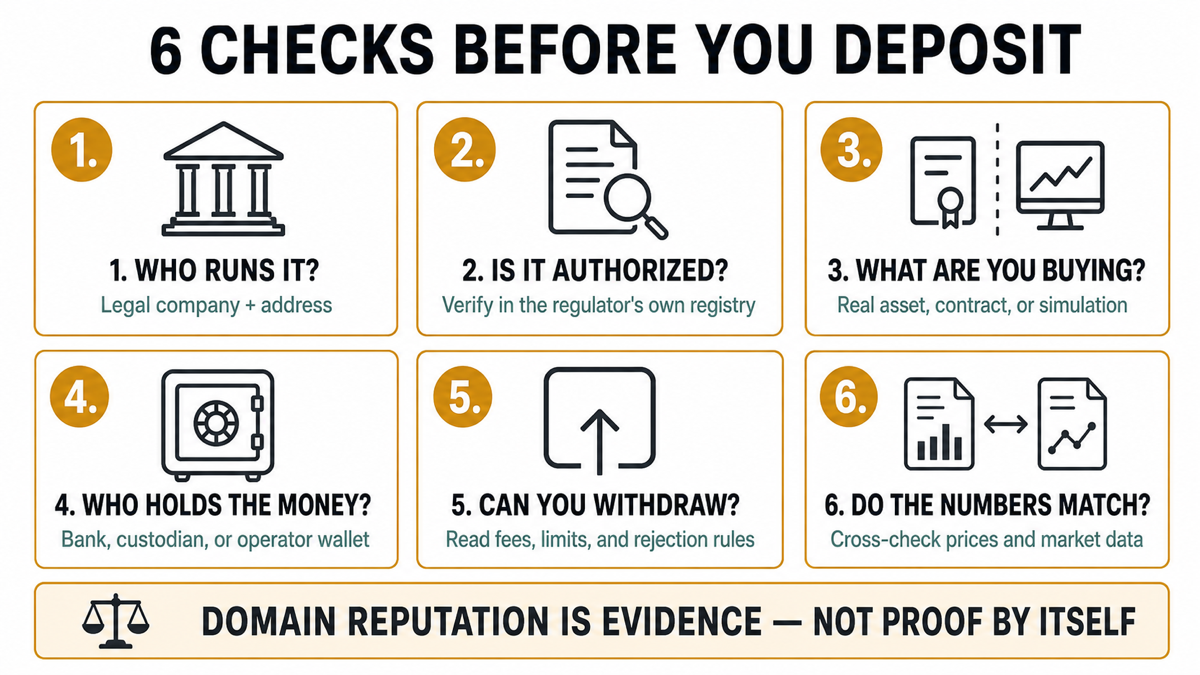
1. Identify the legal operator—not only the brand
Start with the website’s footer, Terms, Privacy Policy, risk disclosure, and payment page. Record the exact company name, registration number, jurisdiction, address, and support details. Then search the official company registry in the claimed country.
A company registration proves only that a legal entity was incorporated. It does not prove that the company is licensed to offer investments, holds customer money safely, owns the website you are visiting, or can pay withdrawals. Treat vague wording such as “governed by the laws where we are registered” without naming the country as a major verification gap.
Also compare names across the entire site. If the Terms name one entity, the payment recipient is another, and the support team will not explain the relationship, stop. A legitimate group can use several companies, but it should disclose what each one does.
2. Verify authorization in the regulator’s own register
Do not click a “license” badge or regulator link supplied by the platform and assume it is genuine. Open the regulator’s website through an address you find independently, then search the legal company and the people selling the product. For U.S. securities professionals, FINRA recommends checking BrokerCheck and, when applicable, the SEC’s Investment Adviser Public Disclosure database. It also warns that impostors may copy the identity of a real registered firm [1].
Match more than the name:
- exact domain and email domain;
- phone number and physical address;
- company or firm reference number;
- status and disciplinary history;
- the services and products the firm is permitted to offer;
- the countries or customer types it may serve.
A real firm can be cloned, and a real registration can be irrelevant to the product being sold. Conversely, a missing license does not automatically prove fraud: rules differ by product and jurisdiction. It does mean you may have little regulatory protection, so the operator should clearly explain why authorization is not required.
3. Understand what the balance represents
Ask what you are actually buying. A conventional brokerage account, a crypto exchange balance, a prediction or event contract, and a prop-firm evaluation are not the same product.
Words such as funded account, buying power, or capital up to $100,000 can refer to a simulated environment rather than money placed in an account for you. Simulation is not automatically fraudulent, but the platform must explain it before payment. You should be able to tell:
- whether trades reach an external venue or stay in an internal simulation;
- which part of the displayed balance can actually be withdrawn;
- whether you are paying for an evaluation, data access, a contract, or custody of an asset;
- which events close the account or cancel profit;
- whether the operator can change drawdown, eligibility, or payout rules after purchase.
If the marketing describes “our capital” while the risk disclosure describes only simulated trading, base your decision on the disclosure—not the headline.
4. Find out who holds the money
Trace the payment path before sending anything. A regulated broker may use a named bank or custodian and disclose how client assets are held. A crypto platform may send funds to an operator-controlled wallet. A payment processor may appear on the statement even though a different company operates the service.
Ask for the custodian’s name, account ownership, segregation policy, deposit and withdrawal methods, and the legal entity responsible for returning funds. Published wallet addresses, reserves, or an audit can add evidence, but none should be assumed from a dashboard balance alone.
If the recipient’s name does not match the disclosed operator, ask for a documented explanation. Do not accept “finance partner” or “cold wallet” as a substitute for identifying who has legal and technical control of the funds.
5. Read the withdrawal rules before paying
Search the Terms, fee schedule, FAQ, and risk disclosure for withdraw, payout, verification, tax, review, reserve, bonus, and termination. Note minimum amounts, processing times, identity checks, profit splits, chargebacks, inactivity rules, and every reason the operator may delay or reject a request.
Contradictory rules matter. If one page says verification begins at a threshold, another requires it before the first withdrawal, and support gives a third answer, do not assume the most favorable version will apply.
A demand to send new money for a “tax,” “unlock,” “security deposit,” “liquidity check,” or “verification fee” before releasing an existing balance is a classic advance-fee warning. The CFTC and SEC describe cases where fraudulent trading websites demanded extra payments to withdraw fake profits [2]. Stop paying and preserve the demand as evidence.
The current Pwadex and Polywax prediction-market check shows how to compare matching public templates, verify the exact domain, and choose the right response after a deposit, wallet action, password, ID upload, or download.
6. Cross-check prices, markets, volume, and trades
Real-looking market data is not proof of platform activity. Websites can embed public price feeds, copy market names and identifiers, or display volume reported by another venue. Cross-check several items against an independent source:
- the asset or market name and contract identifier;
- timestamp, price, settlement rule, and expiry;
- 24-hour and lifetime volume;
- whether order IDs or transaction records exist outside the platform;
- whether a claimed partner or liquidity venue acknowledges the relationship.
If the numbers match another venue exactly, you have proved that the website can display that venue’s data—not that it has the same customers, liquidity, reserves, trades, or payout history. Ask the operator to label third-party data clearly.
Use Website Reputation Checker as one evidence layer
Paste the exact domain—not the brand name—into the Gridinsoft Website Reputation Checker. Check every domain involved in registration, payment, login, downloads, and support because scam flows often move users between sites.
The report can help you inspect domain age, reputation, provider warnings, phishing or malware signals, hosting context, redirects, and other trust indicators when available. This is especially useful when a polished financial site appeared recently or uses a different domain from the company it claims to represent.
A reputation result is evidence, not a legal judgment. It cannot prove that an operator is licensed, that reserves exist, that market data belongs to the platform, or that withdrawals will be honored. A new domain may belong to a real startup, and an older clean domain can be compromised or sold. Combine the domain report with the operator, regulator, product, custody, withdrawal, and data checks above.
For broader domain and payment checks outside financial platforms, use our scam website safety checklist. For wallet approvals, seed phrases, fake exchanges, and other crypto-specific risks, see our guide to cryptocurrency scams.
Red flag, high risk, or confirmed fraud?
| Evidence level | What it supports |
|---|---|
| Confirmed evidence | A regulator or law-enforcement warning naming the exact operator/domain, a court finding, an admission, independently verified theft, or documented manipulation can support calling a scheme fraudulent. Check dates and exact entities. |
| High-risk, unverified | No identifiable operator, unverifiable authorization, contradictory terms, operator-controlled crypto deposits, unclear custody, simulated balances presented ambiguously, or broad withdrawal discretion justify refusing to deposit. They do not prove a crime by themselves. |
| Context, not proof | A young domain, privacy-protected registration, cryptocurrency payments, HTTPS, few reviews, many positive reviews, or a professional design can raise questions or create false confidence. None establishes legitimacy or fraud alone. |
You do not need courtroom-level proof to protect your own money. “Unverified—do not deposit” is often the most accurate and useful conclusion when ownership, authorization, custody, or withdrawals cannot be confirmed.
What to do if you already used the platform
- You only opened the site: close it and do not return through an ad, message, or referral link. A visit alone usually does not mean your account or device was compromised.
- You created an account or reused a password: change the reused password from a trusted device, enable multifactor authentication, and watch for follow-up phishing.
- You sent identity documents: save what you submitted, monitor for impersonation or new-account activity, and contact the document issuer or local identity-theft service if misuse appears.
- You paid by card or bank transfer: contact the bank or card issuer immediately, explain that the transaction may be connected to investment fraud, and ask what recall, dispute, or account-protection options remain.
- You sent cryptocurrency: save the TXID, receiving address, exchange receipts, chats, and screenshots. Contact the exchange you used and report the receiving address. Do not send another transaction to “verify” or unlock the balance.
- Your withdrawal is blocked: stop paying, request the reason in writing, preserve every rule and fee demand, and report the operator to the relevant financial regulator and fraud-reporting service.
- You installed an app, extension, or remote-access tool: disconnect the device from sensitive accounts, remove the software, and run a full security scan. Gridinsoft Anti-Malware can check for unwanted software, hidden files, startup entries, scheduled tasks, and other persistence left by a suspicious installer. Change important passwords from a clean device.
Be ready for a second approach. Recovery scammers often contact people who already lost money and promise to retrieve it for an upfront fee, wallet connection, “court tax,” or remote access. Our crypto recovery scam guide explains why these offers create another loss. The broader post-scam response checklist covers payment, account, identity, and evidence steps.
FAQ
Can an unregulated trading platform be legitimate?
Possibly. Whether authorization is required depends on the product, country, and customer. But an unregulated platform offers less protection, and the operator should clearly identify the product and explain why a license is not required. Missing authorization is a reason to stop and investigate, not automatic proof of fraud.
Does a regulator listing guarantee the platform is safe?
No. Registration does not guarantee good performance, solvency, or honest conduct. Verify the exact domain and contact details because scammers can clone a real firm’s name or license number. Also confirm that the authorization covers the product being offered.
Is a newly registered domain automatically a scam?
No. Legitimate startups use new domains. Domain age becomes meaningful when combined with claims of a long operating history, hidden ownership, copied content, unverifiable licensing, pressure to deposit, or withdrawal restrictions.
Can a fake trading platform show real prices and volume?
Yes. It can embed or copy data from a public feed or another venue. Matching numbers prove only that the data is available to display. They do not prove that your trades occurred, that the platform has that volume, or that your balance is withdrawable.
Does a successful small withdrawal prove the platform is legitimate?
No. It is a positive data point, but some investment scams allow a small withdrawal to build trust before requesting a much larger deposit. Continue to verify the operator, authorization, custody, and rules independently.
Can Website Reputation Checker prove that a trading platform is a scam?
No. It can surface domain and security signals that support your investigation. A scam conclusion needs stronger evidence such as a regulator warning, verified deception or theft, a court finding, or independently confirmed manipulation. Use the report as one layer of the six-check process.
References
- Financial Industry Regulatory Authority. “Check Registration: Sellers and Investments.” FINRA, accessed August 4, 2026. FINRA registration verification guidance.
- U.S. Securities and Exchange Commission, Office of Investor Education and Advocacy, and Commodity Futures Trading Commission, Office of Customer Education and Outreach. “Investor Alert: Watch Out for Fraudulent Digital Asset and ‘Crypto’ Trading Websites.” CFTC, accessed August 4, 2026. CFTC and SEC investor alert.
- Australian Securities and Investments Commission. “Scam Alert: Scammers Luring Investors onto Fake Crypto-Asset Trading Platforms.” ASIC, May 25, 2026, accessed August 4, 2026. ASIC fake-platform alert.