Online dating scams, also called romance scams, happen when a criminal builds a fake relationship to steal money, personal data, photos, accounts, or cryptocurrency. The scammer may meet you on a dating app, Facebook, Instagram, WhatsApp, Telegram, a wrong-number text, or a private message. The relationship feels personal, but the goal is control: first trust, then secrecy, then payment or account access.
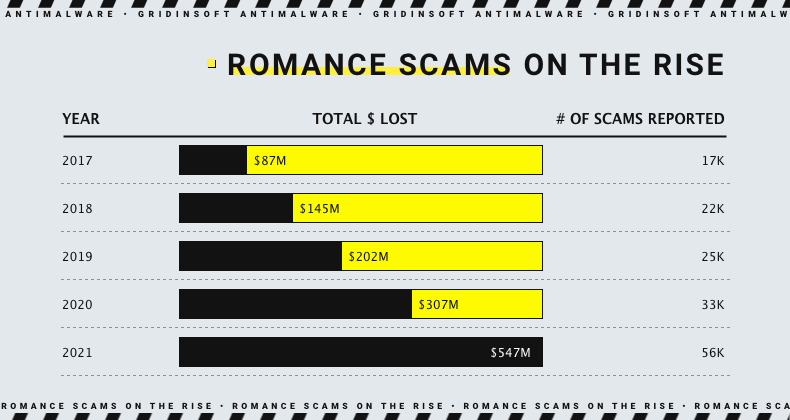
The risk is not theoretical. IC3 recorded 23,159 confidence/romance complaints in 2025 with $929.3 million in reported losses, up from $672 million in 2024. The same report says AI is now used to create believable fake profiles, scripts, voices, and videos, and confidence/romance scams with a likely AI connection caused more than $19 million in reported losses in 2025.
Fast romance scam check
- They quickly move the chat away from the dating app to WhatsApp, Telegram, Google Chat, text, or email.
- They avoid a normal live video call or in-person meeting, then create an urgent money problem.
- They ask for gift cards, wire transfer, crypto, payment-app transfers, bank details, verification codes, or a “small test” investment.
- They push secrecy, guilt, or pressure: “do not tell your family”, “you are the only one who can help”, or “we can build a future if you send this now”.
- If you already paid, stop contact, save evidence, contact the payment provider, and report the profile before the scammer deletes it.
What is a romance scam?
A romance scam is a confidence scheme. The scammer creates affection, trust, and urgency, then asks for help. The request may be framed as a medical emergency, travel problem, military deployment, customs fee, frozen bank account, crypto investment, phone bill, family crisis, or a “temporary” favor.
Some cases begin as catfishing: a fake identity built around stolen photos and a polished story. Others start as a wrong-number message, a friendly social media conversation, or a group invitation. The important signal is not the first platform. It is the shift from affection to money, secrecy, account access, or investment pressure.
| Red flag | Why it matters |
| They avoid meeting or video calls | The profile may use stolen photos, AI-generated images, or a fake identity |
| They move quickly to love or commitment | Fast intimacy lowers skepticism and makes outside advice feel intrusive |
| They ask for money, crypto, or gift cards | Money requests are the central romance scam signal |
| They want to leave the dating app | Private apps reduce platform reporting, moderation, and scam detection |
| They ask for codes, IDs, photos, or account access | This can lead to account takeover, identity theft, or sextortion |
Common romance scam stories in 2026
- Oil rig or overseas worker: they claim they cannot access money until a project ends.
- Military deployment: they say they cannot video call or travel because of service rules.
- Medical emergency: they ask for urgent help for surgery, medicine, or a family crisis.
- Travel problem: they plan to visit, then need money for tickets, customs, visas, or fees.
- Crypto investment or pig-butchering: they introduce a trading platform, wallet, “mentor”, or guaranteed opportunity. If the platform shows fast profits but blocks withdrawals, compare it with our crypto scam checklist.
- Gift card request: they ask for Steam, Apple, Google Play, Amazon, or other gift cards because they are “easier” or “temporary”.
- Wrong-number friendship: they pretend the message was accidental, keep the conversation warm, then move toward investment, travel, or emergency payments.
- Intimate-photo pressure: they request private photos or videos, then use them for blackmail. If that happens, read our sextortion guide and do not pay the extorter.
How to check an online dating profile safely
- Reverse-search profile photos. Stolen images often appear under different names. A clean result does not prove the person is real, especially with AI images or newly stolen photos.
- Ask for a normal live video call. Be cautious if they always refuse, use technical excuses, keep the call extremely short, or never respond naturally to a spontaneous question.
- Keep the chat on the platform at first. Dating apps can detect and remove scam accounts. A fast move to WhatsApp or Telegram is a common warning sign; see our WhatsApp scams guide for platform-specific examples.
- Search the exact phrases they use. Copy a suspicious line plus words like “scam”, “oil rig”, “military”, “inheritance”, “visa fee”, or “crypto platform”. Reused scripts often surface in reports.
- Check links before clicking or paying. If they send a trading website, shipping page, charity page, or document link, check the domain with the Gridinsoft Website Reputation Checker before entering data. For a current rotating-domain example, see our Fapni scam investigation, where the observed destination changed between dated checks.
- Do not send private photos or documents. They can be used for extortion, identity theft, or fake account creation.
- Do not share verification codes. Codes can let scammers take over WhatsApp, email, banking, or social accounts.
- Talk to someone you trust. Scammers isolate victims by asking for secrecy. A second opinion often breaks the pressure loop.
What to do if you sent money to a romance scammer
Act quickly and do not warn the scammer. Save screenshots, wallet addresses, transaction IDs, phone numbers, usernames, profile links, receipts, email headers, and chat history before accounts disappear.
- Contact the payment provider first. Call your bank, card issuer, payment app, crypto exchange, wire-transfer service, or gift-card issuer. Tell them you paid a scammer and ask whether the payment can be reversed, frozen, disputed, or internally flagged.
- Report the account on the platform. Use the dating app, social network, WhatsApp, Telegram, or email provider’s reporting flow. Include profile links and screenshots.
- Report the fraud officially. In the U.S., use FTC ReportFraud.gov and FBI IC3. Other countries have their own cybercrime or consumer-protection reporting portals.
- Secure your accounts. Change passwords, enable MFA, revoke unknown sessions, and rotate email, banking, and social media passwords if you shared codes, IDs, or credentials.
- Watch for recovery scams. A stranger promising guaranteed money recovery, crypto tracing, or law-enforcement help for an upfront fee is usually a second scam.
- If ID documents were shared, treat it as identity theft. Consider credit monitoring, credit freezes, bank alerts, and checks for new accounts opened in your name.
Romance scam vs real relationship
| Real relationship | Romance scam pattern |
| Moves at a normal pace | Intense affection very quickly |
| Can verify identity over time | Excuses for no video call, no meeting, or no normal proof of life |
| Respects boundaries | Pushes secrecy, guilt, and urgency |
| Does not ask for money early | Requests money, crypto, gift cards, account access, codes, or private photos |
| Welcomes outside advice | Tries to isolate you from friends, family, or platform support |
Why stronger romance scam pages often rank higher
Google’s top results for broad romance-scam queries usually favor official guidance, recent data, and pages that answer “what do I do now?” quickly. That means a useful page should not stop at definitions. It should show current loss trends, explain the exact red flags victims search for, cover WhatsApp and crypto investment lures, and give a clear response plan for people who already paid.
This page is written for that practical lane: someone suspects a dating profile, online relationship, WhatsApp contact, or crypto “partner” may be fraudulent and needs a safe next step without being pushed into risky confrontation.
FAQ
What is the biggest red flag in online dating scams?
A request for money, crypto, gift cards, payment help, account access, private photos, or verification codes from someone you have not met in person is the biggest red flag.
Why do romance scammers ask for gift cards?
Gift cards are easy to redeem and hard to recover. A legitimate romantic partner should not need gift card codes from someone they just met online.
Can romance scammers use video calls?
Yes. Some use short clips, deepfake-style tricks, stolen videos, or scripted calls. A live video call helps, but it is not enough if the person later asks for money, secrecy, codes, or investments.
What if the person has not asked for money yet?
Slow down and verify. Many scams spend days or weeks building trust before the first request. Watch for pressure to leave the platform, avoid meeting, keep secrets, or invest through a site they recommend.
Should I confront the scammer?
No. Save evidence, stop sending money or information, report the profile, and secure your accounts. Confronting them often leads to more manipulation or deleted evidence.
Where should I report a romance scam?
Report it to the dating app or social platform where the profile appeared. In the U.S., also report to FTC ReportFraud.gov and FBI IC3. If money was sent, contact the payment provider immediately.
References
- Federal Trade Commission. “What To Know About Romance Scams.” Consumer Advice, accessed June 7, 2026. https://consumer.ftc.gov/articles/what-know-about-romance-scams
- Federal Trade Commission. “Love Stinks – when a scammer is involved.” FTC Business Blog, February 16, 2024, accessed June 7, 2026. https://www.ftc.gov/business-guidance/blog/2024/02/love-stinks-when-scammer-involved
- Federal Bureau of Investigation, Internet Crime Complaint Center. “2025 IC3 Annual Report.” FBI IC3, 2026, accessed June 7, 2026. https://www.ic3.gov/AnnualReport/Reports/2025_IC3Report.pdf