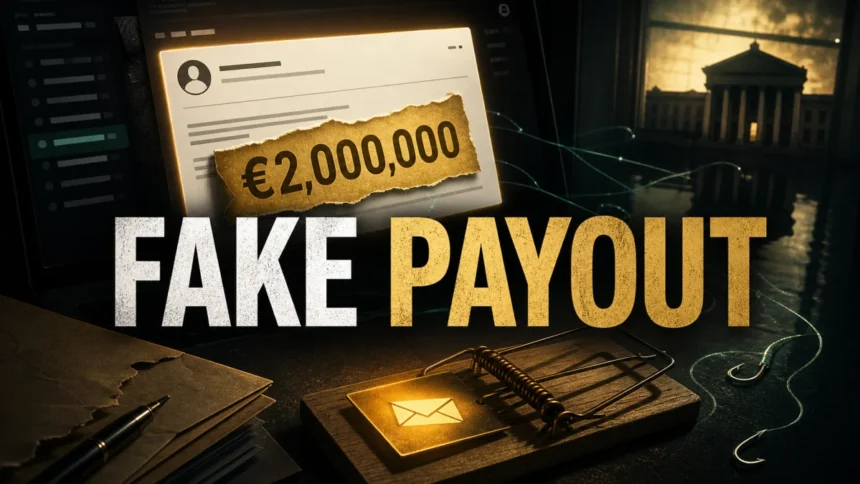
The “Internet Fraudsters Arrested” email is a fake compensation scam, not a real notice from Spanish police, the Supreme Court of Spain, the International Monetary Fund (IMF), Citi, or any government compensation program. The common version claims that online fraudsters who previously scammed you have been arrested and that you can receive about €2,000,000 if you contact a “barrister” or legal representative. Other versions use “Internet Fraud Victim Compensation,” “Business Owner Compensation,” or “CitiBank Compensation Fund Deposit” wording. In every version, the payout is bait: the next step is usually a request for personal or business details, identity documents, banking information, or a bogus processing fee.
If this email is in your inbox, do not reply, do not send ID documents, and do not pay any release, tax, court, transfer, or verification fee. If you already answered, secure your email and bank accounts first, then report the message and scan the device if you opened links or attachments.
What the “Internet Fraudsters Arrested” email claims
The common version arrives with a subject similar to “From the Crime Fraud Investigation Department Spain.” It says a supposed detective, judge, police unit, or court representative has identified you as a victim of a previous fraud case. The email then claims that the Spanish government has approved a large compensation payment, often written as €2,000,000 or “Two Million Euros.”
The same recovery-scam script also appears as an “Internet Fraud Victim Compensation” email that pretends to come from the IMF. That variant may claim a review found you eligible for $4,600,000, name IMF Managing Director Kristalina Georgieva, and ask for your full name, phone number, home address, occupation, identification card or passport copy, and claim documents.
Scammers use this story because it targets people who may already be worried about a previous fraud loss. Instead of threatening you, the email creates relief and hope: it says the criminals were caught, the court ruled in your favor, and you only need to contact the named representative to release the funds.
Why this message is fake
The message is fake because it asks you to trust a private contact inside an unsolicited email instead of verifying the case through official channels. Real courts, police, and government agencies do not randomly award large compensation by telling victims to contact a Gmail, Outlook, or lookalike-domain address.
This lure keeps appearing because it combines three reliable scam pressures: official-looking authority, the hope of recovering lost money, and a private reply path controlled by the attacker. If the message asks for documents or fees before a supposed payout, treat it as a recovery scam, not as a legal notice.
Red flags in the email
- Unexpected compensation: you did not file a verified claim, but the email says a huge payment is waiting.
- Fake authority language: it references Spanish police, courts, judges, cybercrime departments, the IMF, FELA, a political administration, a law firm, or a named international official without a verifiable case path.
- Private contact details: the “barrister” or officer uses free email, a throwaway domain, or a reply-to address unrelated to an official site.
- Pressure to reply privately: the message asks you to keep the matter confidential or contact only the person named in the email.
- Requests for documents or money: later replies may ask for passport scans, bank details, card numbers, crypto, wire transfers, gift cards, or “processing” fees.
- Bad legal logic: a court judgment, victim compensation, and international transfer are compressed into a casual email with no secure portal or verified case record.
How to verify an authority or law-firm compensation email
Do not verify the message by replying to it. Open a fresh browser tab and search for the official website of the organization named in the message. The official Supreme Court of Spain is represented through the Poder Judicial/CGPJ website, and Spain’s INCIBE provides citizen fraud-reporting guidance for phishing, fraudulent websites, and malware-related incidents. If the email claims to be from police, a court, or a law firm, use a public official contact route from the real website, not a phone number or email address printed in the suspicious message. A real organization name in the signature does not prove the sender works there.
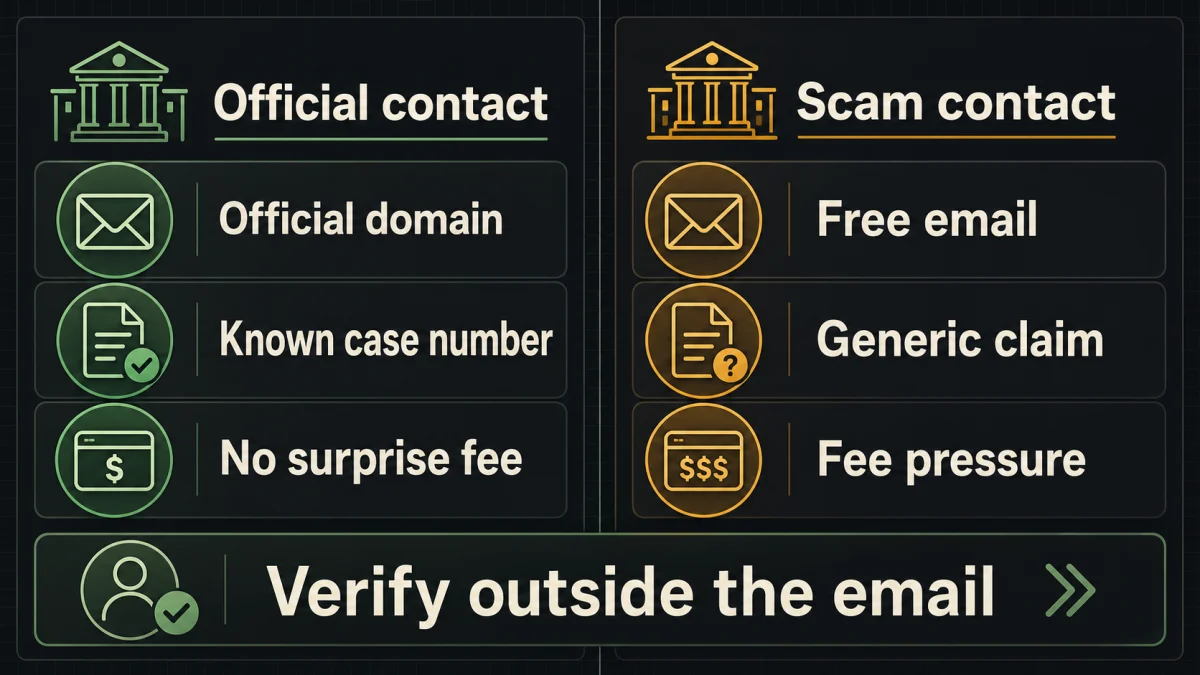
For a quick email check, compare the full sender address, reply-to address, return path, links, attachment names, and the domain shown after the @ sign. If the message says “Spanish government” but routes you to a free mailbox, shortened link, unrelated domain, or a page that asks for banking details, treat it as phishing.
What scammers want from victims
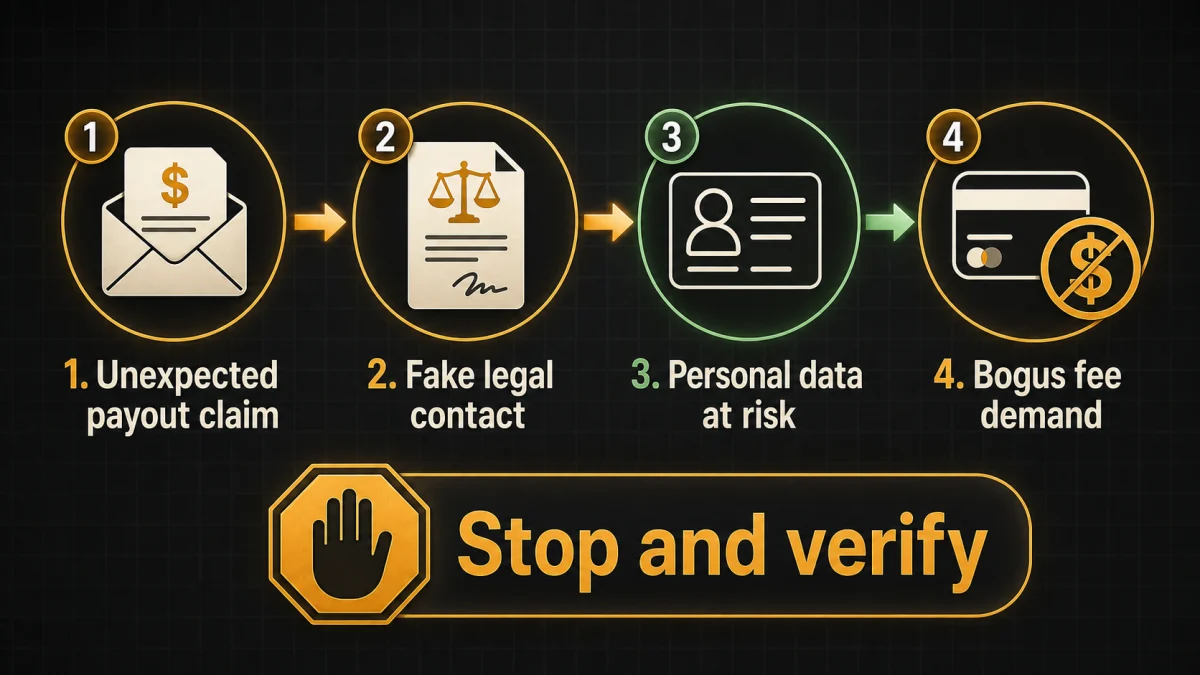
This scam usually leads to one of three outcomes. First, the attacker asks for personal or business information such as full name, address, date of birth, phone number, occupation, gender, business name and address, passport scan, driver’s license image, identification card, or tax number. These details can support identity theft and more convincing follow-up messages aimed at the business, its staff, or its suppliers. Second, the attacker asks for financial information, including bank account details or card data. Third, the attacker demands an advance fee, often described as a legal fee, release charge, transfer tax, anti-fraud certificate, courier fee, or currency-conversion cost.
That makes “Internet Fraudsters Arrested” a recovery-style advance-fee scam. The fake payout is not the product; the victim’s money and identity documents are.
Sample wording seen in this scam
Variants change, but the core text is recognizable. Treat messages with wording like this as suspicious:
Subject: From the Crime Fraud Investigation Department Spain

Be informed that the internet fraudsters who defraud you have been arrested
and charged to court. The court has ordered the Spanish Government to pay
you compensation and damages for all the money you lose to those fraudsters.

The sum of €2,000,000 has been approved to compensate you. Contact Barrister
George Hernández immediately to claim your compensation fund.
Other variants may mention a Spanish court notice, cybercrime victim compensation, a police case reference, a court ruling date, a “Crown Attorney,” or a deadline for claiming the funds. Those details are meant to make the message feel official, but they do not prove it is real.
IMF “Internet Fraud Victim Compensation” variant
The IMF-themed version uses the same recovery hook with a different authority name. It says the recipient has been approved for compensation as a victim of internet fraud, then asks for personal details and identity documents before any payment can be released. The real IMF warns that scammers misuse its name in fake emails and letters, including messages that request banking details, confidential information, or advance fees for large sums of money.
Subject: Internet Fraud Victim Compensation

We have reviewed your case and approved compensation of $4,600,000
from the International Monetary Fund. Send your full name, address,
telephone number, occupation, age, identification card or passport copy,
and claim documents so the payment can be released.

Yours faithfully,
Kristalina Georgieva
International Monetary Fund
Do not send the requested documents. A passport, ID card, phone number, and address can be reused for identity theft, account recovery attempts, SIM-swap pressure, or more targeted follow-up scams. A real international organization will not approve a multimillion-dollar personal payout through an unsolicited mailbox message.
CitiBank Compensation Fund Deposit email scam
The unsolicited “CitiBank Compensation Fund Deposit” email is another recovery and advance-fee scam, not a compensation notice from Citi. It claims that a fund or deposit has been approved for the recipient, then asks for a reply, identity or banking documents, or a supposed release or verification step. The wording here refers to this unexpected compensation message; it does not mean that genuine account alerts or secure messages from Citi are fraudulent.
The combination of a compensation claim you never filed, a request for identity documents, and any release, tax, transfer, court, or verification fee is the decisive warning. Do not use the email’s links, reply address, or phone number to check it. Open the Citi app or type citi.com yourself and use the contact information shown there or on the back of your card. Citi’s official fraud page lists a dedicated route for reporting suspicious emails and phishing [5].
What to do based on what happened
- You only read the email: report it as phishing, delete it, and do not engage. Opening a normal message by itself does not mean the device is infected.
- You replied but sent no documents or money: stop replying and expect follow-up messages. If you disclosed a password or verification code, change the affected account credentials from the official app or website.
- You sent identity documents: preserve the messages as evidence, start the identity-theft response available in your country, and consider a fraud alert or credit freeze where those protections exist.
- You sent money or bank/card details: contact the bank or payment provider immediately, say the transaction was part of a scam, and ask whether it can be stopped, recalled, or disputed. The FTC recommends acting quickly and contacting the company used to send the money [2].
- You opened a link, attachment, download, or remote-access tool: secure the email and financial accounts from a trusted device, remove unknown remote-access software, and run a full security scan before resuming sensitive activity.
Business Owner Compensation / “Compensate Notification” variant
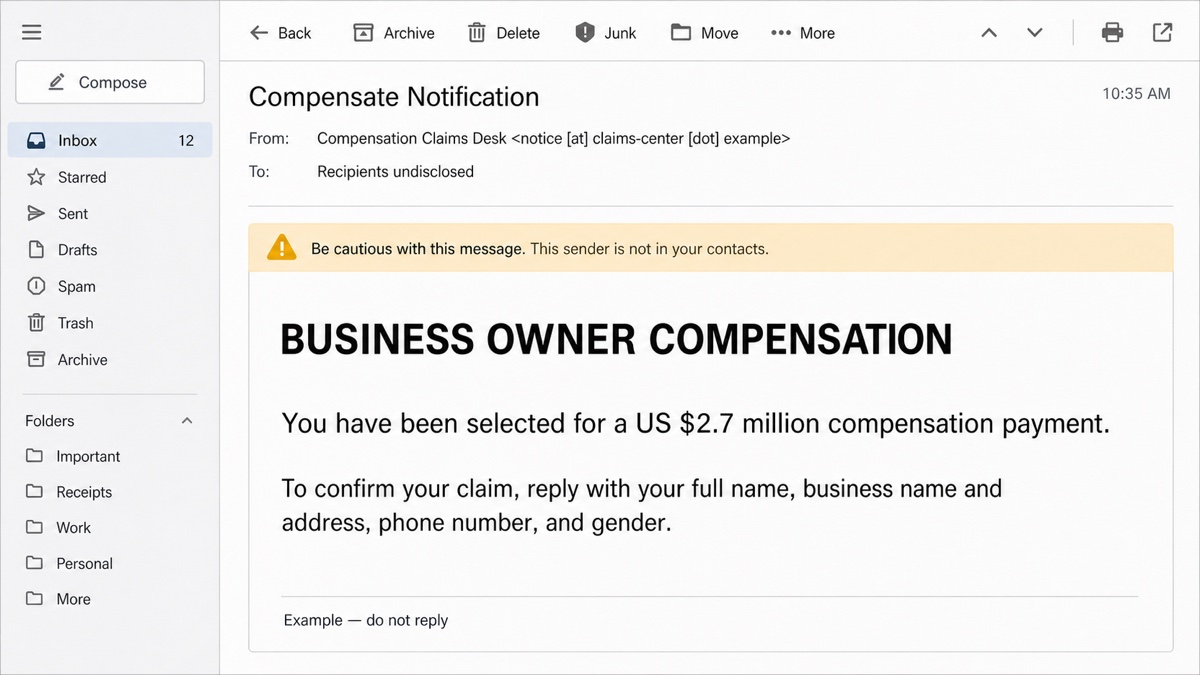
This version claims a US $2.7 million payment is available to business owners, founders, CEOs, school owners, and even people injured by war. It may say the payout was approved by the Trump administration, call the program “FELA Claims,” and place the name of the real Tycko & Zavareei LLP law firm in the signature. Those details do not create a case, prove eligibility, or authenticate the sender.
Why “FELA Claims” does not make the email legitimate
In U.S. law, the Federal Employers’ Liability Act applies to liability of railroad carriers for injuries to employees. It is not a worldwide compensation program for unrelated business owners, founders, CEOs, school owners, or war injuries. A real claim would start from an actual employment injury and a verifiable legal case, not an unsolicited message promising the same multimillion-dollar amount to broad groups of people.
Why a real law-firm name does not authenticate the sender
Scammers copy names of real lawyers, firms, agencies, and officials to make a reply request feel safer. Do not use the email address, phone number, or link in the message. Find the firm’s official website independently, use its published contact route, and ask whether the exact case number and sender exist. The real firm’s existence is not evidence that it sent the email.
The request for your full name, business name and address, phone number, and gender gives the sender enough context for identity theft and a tailored second message. That follow-up may introduce a “tax,” “legal charge,” “release fee,” or bank-transfer cost before the fake compensation can supposedly be paid.
Example:
Subject: Compensate Notification

You have been selected for a US $2.7 million Business Owner Compensation
payment. This program is said to cover business owners, founders, CEOs,
school owners, and people injured by war.

Reply with your full name, business name and address, phone number, and
gender so your claim can be confirmed.

Legal Claims Desk
If you only received the email
- Do not reply and do not click links or open attachments.
- Mark the message as phishing or spam in your email client.
- Block the sender after reporting it to the mail provider.
- If the message contains a suspicious link, check the domain with the Gridinsoft Website Reputation Checker before visiting it.
- Warn relatives or coworkers if the email was sent to a shared mailbox or if similar messages are spreading in your organization.
If you already replied or sent information
- Stop communication now. Do not argue with the sender or try to “prove” they are fake.
- Secure your email account. Change the password, enable multi-factor authentication, review forwarding rules, and sign out of unknown sessions.
- Call your bank or card issuer if you sent payment details, paid a fee, shared card data, or gave the scammer enough information to attempt account recovery.
- Protect your identity if you sent ID documents. Consider a fraud alert, credit freeze, or local equivalent where available.
- Report the incident to your local cybercrime/fraud portal. U.S. victims can report to the FTC and IC3; victims in Spain can use INCIBE’s fraud-reporting guidance.
- Scan the device if you opened a file or visited a page from the email. A follow-up phishing page can deliver malware or browser notification spam. Gridinsoft Anti-Malware can help check the device for malicious files and unwanted changes.
For broader recovery steps after any scam payment or data exposure, see our guide on what to do when you get scammed.
How this differs from a real fraud recovery notice
A real fraud recovery process starts from a case you can verify independently: a police report, court case, official victim-services contact, bank investigation, or public agency portal. A real process will not ask you to send sensitive documents to a random private email address, pay a surprise fee by irreversible methods, or keep the entire matter secret from your bank, family, or local authorities.
If you were previously scammed, be extra cautious with any message that says your lost money has been found. Scammers often recycle victim lists and target the same people again with “refund,” “recovery,” “lawyer,” “court,” and “compensation” stories.
Related scam patterns
- Crypto recovery scams use the same false-hope mechanism after cryptocurrency theft.
- Phishing emails often hide fake sender domains behind convincing display names.
- Online scam red flags help explain why surprise money, urgency, secrecy, and odd payment methods are dangerous together.
- Fake banking notifications use similar urgency and identity-verification pressure.
- Fake funds-transfer document emails show how scammers misuse bank, World Bank, and IMF names to collect documents and fees.
For a closely related law-enforcement variant, compare this with the FBI Funds Recovery Dept email scam, which uses an FBI display name, HSBC payment story, and fake affidavit/deed documents to push the same second-chance recovery pressure.
FAQ
Is the “Internet Fraudsters Arrested” email real?
No. It is a phishing and advance-fee scam. The message falsely claims that Spanish authorities arrested fraudsters and approved a large compensation payment for you.
Is the IMF “Internet Fraud Victim Compensation” email legitimate?
No. The IMF does not approve personal compensation payouts through unsolicited emails, and it warns that scammers misuse its name to request confidential information or advance fees. Treat an IMF-branded message promising $4,600,000 as a phishing and advance-fee scam.
Could a government really compensate scam victims?
Victim compensation and restitution can exist in real legal processes, but you would verify them through official case channels. A surprise email from a private “barrister” promising €2,000,000, or an IMF-themed mailbox message promising $4,600,000, is not a real compensation process.
Why did I receive this email?
It may have been sent in bulk to leaked or scraped email addresses. If you were previously scammed, your address may also be on a victim list that scammers reuse for recovery-style fraud.
What if I sent my passport or bank details?
Contact your bank immediately, secure your email account, monitor accounts for suspicious activity, and report the incident to your local fraud or cybercrime authority. If you sent identity documents, consider identity-theft protection steps such as a fraud alert or credit freeze where available.
Should I click the links to check whether the email is real?
No. Verify outside the email. Open the official website manually or use a trusted domain-checking tool before visiting any suspicious link.
References
- International Monetary Fund. “Fraud Alert: Protect Yourself from Scams Using the Name of the IMF.” IMF, last updated April 14, 2025, accessed July 9, 2026. https://www.imf.org/external/scams.htm
- Federal Trade Commission. “Refund and Recovery Scams.” FTC Consumer Advice, December 2023, accessed July 25, 2026. https://consumer.ftc.gov/articles/refund-and-recovery-scams
- INCIBE. “Reporte de fraude.” Instituto Nacional de Ciberseguridad, accessed June 7, 2026. https://www.incibe.es/ciudadania/ayuda/reporte-de-fraude
- Office of the Law Revision Counsel, U.S. House of Representatives. “45 U.S.C. §51: Liability of Common Carriers by Railroad for Injuries to Employees.” United States Code, accessed July 25, 2026. 45 U.S.C. §51
- Citigroup Inc. “Citi Fraud and Scam Prevention Central.” Citi, accessed August 13, 2026. https://citicards.citi.com/cbol/fraudprevention/default.htm