Slubit.com should be treated as a high-risk crypto platform, not as a normal exchange with a temporary withdrawal problem. The Gridinsoft Website Reputation Checker classifies Slubit.com as a Cryptocurrency Scam, gives it a 1/100 trust score, and records blacklist and young-domain signals. Do not deposit more funds, connect a wallet, share a seed phrase, upload identity documents, or pay a tax, gas, VIP, verification, or unlock fee to withdraw money.
If you already used Slubit.com, the safest next move is to stop the money flow first. Save the domain, account screenshots, chat messages, wallet addresses, transaction hashes, emails, and review-page links before anything disappears. Then secure your wallet and exchange accounts from a clean device.
What Is Slubit.com?
Slubit.com presents itself like a cryptocurrency exchange or trading platform. That is exactly why the decision is hard for victims: the page can look like a normal place to buy, sell, or withdraw crypto. The warning comes from the risk signals around the domain and the common fake-exchange pattern, not from one broken page element.
Gridinsoft’s report says the domain is only a few months old, has a 1/100 trust score, and is classified as a Cryptocurrency Scam based on signals such as blacklist detections, crypto-exchange content, registration forms, low external trust, and limited popularity. A platform that asks for deposits or wallet access while carrying that risk profile deserves a hard pause.
What the Slubit Site Shows
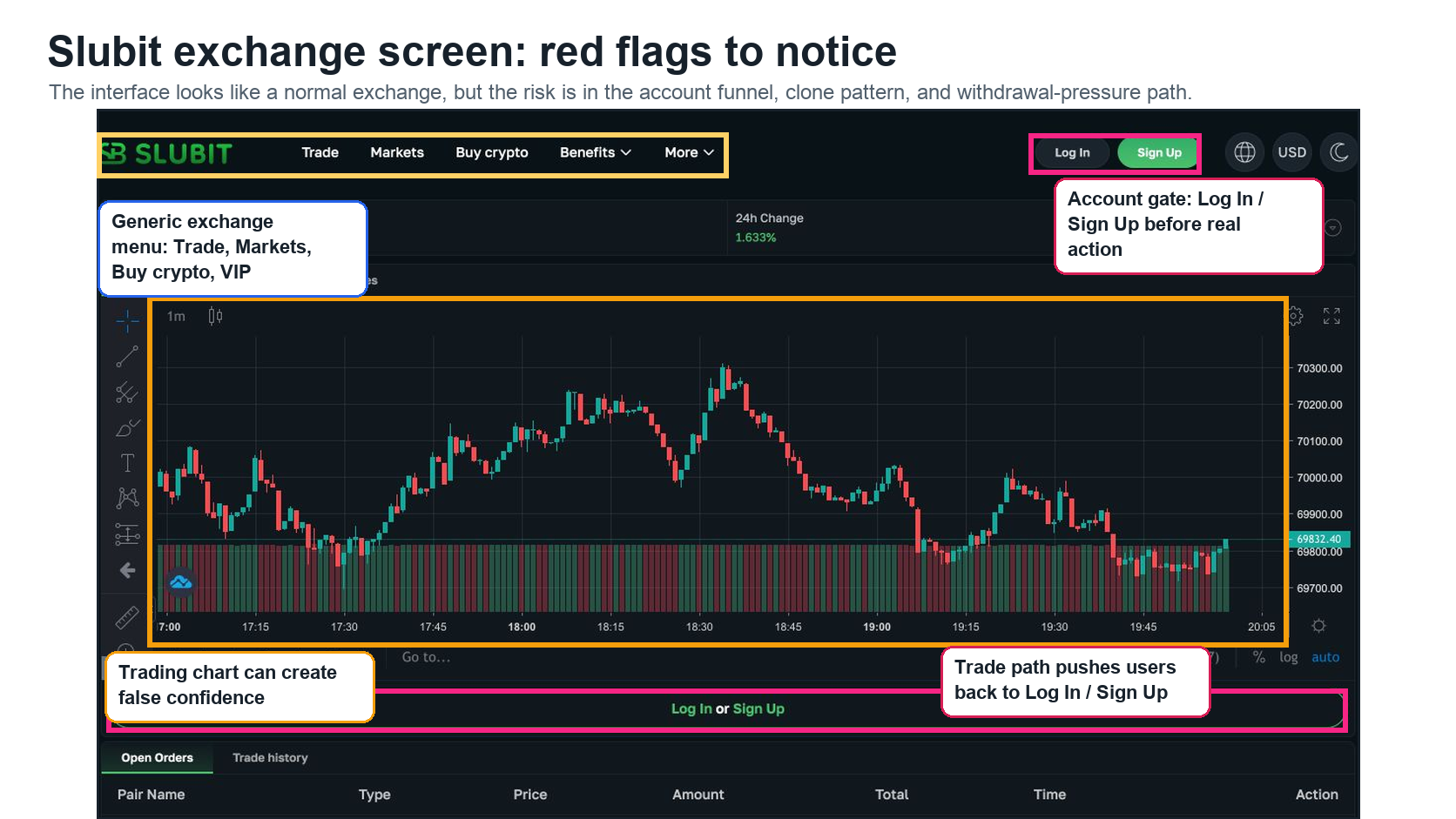
Slubit.com uses public pages that look like a normal crypto exchange: a trading chart, a market menu, a sign-up funnel, VIP and referral links, and large reserve or volume claims. Those visuals can make the site feel legitimate, but they do not prove that withdrawals, support, or custody are safe.
Why the Slubit.com Warning Matters
| Signal | Why it matters |
|---|---|
| Gridinsoft verdict: Cryptocurrency Scam | The site matches high-risk crypto-scam signals rather than ordinary exchange reputation. |
| 1/100 trust score | A very low score means the domain should not receive payment data, wallet access, or personal documents without independent proof. |
| Very young domain | New exchange domains are common in disposable fake-platform campaigns. |
| Blacklist and low-trust signals | Multiple warning sources reduce the value of a polished interface or friendly support chat. |
| Crypto exchange and account forms | The risk is higher because the site can ask for deposits, identity data, wallet access, or withdrawal fees. |
| Positive-looking review snippets | Reviews are useful context, but they do not override blacklist, domain-age, and withdrawal-risk signals. |
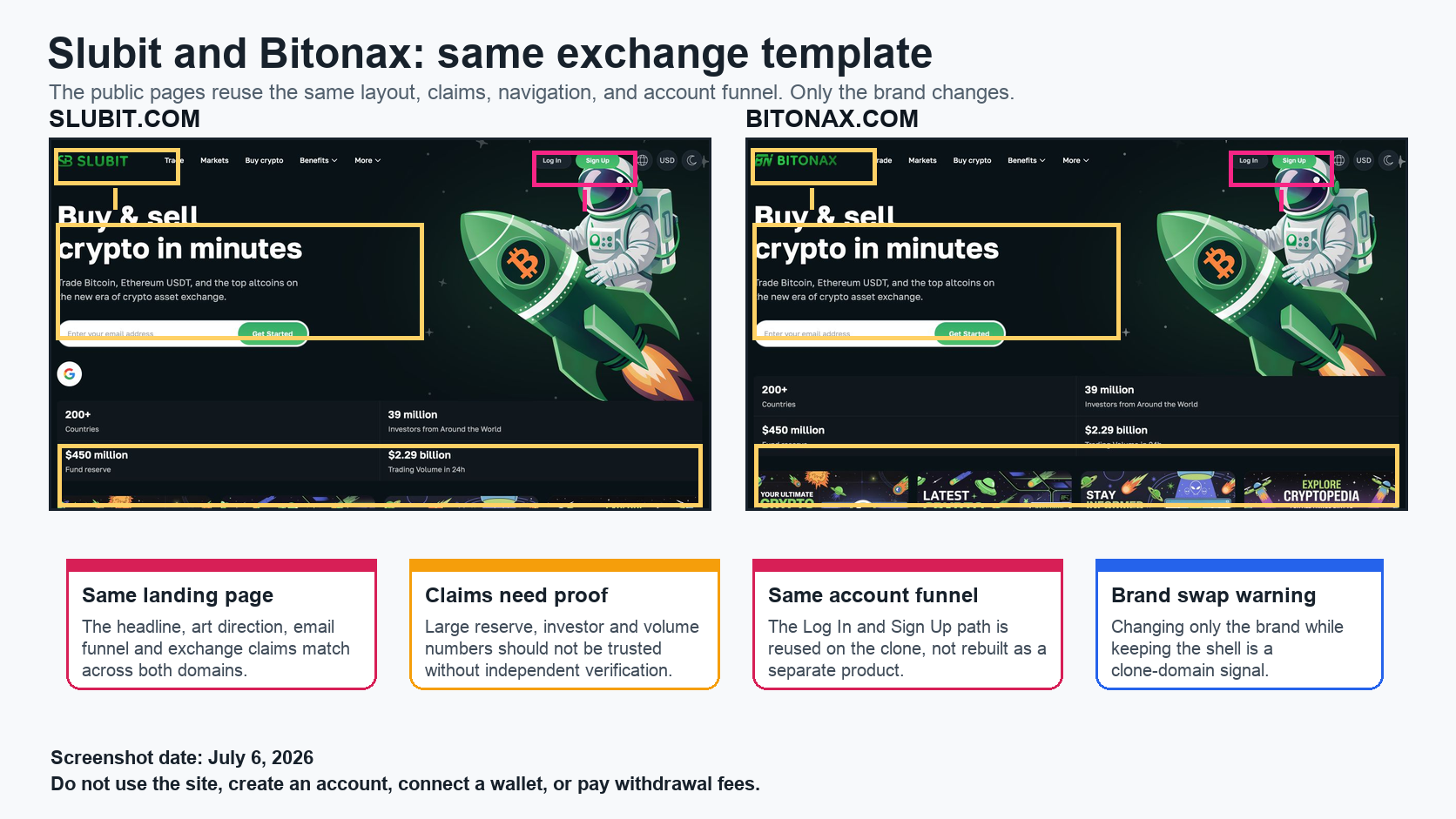
| Related clone: Bitonax.com | Bitonax.com follows the same Slubit-style fake-exchange risk pattern and has its own 1/100 Gridinsoft scam score; the domain was created on June 22, 2026, only about two weeks before this update. |
Bitonax.com Clone Warning
Bitonax.com is a Slubit-style clone domain, not a safer replacement exchange. It presents the same kind of cryptocurrency-exchange surface and should be handled with the same stop-deposit rule. Gridinsoft’s Bitonax report classifies Bitonax.com as a Cryptocurrency Scam with a 1/100 trust score.
The Bitonax domain was created on June 22, 2026. It was only about 10 days old when first flagged, and the live Gridinsoft report now shows it as 13 days old. That age matters because fake exchanges often rotate to fresh domains after warnings start appearing. If a support chat, Telegram account, video, or review tells you to move from Slubit.com to Bitonax.com, treat it as the same risk path: do not deposit, do not connect a wallet, and do not pay a withdrawal fee.
How a Slubit-Style Withdrawal Trap Works
Fake crypto platforms usually do not steal trust all at once. They show a familiar exchange interface, make a balance appear, then move the pressure to withdrawal. The fee name changes, but the decision is the same: if you must send more money to get your own balance back, stop.
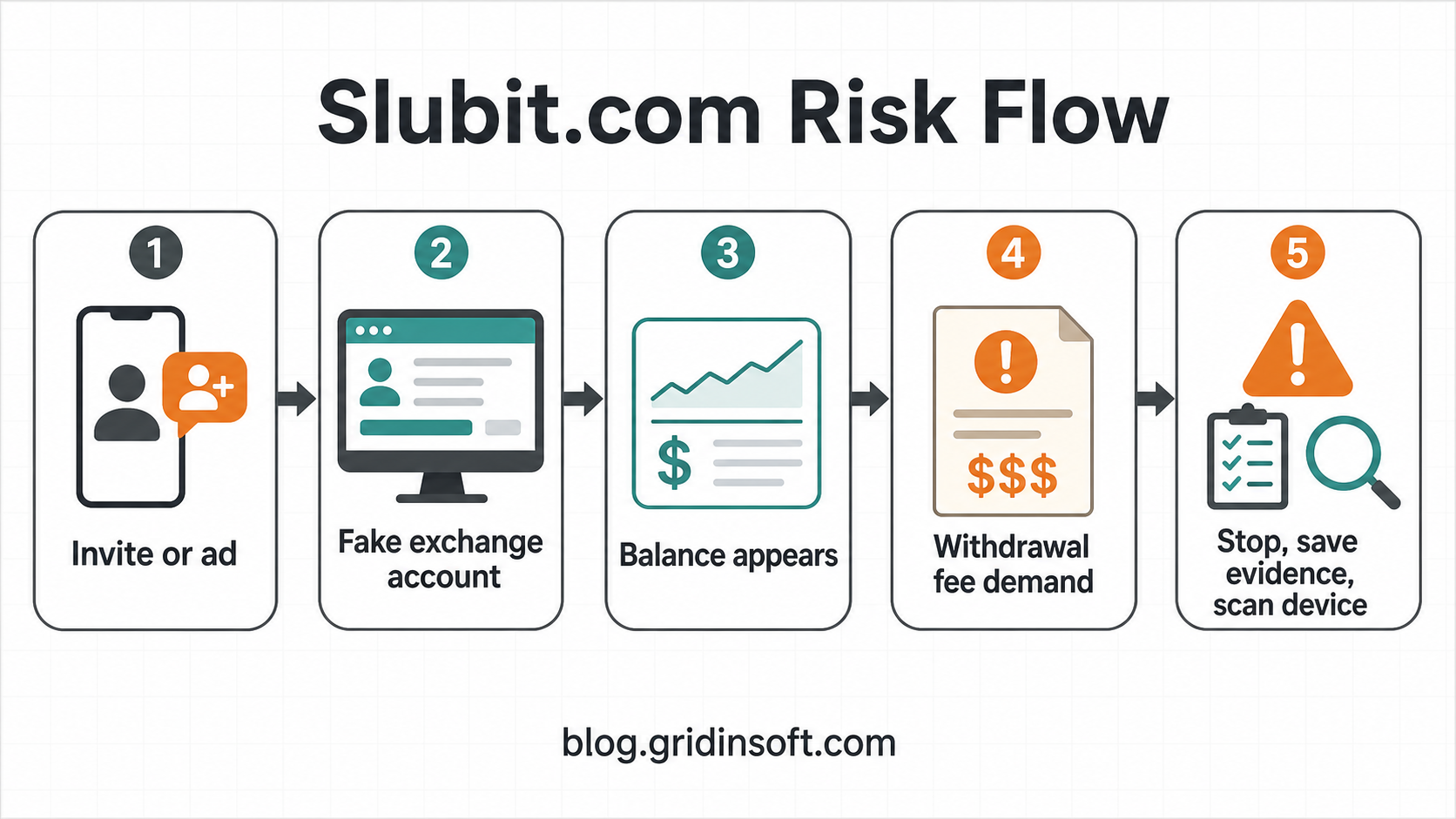
The FTC warns that crypto scammers often promise big payouts or guaranteed returns, and that testimonials or celebrity-style social proof can be faked [1]. The CFTC and SEC also warn that fraudulent digital-asset trading websites often use red flags such as claims of guaranteed returns or little to no risk [2]. Treat those warnings as practical context for any new trading site that asks for deposits before you can verify it independently.
What To Do If You Have a Slubit.com Account
- Stop depositing. Do not pay a new fee to unlock a withdrawal, verify a wallet, pay tax, restore credit score, pass KYC, or raise an account level.
- Preserve evidence. Save the Slubit URL, account ID, dashboard screenshots, chat logs, email headers, wallet addresses, transaction hashes, deposit receipts, support handles, and any recovery promises.
- Contact the exchange or payment service you used. Crypto transfers are usually irreversible, but fast reporting can help exchanges flag wallets or preserve records.
- Secure your email and exchange accounts. Change passwords from a trusted device, enable multi-factor authentication, review active sessions, and remove unknown API keys or withdrawal addresses.
- Move remaining wallet funds only from a clean device. If you typed a seed phrase or signed a suspicious approval, create a new wallet and move remaining assets carefully.
- Report the incident. US victims can report cyber-enabled fraud to IC3. Keep transaction hashes and wallet addresses ready because investigators need exact blockchain evidence [3].
- Ignore recovery agents who ask for upfront fees. Recovery scams often target people immediately after a crypto loss.
Should You Pay a Slubit Withdrawal Fee?
No. A request for more money to release a displayed balance is one of the strongest fake-exchange warning signs. Scammers may call it tax, gas, verification, AML review, liquidity, insurance, VIP upgrade, KYC correction, or account unlock. The label can sound official, but the outcome is usually another payment demand.
If a real regulated exchange needs identity verification, it does not normally require you to send crypto to an unrelated wallet to prove ownership or unlock profits. Verify any claim through official, independently found support channels and regulatory records, not through the chat window or email address Slubit gives you.
If You Connected a Wallet or Entered a Seed Phrase
- If you only opened the site: close it and do not interact with prompts.
- If you connected a wallet but signed nothing: disconnect the site in your wallet settings and watch for suspicious prompts.
- If you signed an approval: review and revoke risky allowances where possible, then move valuable assets to a new wallet if exposure is unclear.
- If you typed a seed phrase or private key: treat that wallet as compromised. Move remaining funds from a clean device to a new wallet, then retire the old one.
- If support asked for remote access: disconnect the session, uninstall the tool, and change passwords from another device.
If You Downloaded a Slubit App, Extension, or Support Tool
The website itself is a scam-risk decision, but malware risk rises if the lure made you download a desktop app, wallet installer, browser extension, phone-management tool, remote-support app, archive, or “security verification” file. In that case, do not log back into exchange or wallet accounts from the same device until you check it.
Gridinsoft Anti-Malware makes this cleanup easier because it can check the parts a manual uninstall often misses: suspicious installers, browser extensions, startup entries, scheduled tasks, bundled apps, and persistence. Run a full scan, remove detections, reboot, and scan again if pop-ups, redirects, blocked connections, or unknown startup items return. The scan cannot recover stolen cryptocurrency or prove no exposure ever happened, but it can help clean the local infection path before you use financial accounts again.
If the page or email made you download an invoice, coupon, tracking app, browser extension, or support tool, scan the PC before opening it again or logging into sensitive accounts.
Scan after a Slubit downloadHow To Check a Crypto Platform Before Depositing
- Search the exact domain plus scam, review, withdrawal, and complaint. Do this before signing up and again before any large deposit.
- Check the domain age and company identity. A new domain claiming exchange-level trust needs strong, independent proof.
- Verify regulatory claims through the regulator’s own website. Badges and certificate images on the platform are not enough.
- Scan the URL. Use the Gridinsoft safety report for Slubit.com or the Gridinsoft Website Reputation Checker before entering payment or wallet data.
- Never test withdrawals with money you cannot lose. A small successful withdrawal does not prove a platform will release a larger balance later.
- Ask someone outside the chat. Scammers isolate victims because a second opinion often breaks the pressure loop.
For broader patterns, compare this case with our crypto scams guide, our crypto recovery scam warning, and the fake crypto casino withdrawal-trap guide.
FAQ
Is Slubit.com safe?
No. Treat Slubit.com as unsafe unless strong independent evidence proves otherwise. Gridinsoft classifies it as a Cryptocurrency Scam and gives it a 1/100 trust score.
Can positive Slubit.com reviews prove it is legitimate?
No. Reviews can help you notice patterns, but they do not override domain age, blacklist warnings, blocked-withdrawal behavior, suspicious wallet prompts, or a very low safety score.
Is Bitonax.com a Slubit clone?
Bitonax.com should be treated as a related clone and fake-exchange risk. Gridinsoft classifies Bitonax.com as a Cryptocurrency Scam with a 1/100 trust score, and the domain was created on June 22, 2026. Do not move funds from Slubit.com to Bitonax.com or pay Bitonax withdrawal, tax, verification, or unlock fees.
Should I pay Slubit.com to unlock my withdrawal?
No. Extra tax, gas, verification, AML, VIP, liquidity, or unlock payments are common fake-exchange pressure tactics. Save evidence and stop sending money.
Can I recover crypto sent to Slubit.com?
Crypto recovery is uncertain and often impossible without exchange or law-enforcement help. Report quickly, preserve transaction hashes and wallet addresses, and avoid anyone who guarantees recovery for an upfront fee.
Do I need to scan my computer?
Scan if you downloaded a Slubit app, wallet file, browser extension, remote-support tool, or archive, or if you allowed notifications or see pop-ups and redirects after visiting the site.
What evidence should I save?
Save the Slubit URL, account screenshots, chat logs, emails, transaction hashes, wallet addresses, deposit receipts, support handles, review links, and any messages asking for withdrawal fees or recovery payments.
References
- Federal Trade Commission. “What To Know About Cryptocurrency and Scams.” FTC Consumer Advice, accessed July 5, 2026. https://consumer.ftc.gov/articles/what-know-about-cryptocurrency-scams
- Commodity Futures Trading Commission and U.S. Securities and Exchange Commission. “Watch Out for Fraudulent Digital Asset and Crypto Trading Websites.” CFTC, accessed July 6, 2026. https://www.cftc.gov/LearnAndProtect/AdvisoriesAndArticles/watch_out_for_digital_fraud.html
- Federal Bureau of Investigation. “Internet Crime Complaint Center (IC3).” FBI, accessed July 5, 2026. https://www.ic3.gov/