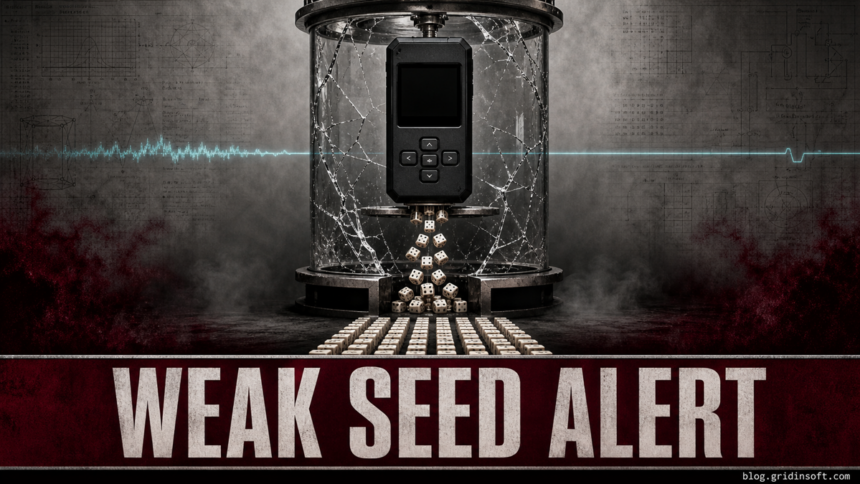
Coinkite has fixed a Coldcard seed-generation flaw across Mk3, Mk4, Mk5, and Q release tracks, but installing the new firmware does not repair a seed that was already created on an affected version. Coldcard owners should first identify the model, firmware track, and how the seed was generated. If the affected seed did not include at least 50 private dice rolls, a careful move to a newly generated wallet is the durable fix.
Coinkite expanded its advisory on August 1, 2026 after initially warning Mk3 owners. The company now says pre-fix Mk4, Mk5, and Q seeds had about 72 bits of entropy instead of the expected 128 bits. Its investigation remains open. The official advisory says funds controlled by affected seeds are at risk; it does not validate a public victim count or theft total.
Which Coldcard versions are affected?
| Model and track | Affected seed and fixed release |
|---|---|
| Mk3 standard | Seeds generated on 4.0.1 through 4.1.9 are affected. Install 4.2.0 or later before generating a replacement. |
| Mk4 or Mk5 standard | Seeds generated before 5.6.0 are affected. Use 5.6.0 or later. |
| Mk4 or Mk5 Edge | Seeds generated before 6.6.0X are affected. Use 6.6.0X or later. |
| Q standard | Seeds generated before 1.5.0Q are affected. Use 1.5.0Q or later. |
| Q Edge | Seeds generated before 6.6.0QX are affected. Use 6.6.0QX or later. |
Standard and Edge are separate release tracks. An older Edge 6.x number is not automatically fixed just because it looks higher than a standard 5.x release. Check the complete suffix shown on the device and use the official download for that exact model and track.
TAPSIGNER, OPENDIME, and SATSCARD are not affected because they use different codebases. A seed imported into Coldcard from another source was not generated by this flaw, although the security of that seed still depends on the original generator.
Do you need to move the funds?
| Your setup | Decision |
|---|---|
| At least 50 fair, independent, private dice rolls were added before the final seed words appeared | Coinkite does not consider that seed at risk from this RNG issue alone. Be certain about the roll count and that the rolls were never recorded or exposed. |
| A strong, unique BIP-39 passphrase protects the wallet | The passphrase adds an independent barrier, but it does not repair the weak seed. Migrate as soon as practical, especially if the passphrase is short, patterned, quoted, or reused. |
| Only the Coldcard PIN was used | The PIN is not a BIP-39 passphrase and does not provide the same barrier. Follow the migration guidance. |
| The seed was generated on affected firmware and no dice were added | Update first, then create a new seed and move the balance. |
| You do not remember the version, roll count, or setup method | Treat the seed as affected and migrate carefully instead of trying to test it online. |
On the affected implementation, 50 to 98 private dice rolls contributed at least 128 bits of independent entropy, while 99 or more contributed approximately 256 bits. Fewer than 50 rolls—or an uncertain memory—does not meet Coinkite’s exception. The dice sequence is secret key material: never photograph it, save it in a cloud document, post it for review, or enter it into a networked calculator.
Why the firmware update does not repair the old seed
The update corrects how a new seed is created. It cannot change the private keys and addresses derived from the seed already controlling the wallet. That is why the response has two separate parts: install a fixed release before generating anything new, then transfer funds to addresses derived from a new seed.
This is also why “it is a cold wallet” is not enough to dismiss the warning. Cold storage limits remote access to keys, but the keys still depend on the quality of the original seed generation. The broader hot-wallet versus cold-wallet security guide covers the separate risks from phishing, blind signing, address replacement, and stolen backups.
How to migrate an affected Coldcard wallet safely
- Confirm the model, track, and current version. Do this on the device. Do not type the seed words into a website, “checker,” support chat, or firmware page.
- Install the fixed release from the official Coldcard download page. Verify the complete version after restart. Do not generate the replacement seed before the correct fixed release is installed.
- Verify the old backup before erasing anything. Record the wallet fingerprint and confirm that the written backup belongs to the funded wallet. Keep the old backup until every transfer is confirmed.
- Create a new seed on fixed firmware. A second fixed device makes the process simpler. If the affected Coldcard is the only device, follow Coinkite’s one-device sequence and carefully alternate between verified old and new backups.
- Record and test the new wallet offline. Verify its backup and fingerprint, then display a receive address on the hardware wallet itself.
- Send a small test transaction. Compare the full destination on the device screen and after broadcast. The wallet-address verification checklist explains why matching only the first and last characters is unsafe.
- Move the remaining balance only after the test arrives. Confirm the destination and balance before retiring the old seed.
- Ignore urgent helpers and recovery guarantees. Coinkite will not need the seed phrase to update firmware. Anyone asking for it or sending a “safe wallet” address may be exploiting the incident for phishing.
Do not confuse this seed-generation issue with the physical laser attack against Tangem cards. The Tangem research requires possession of a card and specialized equipment; the Coldcard warning concerns the entropy of keys generated by affected firmware. Both can require a new wallet in specific cases, but the exposure decision is different.
References
- Coinkite. “Coldcard Security Advisory.” Coinkite Blog, published July 30, 2026, updated August 1, 2026, accessed August 1, 2026. official security advisory.
- Coldcard. “Firmware Downloads.” Coinkite, accessed August 1, 2026. official fixed releases.