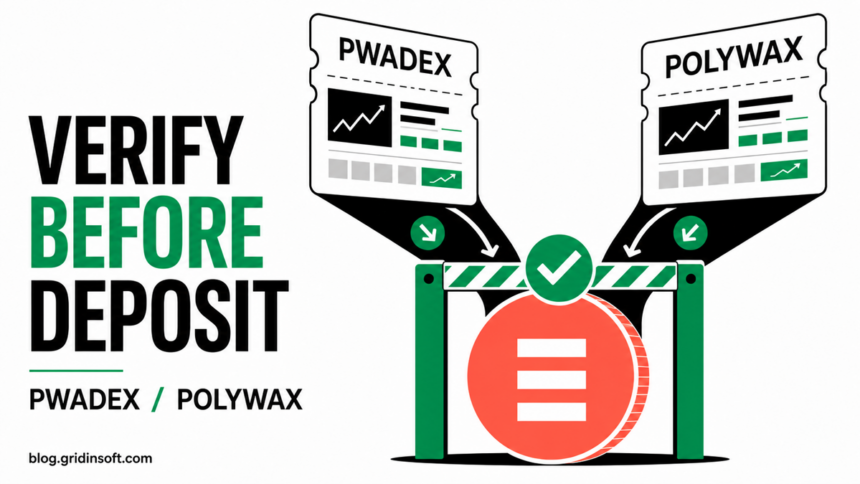
Pwadex.com and Polywax.net should not receive a deposit, wallet approval, password, or identity document until the platform operator and the exact domain are verified independently. Current Gridinsoft checks give Pwadex a 1/100 trust score and classify it as a Scam Website; Polywax has an 11/100 score and is classified as a Suspicious Website. The two public sites also expose the same application labels, versioned web assets, and “Verification Deposit” policy wording. That supports a shared-template warning, but it does not by itself prove common ownership or prove that every displayed market is fabricated.
If either site says you must deposit more money to withdraw an existing balance, stop. Do not send a small test payment, “tax,” “gas fee,” compliance charge, insurance payment, or refundable verification deposit. Save the demand and transaction details before blocking the contact.
What the current Pwadex and Polywax checks show
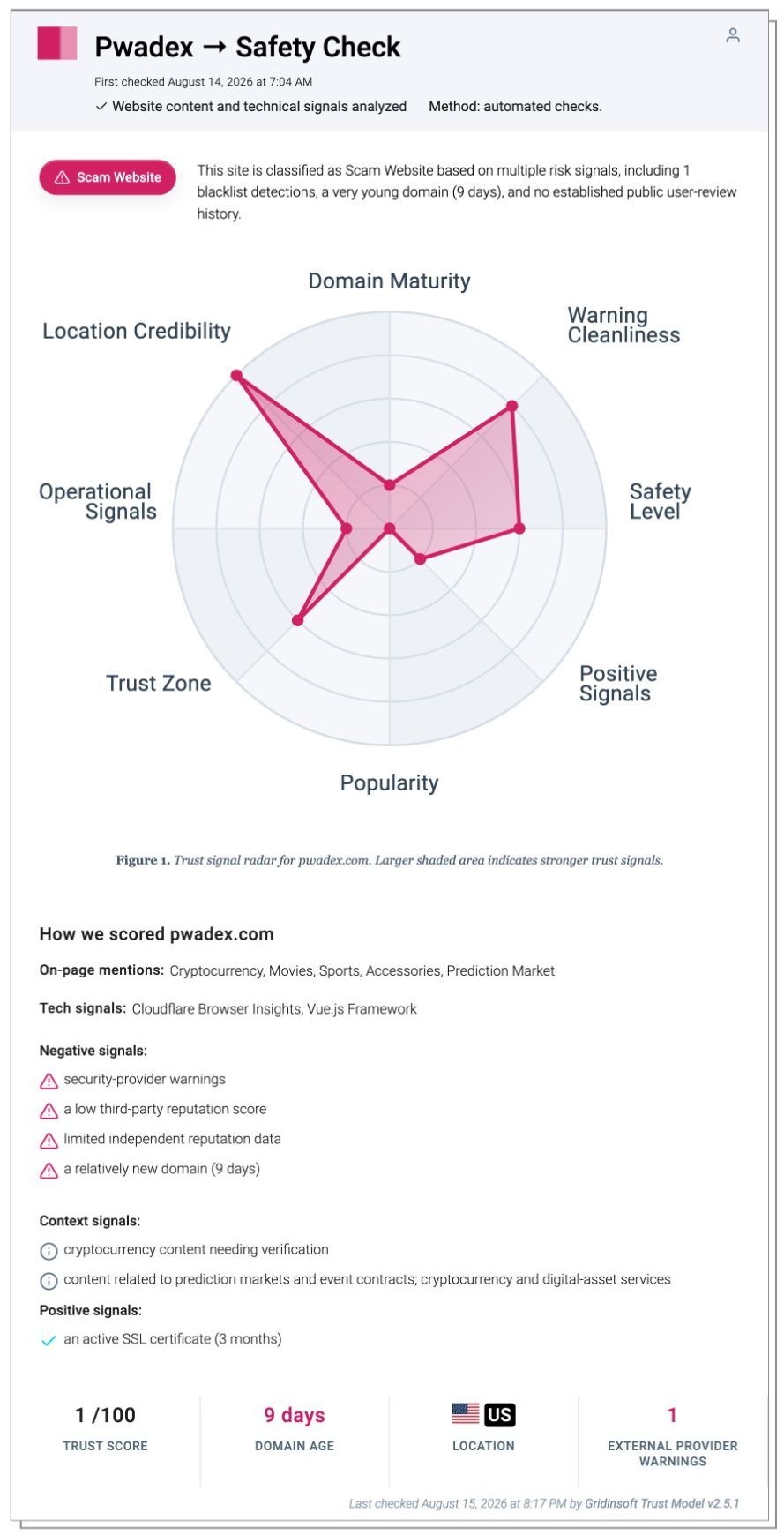
The Pwadex.com safety report, checked August 15, 2026, records a nine-day-old domain, one external provider warning, limited independent reputation history, and a 1/100 trust score. The report labels the domain a Scam Website. A young domain or automated score alone is not proof of fraud, but the combination is not a reasonable basis for trusting a financial site with money or identity data.
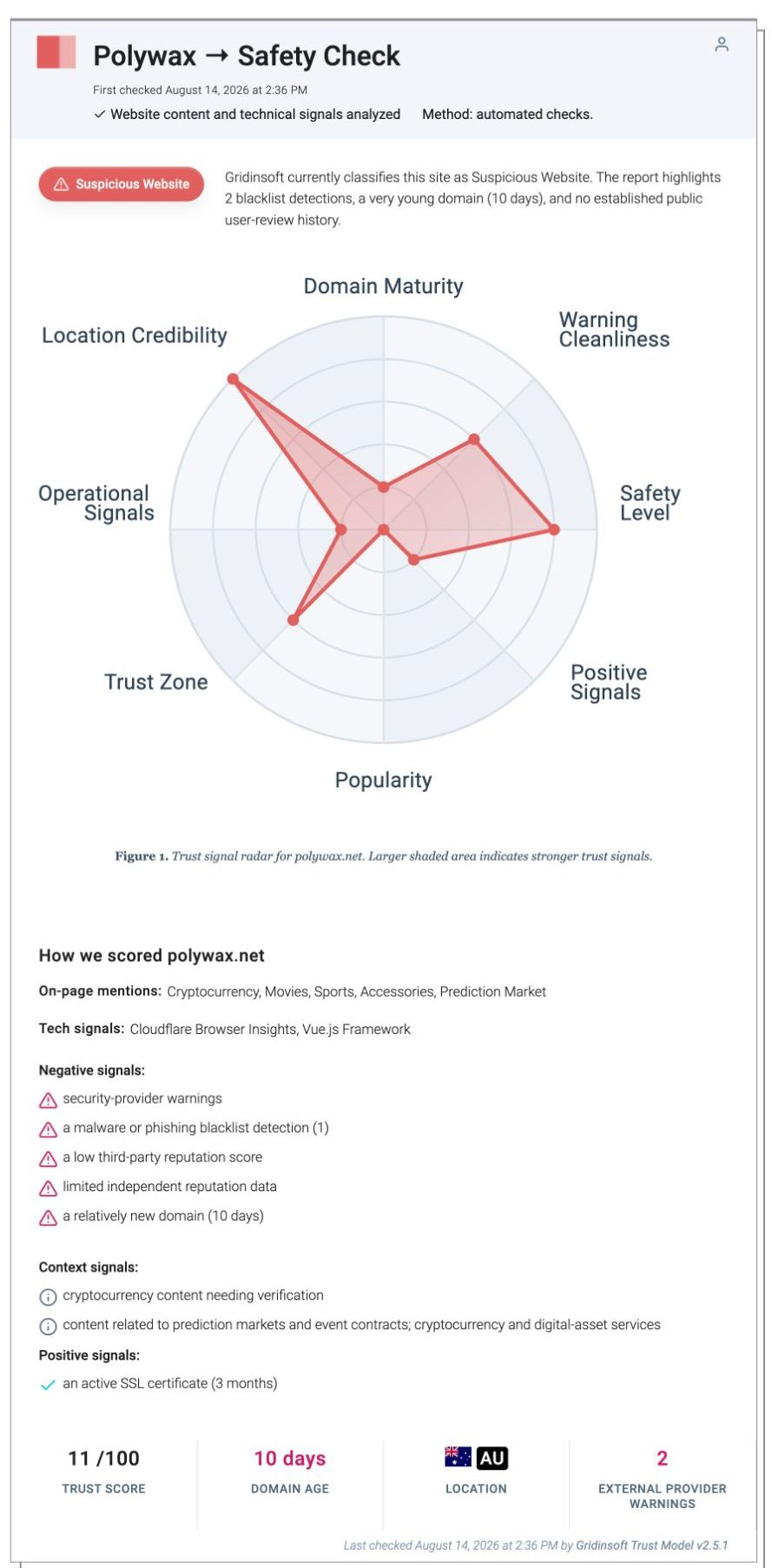
The Polywax.net safety report, checked August 14, 2026, gives the domain an 11/100 trust score and classifies it as a Suspicious Website. Its report also places the domain in the danger zone and shows weak maturity and operational signals. These are point-in-time risk assessments. They should trigger verification and caution, not exaggerated claims about transactions that have not been independently observed.
Why the matching public template matters
During an August 17 review, both sites served the same “Forecast Exchange” label, the same AtlasCorpPoly application or session identifier, and matching versioned JavaScript and CSS bundle names. Their public pages exposed the same deposit components and substantially matching AML wording, including a section called “Verification Deposit.”
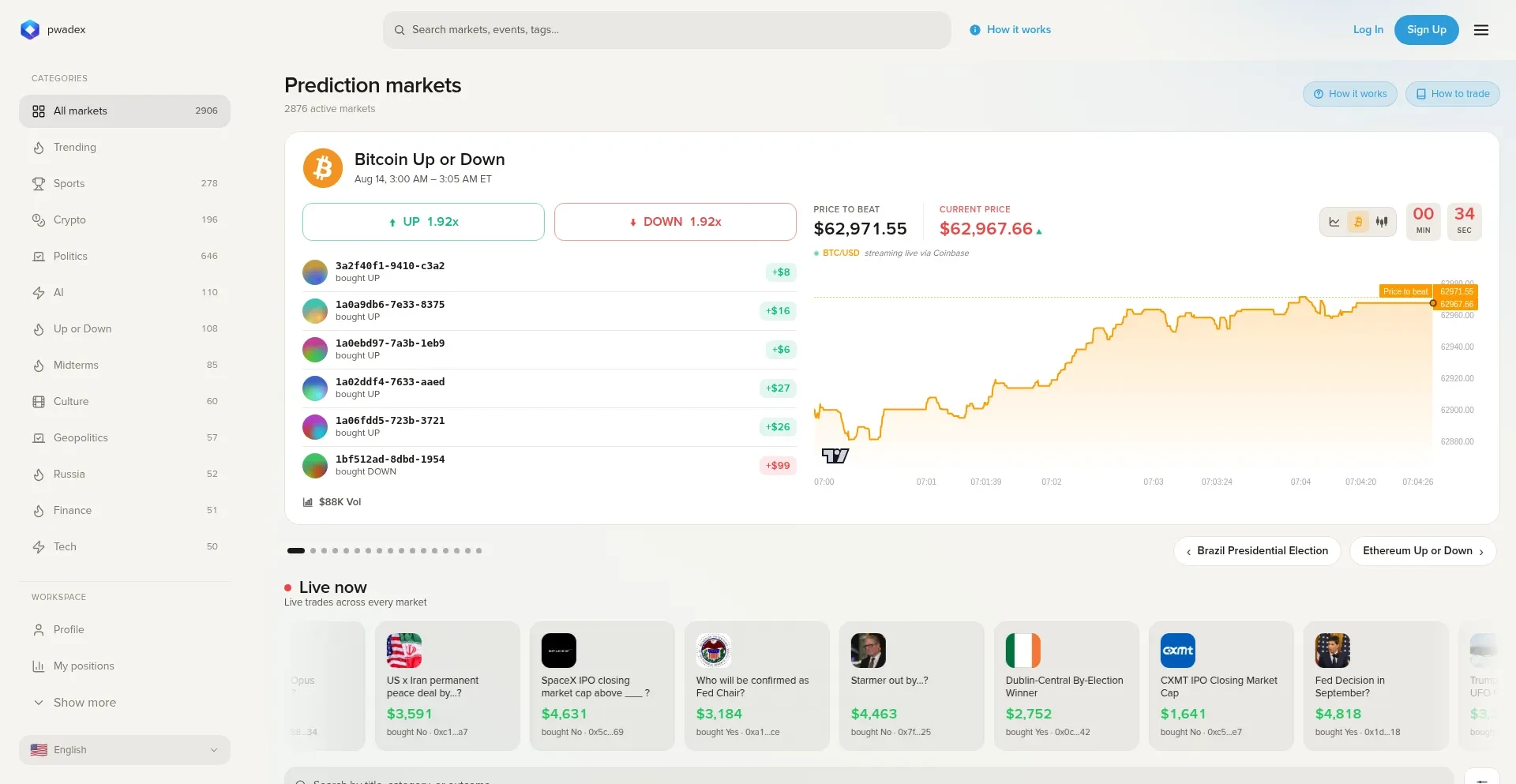
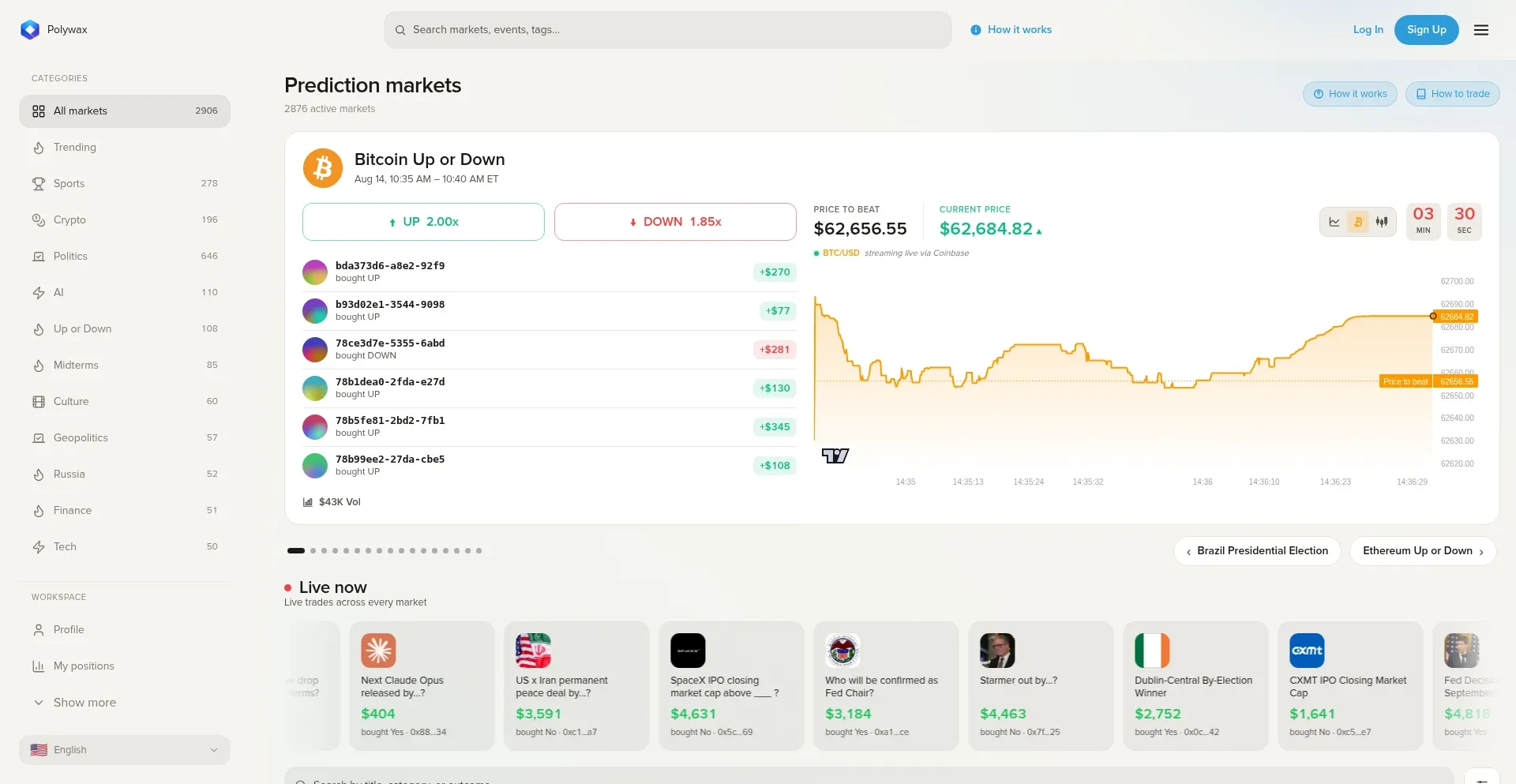
Those details are stronger than a similar color scheme. They show that the public sites use the same application build or template. They do not identify the people behind the domains. A template can be licensed, copied, resold, or deployed by unrelated operators, so it would be irresponsible to turn a code match into a claim of shared beneficial ownership.
This is a different cluster from the Polyglow prediction-market investigation, where several domains repeated the same claimed legal identity. Both cases teach the same verification lesson: polished interfaces and long policy pages are operator-controlled statements, not independent proof of custody, registration, settlement, or withdrawals.
What to verify before any deposit
A prediction-market dashboard can display prices, open markets, account balances, countdowns, and recent trades without proving that customer orders reach a real market. Before paying, use the same independent checks you would apply to any online trading platform.
| Check | What must be verified independently |
|---|---|
| Legal operator | A real company in an official registry, with an address and contacts that match across the site, regulator record, and account agreement. |
| Registration | The relevant regulator’s own database names the operator and, when applicable, the exact website. A badge, certificate image, or number on the platform is not enough. |
| Contract rules | Who resolves each event, which source controls settlement, what happens after cancellation or dispute, and when a position pays out. |
| Fees | Trading, withdrawal, network, inactivity, and dispute costs are disclosed before funding, not invented after a balance appears. |
| Custody | Whether the platform, a regulated intermediary, or a smart contract controls funds, plus the exact withdrawal process. |
| Wallet action | The domain, contract address, network, token, allowance, recipient, and amount in the wallet prompt match the action the user intended. |
| Official app/domain | Any app or extension is linked from a verified operator or regulator record, not an ad, direct message, support chat, or lookalike domain. |
For U.S. customers, the CFTC says to use registered entities, verify that websites and apps belong to them, and expect transparent information about fees, contract terms, settlement, and access to funds. A platform outside the United States may fall under a different regulator, but the verification principle is unchanged: search the regulator’s own record, not a seal supplied by the platform.
Why a “verification deposit” is a stop signal
Identity verification and an extra payment are different things. A legitimate provider may request identity or source-of-funds documents through a verified compliance process. Requiring new money to release an existing balance turns the withdrawal itself into an advance-fee demand.
A recent public question about Polywax described a $150 deposit requirement before withdrawal. That report is useful user-problem evidence, not proof about every account. The safe decision does not require testing the claim with more money. A displayed balance can be edited by the site, while a crypto transfer leaves the sender’s control when it is confirmed.
This is the same decision error used in fake inheritance and account-balance schemes: the victim is asked to pay a smaller amount to unlock a much larger amount. The 7 Million USDT scam shows why the on-screen balance should never be treated as recoverable money until a withdrawal reaches an account the user controls.
What to do after using Pwadex or Polywax
Match the response to the action that actually occurred. Preserve the domain, page captures, support messages, account identifier, wallet address, transaction hash, amount, time, and any withdrawal demand before deleting messages or clearing browser data.
| What happened | Risk and next action |
|---|---|
| You only visited | Close the page and do not return through an ad or message. A visit alone does not prove device infection. Remove notification permission only if it was granted. |
| You registered | Do not fund the account. If the password was reused, change it first on the real email account and every other service that used it. |
| You uploaded ID | Save what was submitted and when. Watch for targeted identity or account-recovery messages and follow the issuing authority’s identity-theft guidance where appropriate. |
| You connected a wallet but signed nothing | Disconnect the site in the wallet’s connected-app settings. Review the activity, but do not assume that a connection alone authorized token movement. |
| You signed a token approval or transaction | Inspect the exact contract and allowance using the wallet’s official tools or a trusted blockchain explorer. Revoke unnecessary approvals. A signed transaction may require a different response from a simple connection. |
| You exposed a seed phrase or private key | Treat the wallet as compromised. Create a new wallet on a clean device and move remaining assets carefully. Disconnecting a site cannot make an exposed secret safe again. |
| You sent crypto | Contact the sending exchange or service immediately, report the transfer as fraudulent, and provide the transaction hash. Do not pay a recovery service that promises guaranteed retrieval. |
| You downloaded or ran something | Remove the file, app, profile, or extension; review startup and browser changes; then run a full security scan before changing sensitive passwords on that device. |
If you reused a password or uploaded ID
Start with the email account because it can reset other services. From a known-clean device, set a unique password, sign out other sessions, enable MFA, and review forwarding rules and recovery addresses. Then follow the account recovery checklist for every reused credential. For ID exposure, document the submission and be skeptical of follow-up calls or messages that already know your name and the platform.
If you connected or approved a wallet
A connection, signature, token approval, and transfer are not interchangeable. Read the wallet activity before acting. The crypto-drainer response guide explains why disconnecting a site does not revoke an on-chain allowance and why exposing a seed phrase requires a new wallet rather than a settings change.
If you sent money
Crypto transfers are typically not reversible, but prompt reporting still matters. Contact the exchange or payment service used to send the assets and ask whether it can flag or stop the transaction. Save evidence and report the incident through the appropriate fraud or law-enforcement channel. The FTC also advises contacting the payment company and warns that only the recipient can normally return a completed cryptocurrency payment.
Do not let a second contact turn the loss into a recovery scam. Anyone asking for an upfront retainer, tax, wallet “synchronization,” or another crypto payment to recover funds is creating another advance-fee demand. The broader scam response guide covers evidence preservation and account triage.
If you downloaded software or an extension
A financial dispute cannot be solved by malware scanning. A scan becomes relevant only if the site or a contact led you to install an app, browser extension, configuration profile, remote-support tool, archive, or executable. Remove the visible item, then use Gridinsoft Anti-Malware to check for bundled applications, browser changes, startup entries, scheduled tasks, and other persistence. Change sensitive passwords only after the device is trustworthy.
FAQ
Are Pwadex.com and Polywax.net definitely operated by the same people?
No. Their public pages expose matching application labels, bundles, deposit components, and policy wording, which supports a shared-template finding. Those facts do not identify the operators or prove common beneficial ownership.
Does the 1/100 or 11/100 score prove every market is fake?
No. The scores are current risk assessments based on domain maturity, reputation, warnings, and technical signals. They justify stopping before payment and demanding independent verification; they are not transaction-level proof.
Should I pay a verification deposit to withdraw?
No. Do not add money merely to release an existing balance. Save the demand, contact the sending exchange if you already paid, and do not test the withdrawal with another transfer.
Can Gridinsoft Anti-Malware recover sent cryptocurrency?
No. It can check a device after a suspicious download or installation. It cannot reverse a blockchain transfer, revoke a wallet approval by itself, restore a seed phrase, or prove that a platform is regulated.
References
- U.S. Commodity Futures Trading Commission. “Understanding Prediction Markets and Event Contracts.” CFTC Learn & Protect, accessed August 17, 2026. cftc.gov/LearnandProtect/PredictionMarkets.
- U.S. Federal Trade Commission. “What To Do if You Were Scammed.” FTC Consumer Advice, July 2022, accessed August 17, 2026. consumer.ftc.gov/articles/what-do-if-you-were-scammed.