A T-Mobile text that gives you thousands of points and a deadline can look like an account update. New research published on September 17 identifies a phishing campaign monitored since May: more than 1,000 related message templates and at least 81 domains over four months. The promise changes shape; the pressure to redeem remains. [1]
A balance is not proof of an account
The revealing mismatch is between a precise number and an unverified sender. A balance can be typed into a message as easily as a greeting. Before treating it as money you might lose, ask where you can independently see that same balance.
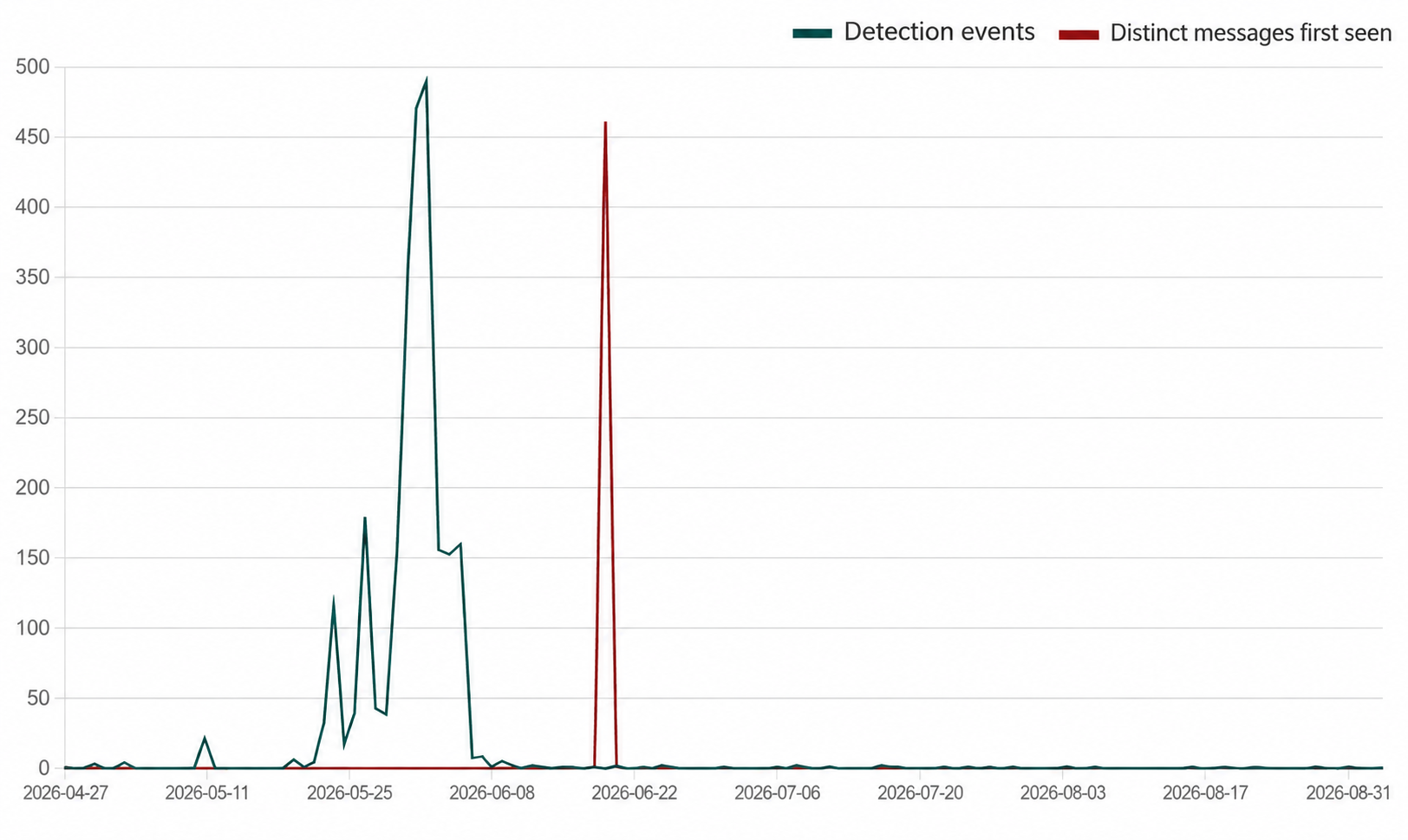
The graph measures detections, not people who lost money. A campaign can produce many message variations without demonstrating the same number of victims. That distinction matters when deciding whether a warning describes an observed lure or a confirmed loss.
Read the address past the brand name
Consider the deliberately nonworking example t-mobile.reward-check.example/pay. Its recognizable opening does not make it part of t-mobile.com: the brand appears in a subdomain controlled by whoever controls reward-check.example. The path /pay adds no authentication.
This is the trust decision behind the trap. The SMS supplies both the claim and the place where you are supposed to verify it. Following that route lets the same sender control both sides of the conversation. Changing the route—opening an app you already use—breaks that dependency.
Real rewards exist; verify them independently
Do not rely on the blanket claim that T-Mobile has no rewards. Its US Visa card has a real program. T-Mobile’s FAQ says those rewards remain valid while the card account is open, although closing it can forfeit unused rewards. Cardholders can check their balance through T-Life or their Capital One account. [2]
The FTC’s advice for expiring-points texts is to find the company’s website or app yourself and check there. T-Mobile and Metro customers in the US can forward suspicious SMS to 7726. [3] [4]
The same distinction matters for fake bpost customs-fee messages: real import charges exist, but the newly documented imitation asks for an IBAN alongside card details.
If you already supplied information, use the relevant branch in our spam-text response guide: opening a page, disclosing a password and entering card details call for different responses. An optional Gridinsoft domain reputation check can add context, but cannot authenticate a rewards balance.
The useful check is not whether the message looks professional. It is whether the claimed reward still exists when you leave the sender’s link behind.
A separate investigation, Operation WallHack in Ukraine, shows the coordination layer behind fake websites: messaging communities used to distribute phishing links and find partners. It is not evidence linking those communities to this T-Mobile campaign.
References
- Pieter Arntz. T-Mobile rewards phishing campaign analysis. Malwarebytes Labs, September 17, 2026. Research report.
- T-Mobile. Visa credit card FAQs: rewards and expiration. Accessed September 17, 2026. Official FAQ.
- Federal Trade Commission. Expiring reward points text warning. April 2026; accessed September 17, 2026. Consumer alert.
- T-Mobile. Online safety resources: reporting suspicious messages. Accessed September 17, 2026. Reporting guidance.