Polyglow.cc should not receive money, wallet approvals, account credentials, or identity documents until its operator and claimed authorization can be verified independently. The current evidence warrants serious caution: the domain is extremely young, several security providers warn about it, and multiple prediction-market sites repeat the same operator details and legal wording. That pattern is not proof that every displayed trade is fake or that a theft has already occurred, but it is enough to stop before connecting a wallet or sending funds.
This guide separates what can be verified from what remains an operator claim, then gives the right response for each exposure: registration, KYC upload, wallet connection, signed approval, crypto transfer, or downloaded software.
Why Polyglow.cc is risky to trust
The current Gridinsoft Website Reputation Checker report for Polyglow.cc assigns a 2/100 trust score, records a domain age of 15 days, and shows four provider warnings. Its classification is “Unsettled Website,” not a definitive criminal judgment. The practical meaning is that Polyglow.cc has not built the history, independent reputation, and transparent verification expected before a financial platform handles money, wallets, or identity data.
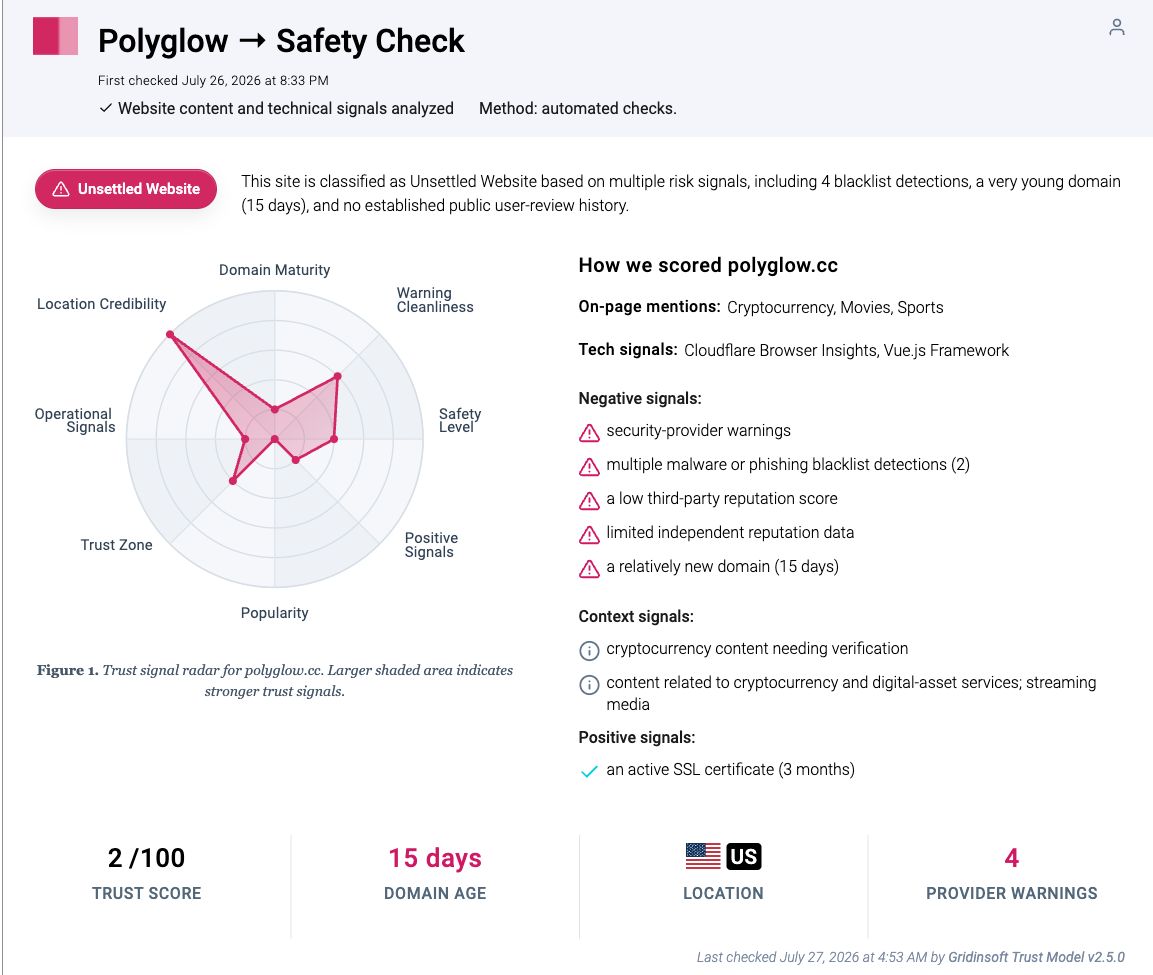
A young domain alone does not prove fraud. An SSL certificate also does not prove legitimacy; it only encrypts the connection. The concern comes from the combination of youth, warnings, financial and identity-data requests, difficult-to-check operator claims, and a broader group of sites using substantially the same identity and policy template.
The Forecast Harbor identity appears across multiple sites
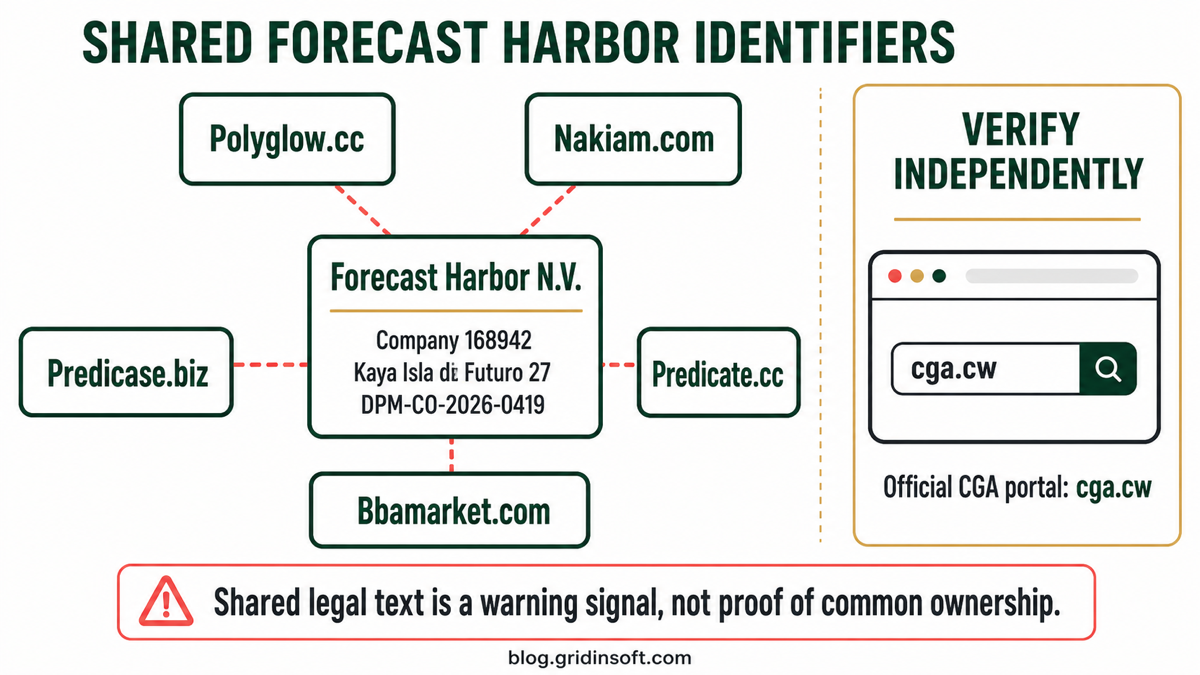
Polyglow.cc’s public terms claim that the service is operated by “Forecast Harbor N.V.” under company number 168942, at Kaya Isla di Futuro 27 in Willemstad, Curaçao. They also display certificate number DPM-CO-2026-0419 and a pending application number. During our July 27 review, public pages on Nakiam.com, Predicase.biz, Predicate.cc, and Bbamarket.com repeated the same operator name, company number, address, certificate number, and closely matching legal language.
That repetition is a warning signal because apparently separate platforms are presenting nearly interchangeable legal identities. It supports treating them as a related template or operator-claim cluster. It does not, by itself, establish shared beneficial ownership, prove that the same people control every domain, or show that every market and transaction is fabricated.
The exact Google results for “Forecast Harbor N.V.” also surfaced additional prediction-market domains using the same name. That makes independent verification more important, not less. A long terms page can be copied quickly; a verifiable company, regulator record, authorized domain, transparent custody model, and independently inspectable activity are much harder to fake.
How to verify the claimed license
The official online-gaming regulator in Curaçao is the Curaçao Gaming Authority (CGA). Its portal explains that online-gaming and supplier licenses are issued and supervised under the current legal framework, and that applications go through the official portal.[1] A platform’s own certificate wording is not enough.
- Open
cga.cwyourself. Do not use a regulator link supplied in a chat message, withdrawal screen, or support email. - Use the official license register and certificate service on the
cga.cworcert.cga.cwdomains. - Search the exact legal operator name and confirm the license status, not merely an application.
- Check that the authorized-domain record includes the exact domain
polyglow.cc. - Confirm that any seal on the site links directly to a certificate hosted by
cert.cga.cw. A screenshot, image, number, or similarly named “registry” is not equivalent. - Compare the company number and address with an official corporate record where available.
The CGA has publicly warned that fake gambling sites can copy seals and licensing details. Its guidance says a genuine authorization link should lead to an official certificate on cert.cga.cw and recommends checking the official register.[2] In our July 27 search of official CGA domains, we did not find a result for Forecast Harbor or Polyglow. A search miss is not conclusive proof that no license exists, but it means the platform’s claim was not independently confirmed during this review.
Do not “verify” an account by sending more money. A legitimate compliance review may request identity or source-of-funds documents through a verified process. A demand to top up the account, pay tax to unlock funds, buy a higher account tier, or send a “refundable verification deposit” before withdrawal matches a common advance-fee pattern.
The verification-deposit warning
One related site, Predicase.biz, states in its public AML policy that it may require an account top-up called a “verification deposit” before allowing withdrawals, settlement claims, promotional balances, market access, or dispute resolution. This clause belongs to Predicase, so it does not prove that Polyglow has already made the same demand to a specific victim.
It does show why the shared legal-template cluster matters. If any Polyglow representative says you must deposit more crypto to release an existing balance, stop. Do not send a small “test” payment, tax, gas fee, insurance charge, compliance fee, or recovery fee. Our guide to fake crypto casino withdrawal traps shows the same pay-more-to-withdraw pattern and evidence-preservation steps.
Is Polyglow connected to Polymarket?
References to Polymarket-hosted assets or familiar market imagery do not prove a business relationship. Websites can hotlink public images or imitate a known platform’s visual language. A real connection should be confirmed by the recognized company through its own official domain, documentation, contract addresses, or public announcement.
Do not confuse this platform investigation with the separate Polymarket UFC email wallet trap. That campaign impersonates a known brand through email; Polyglow presents itself as a standalone prediction-market service. The safe response is similar only where wallet permissions or signed transactions are involved.
What a trustworthy prediction market should let you verify
| Check | What you should be able to confirm |
|---|---|
| Operator | A legal company that exists in an official registry, with consistent address and accountable contact details. |
| Authorization | A current regulator or licensing record on the regulator’s own domain, tied to the exact operator and website. |
| Market resolution | Clear rules for the data source, closing time, disputes, canceled events, and who can resolve a market. |
| Custody | An understandable explanation of whether funds are custodial, held by smart contracts, or controlled by the user. |
| Contracts and approvals | Identifiable contract addresses and readable wallet prompts that match the action you intended. |
| Withdrawals | Published limits and fees without surprise deposits, taxes, or account upgrades demanded after the balance appears. |
| Independent activity | History, users, support records, and third-party discussion that cannot be created by the operator alone. |
A glossy dashboard, live-looking odds, countdowns, testimonials, and a large balance are not evidence that trades settle or withdrawals work. Our broader online betting scam guide explains how fabricated wins and fixed-match stories create pressure to deposit.
What to do after using Polyglow.cc
Match the response to what actually happened. Do not erase browser history, wallet records, emails, or transaction IDs until you have saved evidence.
| What happened | Risk and next action |
|---|---|
| You only viewed the site | Close it. A visit alone does not prove device infection. Do not return through ads or messages, and do not grant notifications or download files. |
| You created an account | If the password was reused, change it on the real email or service from a clean device. Enable MFA and review active sessions. |
| You uploaded ID or KYC data | Preserve screenshots and dates. Watch for identity-theft attempts, contact the issuing authority when appropriate, and treat follow-up “verification” messages as suspicious. |
| You connected a wallet but signed nothing | Disconnect the site in the wallet and remove it from connected-app lists. Connection alone normally reveals the public address but does not authorize token movement. |
| You signed an approval or transaction | Use the wallet’s official approval-management tools or a trusted blockchain explorer to inspect and revoke allowances. If the seed phrase or private key was exposed, create a new wallet on a clean device and move remaining assets. |
| You sent crypto | Save the destination address, transaction hash, time, amount, chat logs, and page captures. Contact the sending exchange immediately. Do not pay anyone who promises guaranteed recovery. |
| You downloaded software, an extension, or a profile | Disconnect the device from sensitive accounts, remove the item, check browser extensions and startup items, then perform a full security scan. |
If you reused a password
Start with the email account because it can reset other services. Change the password from a known-clean device, sign out other sessions, enable MFA, review recovery addresses and forwarding rules, then update every account that reused the same password. The account recovery checklist covers the correct order.
If you connected or approved a wallet
A wallet connection and a wallet approval are different events. Disconnecting a site removes the session, but it does not necessarily revoke an on-chain token allowance you already signed. Inspect recent transactions and approvals using tools provided by your wallet or the relevant blockchain explorer. Our guide to crypto-draining attacks explains malicious approvals and what to preserve.
If you typed a seed phrase or private key into a webpage, consider that wallet compromised. Do not “change” the seed phrase inside the same wallet. Create a fresh wallet on a clean device, move remaining assets cautiously, and update any services tied to the old address.
If you sent funds
Blockchain transfers generally cannot be canceled after confirmation. Fast reporting can still matter when an exchange or hosted service controls an endpoint. Contact the exchange through its official app or domain, provide the transaction hash, and file a report with the relevant fraud or law-enforcement service. The FTC also warns that crypto payments usually do not have the same protections as card payments and that recovery promises are a frequent second scam.[3]
Before any future payment, use the crypto wallet verification checklist to compare the address, network, recipient identity, and transaction preview.
If you downloaded software or installed an extension
A wallet or payment problem cannot be fixed by a malware scan. A device scan becomes appropriate only if you downloaded and ran software, installed a browser extension or configuration profile, copied a command, granted remote access, or now see recurring redirects and unfamiliar startup items. Removing the visible download may not remove a bundled extension, scheduled task, startup entry, or other persistence.
After removing the suspicious item manually, run a full Gridinsoft Anti-Malware scan, remove confirmed detections, reboot, and scan again if the same behavior returns. Change sensitive passwords only after the device is trustworthy.
If the page or email made you download an invoice, coupon, tracking app, browser extension, or support tool, scan the PC before opening it again or logging into sensitive accounts.
Scan this device after a suspicious downloadFAQ
Is Polyglow.cc definitely a scam?
The available evidence makes it unsafe to trust now, but it does not prove every displayed market is fabricated or document a completed theft. The key problem is that the operator and authorization claims could not be independently confirmed while the domain is very young and carries multiple warnings.
Does a 2/100 trust score prove fraud?
No. It is a risk signal based on domain maturity, warnings, reputation data, and other observations. Use it to justify caution and deeper verification, not as a substitute for regulator, corporate, and transaction evidence.
Is certificate DPM-CO-2026-0419 valid?
Do not accept the number from the site itself. A valid authorization should be confirmed through the relevant official regulator record and tied to the exact operator and domain. Our July 27, 2026 official-domain search did not confirm it.
Should I pay a verification deposit to withdraw?
No additional payment should be made merely to release an existing balance. Surprise deposits, taxes, insurance, or account upgrades before withdrawal are classic advance-fee warning signs.
Can Gridinsoft Anti-Malware recover sent crypto?
No. It can check a device for malicious files, extensions, startup entries, and persistence after a suspicious download. It cannot reverse blockchain transfers, revoke wallet approvals by itself, or recover a seed phrase.
References
- Curaçao Gaming Authority. “Welcome to the Curaçao Gaming Authority Online Gaming Portal.” CGA, accessed July 27, 2026. portal.cga.cw/page/info.
- Curaçao Gaming Authority. “Public Announcement / Warning: Unauthorized Online Gambling Website.” CGA, June 26, 2026, accessed July 27, 2026. official warning PDF.
- U.S. Federal Trade Commission. “What To Know About Cryptocurrency and Scams.” FTC Consumer Advice, accessed July 27, 2026. consumer.ftc.gov.