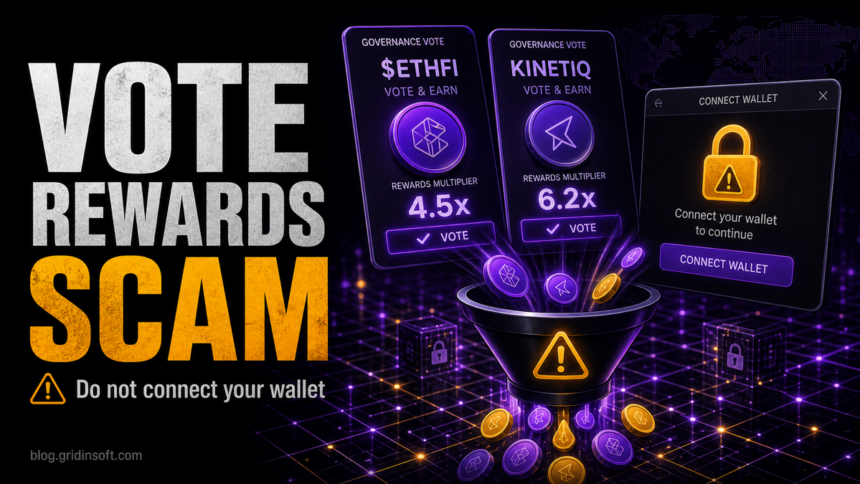
Fake $ETHFI Vote Rewards, Kinetiq Vote Rewards, Grass Vote Rewards, PowerGacha $GACHA Airdrop, Tonkeeper Airdrop, Arc Community Rewards, EtherFiWC26 Voting Rewards, TokenWorks Voting Rewards, Arrow Finance ($ARROW) Vote Rewards, Perpl Vote Rewards, and Flap Vote Rewards pages are crypto wallet-drainer scams, not legitimate governance, voting, staking, or rewards portals. Known lures use domains such as vote-ethfi.app, reward-kinetiq.xyz, vote-getgrass.app, rewards-gacha.com, ton-keeper.pages.dev, governance-arc.com, etherfi-wc26.com, vote-tokensworks-net.pages[.]dev, proposal-arrow[.]info, app-perpl[.]com, and voting-flap[.]com to push a wallet connection, token approval, or signature request. Do not connect a wallet, do not approve transactions, and never enter a seed phrase or private key.
If you already connected a wallet, treat the wallet as exposed until you have checked approvals. Disconnecting the site is useful, but it does not cancel token approvals by itself. Revoke suspicious approvals from a trusted wallet or block-explorer flow, move remaining valuable assets to a fresh wallet if you signed a broad approval, and scan the device if you installed any helper, extension, or claim app from the fake page.
For an exact Ethereum-branded variant that asks for the wallet phrase directly, see our Ethereum Genesis Airdrop scam warning for genesispool.org.
Quick check
| What you see | Risk and safe action |
|---|---|
vote-ethfi.app offering $ETHFI voting rewards |
This is not the official ether.fi voting path. Close the page and open ether.fi resources manually from a saved bookmark or official channel. |
reward-kinetiq.xyz offering a 1.25x Kinetiq rewards multiplier |
Treat it as a Kinetiq impersonation lure. Do not connect your wallet from an ad, social post, direct message, or search result. |
vote-getgrass.app asking users to vote for $GRASS rewards |
Treat it as a Grass impersonation page. Open the real Grass resources manually and do not connect a wallet from a voting link in search, social posts, or direct messages. |
rewards-gacha.com claiming a PowerGacha $GACHA airdrop |
Treat it as a fake airdrop claim page. Close it, avoid the wallet prompt, and check the domain before signing any eligibility or claim request. |
ton-keeper.pages.dev offering a Tonkeeper airdrop |
Treat it as an impersonation page, not an official wallet announcement. Tonkeeper warns that random airdrops, wallet verification messages, and bonus domains are common scam patterns. |
governance-arc.com asking users to vote on Arc Community Rewards |
Treat the voting prompt as a wallet-drainer lure. Do not connect a wallet from a rewards proposal link found in search, ads, replies, or direct messages. |
etherfi-wc26.com promoting EtherFiWC26 voting rewards |
Treat it as a fake World Cup rewards page. A real-looking campaign name or points multiplier does not make a new wallet-connect domain safe. |
vote-tokensworks-net.pages[.]dev showing a TokenWorks Rewards Update |
Treat it as an impersonation lure, not an official TokenWorks vote. The legitimate project uses token.works; wallet options such as WalletConnect, MetaMask, Trust Wallet, Rabby, or hundreds of other providers do not verify the page. |
proposal-arrow[.]info showing a $ARROW Community Distribution Date Proposal |
This is not the official arrowfinance.io domain. Ignore the 24-hour bonus-allocation claim, copied protocol metrics, Vote Now button, and long wallet list; close the page without connecting. |
app-perpl[.]com offering points for a Perpl rewards-distribution vote |
This lookalike is not perpl.xyz. A future-allocation promise and hundreds of wallet logos do not authenticate a proposal; do not connect, sign, or approve. |
voting-flap[.]com offering Flap Vote Rewards |
This is not flap.sh. A copied black-and-green layout, rewards-distribution vote, Vote Now button, and a chooser listing 540+ wallets do not authenticate it; close the page without connecting, signing, or approving. |
| A wallet prompt asks for approval, signature, or token spending access | Cancel it. A drainer does not need your seed phrase if you grant a malicious approval or sign the wrong request. |
| You already approved something | Revoke the approval, move remaining assets if needed, save transaction hashes, and report the scam. Do not pay recovery services. |
New Arrow Finance, Perpl, Flap, TokenWorks, and other vote-rewards lures to avoid
Arrow Finance ($ARROW) Vote Rewards, Perpl Vote Rewards, Flap Vote Rewards, TokenWorks Voting Rewards, Tonkeeper Airdrop, Arc Community Rewards, EtherFiWC26 Voting Rewards, Grass Vote Rewards, and PowerGacha $GACHA Airdrop are names in the same rotating wallet-drainer pattern. The page may look like a community vote, eligibility check, token claim, or branded event, but the safe decision is the same: verify the real project from a trusted bookmark, ignore the fake domain, and do not sign a wallet prompt that came from the claim page.
| Domain or claim | Verdict and safe action |
|---|---|
vote-getgrass.app / Grass Vote Rewards |
Fake rewards-voting lure. Do not connect a wallet; if you already signed, review approvals and move remaining valuable assets from an exposed wallet. |
rewards-gacha.com / PowerGacha $GACHA Airdrop |
Fake airdrop claim lure. Do not approve eligibility, claim, or spending requests; treat any signed approval as a wallet-drainer exposure. |
ton-keeper.pages.dev / Tonkeeper Airdrop |
Tonkeeper impersonation lure. Do not trust a random airdrop page or transaction comment that asks you to verify, connect, or claim from a new domain. |
governance-arc.com / Arc Community Rewards |
Fake rewards proposal page. A vote button that triggers wallet access is not a normal poll; cancel the prompt and check the project from official channels. |
etherfi-wc26.com / EtherFiWC26 Voting Rewards |
Fake voting rewards page using the World Cup theme and multiplier wording. Do not sign a points, reward, or voting request from this domain. |
vote-tokensworks-net.pages[.]dev / TokenWorks Voting Rewards |
Fake TokenWorks Rewards Update claiming that a vote on an upcoming rewards date unlocks an early Treasury Pool Funds (TPF) allocation. Do not use its Vote button or wallet chooser; verify campaigns only through token.works and official project channels. |
proposal-arrow[.]info / Arrow Finance ($ARROW) Vote Rewards |
Fake $ARROW Community Distribution Date Proposal promising a bonus allocation for voting within 24 hours. It copies TVL, aUSD, collateral-ratio, and stability-pool figures and opens a Vote Now wallet chooser; verify Arrow Finance only through arrowfinance.io. |
app-perpl[.]com / Perpl Vote Rewards |
Fake rewards-allocation proposal claiming that a distribution-date vote earns future-allocation points. The official platform uses perpl.xyz; a chooser listing 540+ wallets is not proof that the proposal is legitimate. |
voting-flap[.]com / Flap Vote Rewards |
Fake Flap rewards-distribution vote. The official platform uses flap.sh; the copied black-and-green design, Vote Now button, and a chooser listing 540+ providers such as WalletConnect, MetaMask, Trust Wallet, Rabby, Ledger, Binance, SafePal, Fireblocks, and OKX are lure signals, not verification. |
Why this page is dangerous
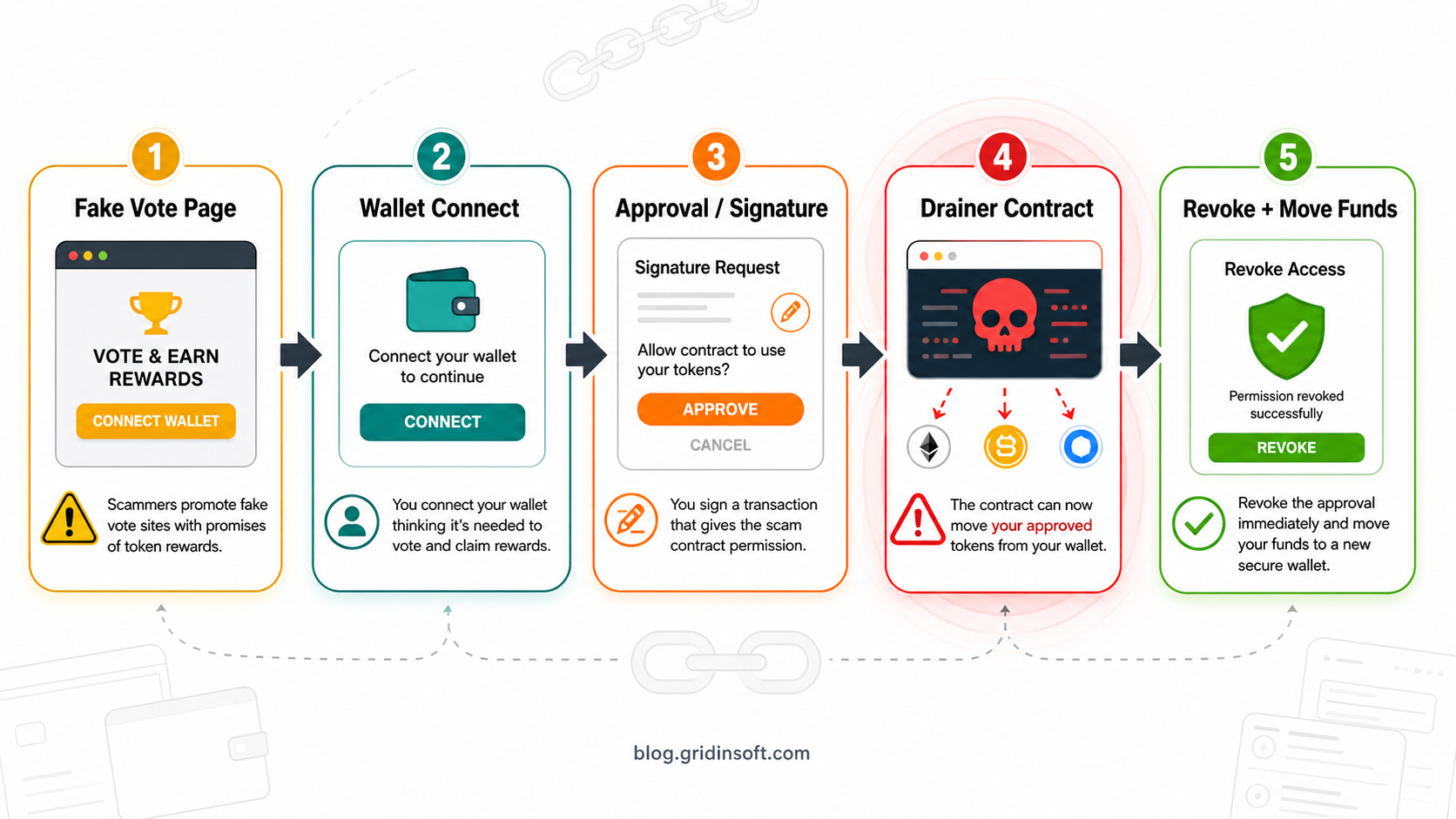
These scams borrow a believable Web3 pattern: real projects do run votes, staking campaigns, and rewards programs. The fake page then adds urgency, a multiplier, or a governance claim so the wallet prompt feels normal. The risky moment is not only the first wallet connection. The dangerous step is the approval or signature that gives a malicious contract permission to move tokens. The same mechanism can arrive through an event invitation: the Polymarket UFC 329 email scam shows how a branded email moves the reader toward that wallet prompt.
That is why the right response is different from a normal website scam. Closing the tab stops new clicks, but it does not automatically undo an on-chain approval. If the approval remains active, the malicious contract may still be able to use the permission later, depending on the token, chain, and request you signed.
An October 1 investigation adds a dated example: 70 fake xStocks, Pendle and other rewards-vote sites used a common wallet chooser and sitemu domain pattern. That report does not establish the same operator as every earlier lure listed here; it shows why a copied brand and familiar connection window do not authenticate a proposal.
Red flags before connecting a wallet
- The domain is not official. A brand name inside a new domain does not make it safe. Check the project website, governance portal, and social channels manually.
- The reward is framed as urgent. Limited-time multipliers, instant voting bonuses, and surprise eligibility claims are common pressure tactics.
- The wallet prompt is broader than the visible action. A simple vote should not require unlimited token spending or unclear contract access.
- The page came from an ad, DM, reply, or repost. Scammers often use fake profiles, compromised accounts, and sponsored-looking placements to make the lure appear current.
- The page asks for a seed phrase or private key. That is always a scam. No real vote or staking reward needs those secrets.
What to do if you connected your wallet
- Do not sign more prompts. Close the page and stop interacting with the site.
- Disconnect the dapp in your wallet. This removes the visible connection, but do not stop there.
- Review active token approvals and spending caps. Use your wallet’s trusted approval controls or the relevant chain’s official block explorer. Revoke suspicious allowances, especially unlimited approvals.
- Move remaining valuable assets to a fresh wallet when exposure is plausible. Do this after revoking what you can, and use a clean device and official wallet app.
- Save evidence. Keep the fake domain, wallet address, transaction hashes, screenshots, social posts, and any contract addresses.
- Report the scam. Report it to the impersonated project, wallet provider, ad or social platform, and the relevant fraud reporting channel in your country.
- Check the device if you installed anything. If the fake page pushed a browser extension, wallet helper, claim app, or downloaded file, run a full security scan before using that device for wallets again. Gridinsoft Anti-Malware can help check Windows for unwanted apps, suspicious extensions, and malware that may have arrived with the scam.
Do not fall for recovery scammers
After a wallet-drainer incident, scammers may contact victims again as “recovery agents”, investigators, blockchain specialists, or support staff. Be careful with anyone who promises to reverse a blockchain transfer for an upfront fee. In most cases, the realistic goals are to stop further loss, preserve evidence, report the wallet and contract addresses, and secure the rest of your accounts.
If you reused passwords, installed a browser extension, or entered credentials on a fake support page, treat that as a separate account-security problem. Change passwords from the official sites, enable MFA, revoke unknown sessions, and check email recovery settings.
Why one guide covers these lures
The scam names target different project communities, but the user problem is the same: a fake vote, rewards, or airdrop page tries to turn wallet trust into a drainer approval. Splitting $ETHFI, Kinetiq, Grass, and PowerGacha copies into thin pages would repeat the same recovery advice and make it harder for readers to see the shared pattern. This page keeps the exact domain examples while explaining the wallet-drainer flow behind them.
For nearby cases, see our guides to crypto draining attacks, fake SOL drops and wallet drainers, crypto scams in 2026, and crypto recovery scams.
FAQ
Is $ETHFI Vote Rewards real?
The scam page using vote-ethfi.app should be treated as fake. Check ether.fi voting and governance only through official ether.fi resources that you open manually.
Is Kinetiq Vote Rewards real?
The lure using reward-kinetiq.xyz should be treated as fake. Do not connect a wallet to a reward page promoted through ads, social replies, or direct messages.
Is Grass Vote Rewards real?
The lure using vote-getgrass.app should be treated as fake. Check Grass voting, rewards, and claim announcements only through official resources you open manually.
Is the PowerGacha $GACHA Airdrop real?
The claim page using rewards-gacha.com should be treated as fake. Do not connect a wallet or sign an eligibility request from that domain.
Are Tonkeeper Airdrop, Arc Community Rewards, and EtherFiWC26 Voting Rewards real?
Treat ton-keeper.pages.dev, governance-arc.com, and etherfi-wc26.com as fake claim or voting pages. Open the wallet or project site manually from a trusted bookmark, and never connect a wallet just because a page uses a familiar brand, event, or multiplier claim.
Is the TokenWorks Voting Rewards page real?
No. vote-tokensworks-net.pages[.]dev is not the legitimate token.works domain. The TokenWorks Rewards Update, early TPF allocation, Vote button, and long wallet-provider list are lure elements, not proof of an official campaign.
Are the Arrow Finance and Perpl Vote Rewards pages real?
No. proposal-arrow[.]info is not arrowfinance.io, and app-perpl[.]com is not perpl.xyz. Their distribution-date votes, bonus or future-allocation claims, copied metrics, and large wallet selectors are lure elements, not proof of an official campaign.
Is Flap Vote Rewards real?
No. voting-flap[.]com is not the official flap.sh domain. Its copied design, rewards-distribution claim, Vote Now button, and large wallet chooser do not make the vote legitimate. Close it without connecting, signing, or approving.
Can a wallet drainer steal funds without my seed phrase?
Yes. A malicious approval or signature can give a contract permission to move tokens. That is why a seed phrase warning is not the only safety check.
Is disconnecting my wallet enough?
No. Disconnecting removes the dapp connection in the wallet interface, but it does not automatically revoke token approvals. Review and revoke suspicious approvals separately.
Can stolen crypto be recovered?
Usually not by a private “recovery” service. Preserve evidence, report the scam, secure remaining assets, and avoid anyone asking for an upfront recovery fee.
References
- MetaMask Help Center. “Disconnect wallet from a dapp.” MetaMask, accessed June 11, 2026. https://support.metamask.io/more-web3/dapps/disconnect-wallet-from-a-dapp/
- MetaMask Help Center. “How to revoke smart contract allowances/token approvals.” MetaMask, accessed June 11, 2026. https://support.metamask.io/more-web3/learn/how-to-revoke-smart-contract-allowances-token-approvals/
- Keeper (formerly Tonkeeper). “Common scams.” Help Center, updated September 15, 2026; accessed October 2, 2026. https://keeperwallet.helpscoutdocs.com/article/123-how-to-recognize-and-avoid-scams