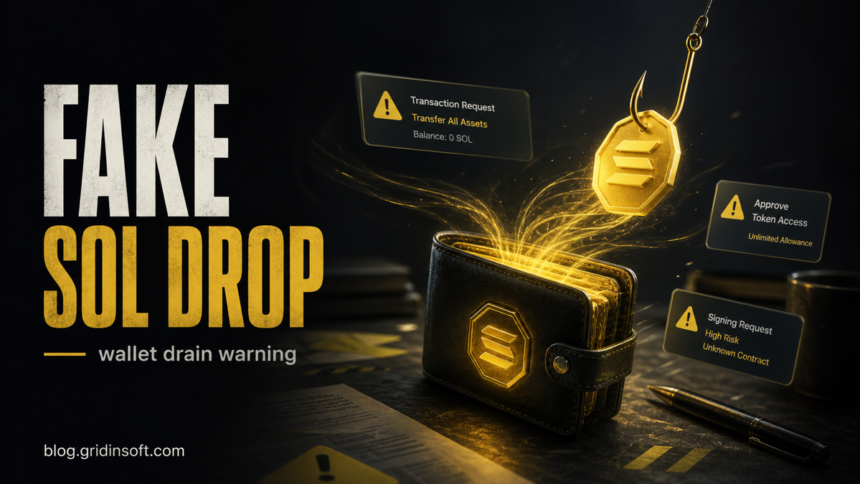
A Solana giveaway that asks you to send SOL first, connect a wallet to an unknown claim page, approve unlimited token access, or enter a seed phrase is a scam. Real Solana projects do not double your coins because you sent money to a wallet address, and the Solana safety guide warns users to protect seed phrases, avoid “free money” traps, and watch for wallet drainers [1]. If you already clicked, signed, paid, or installed something, treat the incident as both a crypto-theft risk and a device-security check.
Another wallet-drainer pattern uses fake vote rewards instead of airdrops. See the $ETHFI and Kinetiq Vote Rewards scam guide for the approval-risk checklist.
Fast Solana Giveaway Scam Check
- Send SOL to receive more SOL: scam. Do not send a test amount.
- Seed phrase or private key requested: scam. Move remaining funds to a new wallet if exposed.
- Unknown site asks for token approval: high risk. Reject the transaction and close the page.
- YouTube, Discord, Telegram, or Reddit link claims “official” urgency: verify from Solana’s real website and official channels, not the ad or DM.
- Recovery agent promises a guaranteed refund: likely a second scam.
What Is the Solana Giveaway Scam?
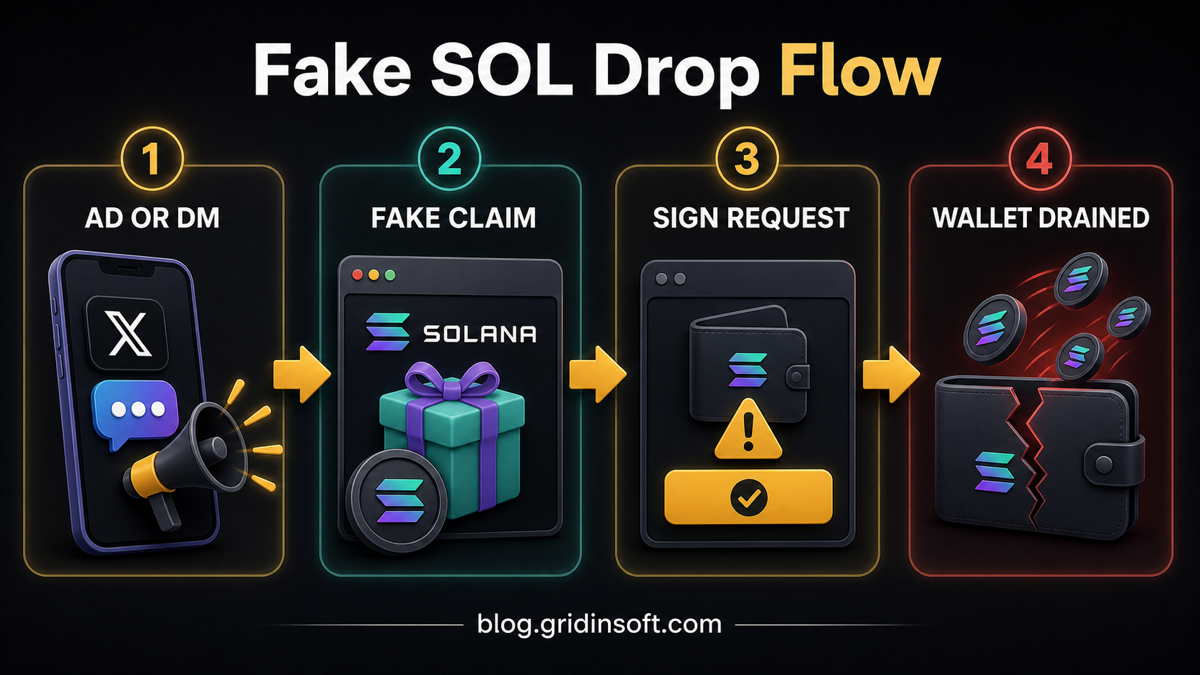
The Solana giveaway scam is a fake reward, airdrop, livestream, social-media post, or direct message that pretends to give away SOL. The lure changes, but the goal is usually one of four things: make you send SOL to a scam wallet, trick you into signing a wallet-draining transaction, steal your seed phrase, or push you toward a fake wallet app or browser extension.
The most common version says a famous Solana account, founder, exchange, influencer, or “foundation event” will return double the amount you send. Another version says you are eligible for a limited airdrop and must connect your wallet before the claim expires. Both are designed to make you act before you verify the source.
Red Flags That Mean It Is Fake
| What you see | What it usually means |
|---|---|
| “Send 5 SOL, receive 10 SOL” | Classic advance-payment giveaway scam. The outgoing transaction is usually irreversible. |
| Claim page asks for your seed phrase | Credential theft. Anyone with the seed phrase can control the wallet. |
| Wallet popup asks to approve token access or “transfer all assets” | Possible wallet drainer. Reject the transaction and disconnect the site. |
| Ad or livestream looks official but the channel handle is slightly wrong | Hijacked, renamed, or impersonation account. |
| Domain is not a known official project domain | Phishing risk. Scammers use similar words, hyphens, extra claims, or temporary domains. |
| Timer, limited slots, secret whitelist, or “final chance” language | Pressure tactic. Real airdrops usually leave time for public verification. |
Where Fake SOL Drops Usually Spread
YouTube: scams often use ads, live streams, deepfake clips, or hijacked verified channels. A fake page may show a QR code or wallet address and claim that the “event” is live only for a short time. Do not scan the code or send funds because a video looks polished.
Discord and Telegram: a fake admin, bot, or support account may DM you after you ask a wallet question. The account may say you must “validate” your wallet, “synchronize” it, or claim an emergency airdrop. Real support will not ask for your seed phrase.
Reddit and X/Twitter: scammers post copied announcements, fake screenshots, and “I just claimed” replies. Check the official project site directly in a clean browser tab instead of trusting a reply link.
Wallet dust and fake tokens: a token can appear in your wallet with a name that includes a claim URL. Do not visit the URL from the token name, and do not sign a transaction to “unlock” or “verify” it.
If You Sent SOL to a Giveaway Address
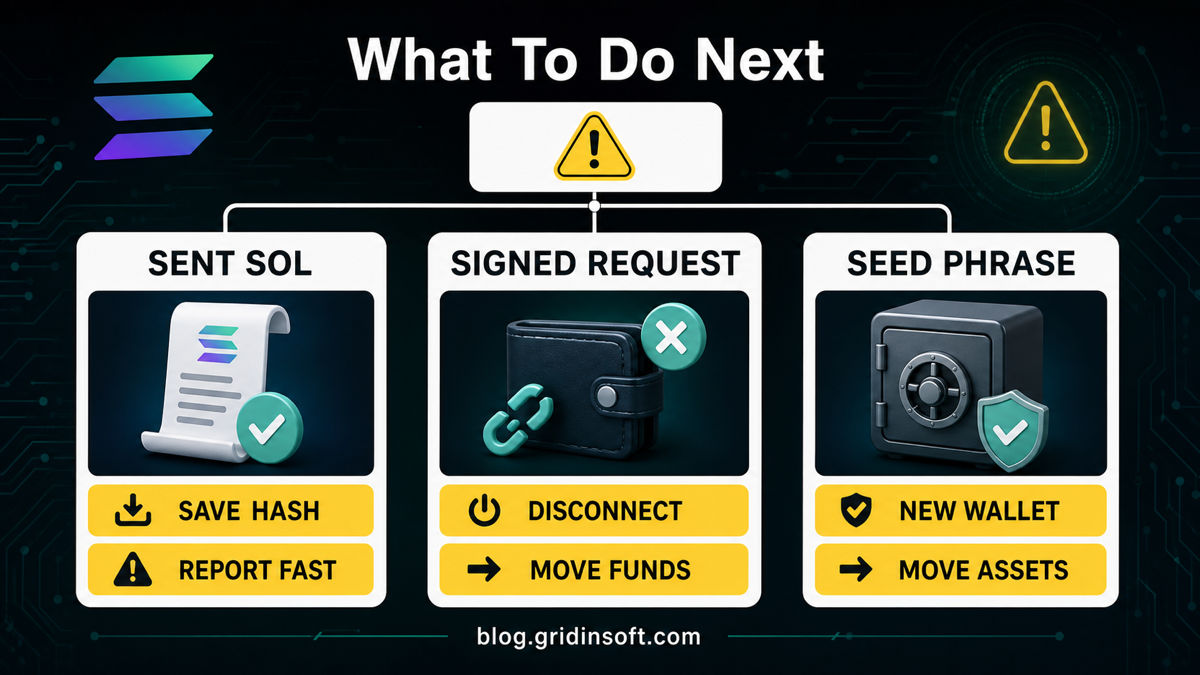
- Stop sending money. A second “verification” or “unlock” payment is usually another part of the same scam.
- Save evidence. Keep the website URL, YouTube or social handle, wallet address, transaction hash, amount, time, screenshots, and chat history.
- Contact the exchange quickly if one was involved. If you bought or withdrew through an exchange, report the destination wallet and transaction hash to that platform.
- File reports. The FTC says people can report fraud and receive recovery guidance through ReportFraud; the FBI IC3 asks crypto-scam victims to include wallet addresses, transaction IDs or hashes, amounts, and dates [2] [3].
- Ignore refund agents in your DMs. Recovery scammers watch public posts and offer guaranteed refunds, often for an upfront fee.
If You Connected Your Wallet or Signed a Transaction
Connecting a wallet is not always the same as losing funds, but signing the wrong transaction can grant access, approve spending, or move assets. Work fast and assume the wallet is no longer trustworthy until checked.
- Disconnect from the site. Remove the site from your wallet’s connected-apps list.
- Check recent transactions. Look for approvals, token transfers, unknown contracts, or “set authority” style changes you did not understand.
- Move remaining funds to a new wallet. Use a new seed phrase created on a clean device. Do not reuse the exposed wallet as a main wallet.
- Revoke risky permissions where your wallet and tooling support it. Be careful to use known, trusted revoke tools only.
- Change related account passwords. Secure email, exchange, Discord, Telegram, X/Twitter, and any account that received the scam message.
If the scam asked you to install a wallet, browser extension, “claim app”, remote-access tool, or desktop file, clean the device before using it for exchanges or recovery phrases. Scan for unwanted extensions, suspicious startup entries, clipboard hijackers, and malware. Gridinsoft Anti-Malware can help check the system when the incident involved a download, browser redirects, pop-ups, or recurring security-tool alerts.
After uninstalling the suspicious app or deleting the visible threat, use Gridinsoft Anti-Malware to check hidden files, startup entries, scheduled tasks, bundled apps, browser changes, and other persistence points that can restore malware.
Download Anti-MalwareIf You Entered a Seed Phrase or Private Key
Do not try to “change the password” of the exposed wallet. A seed phrase is the wallet. Create a new wallet with a new seed phrase on a clean device, move any remaining funds and NFTs, and stop using the old wallet for storage. Then check whether the same phrase was imported into other apps, cloud notes, screenshots, password managers, or shared devices.
The same emergency rule applies to Ethereum-themed lures such as the Ethereum Genesis Airdrop scam, where the fake claim page tries to collect the recovery phrase itself.
Never paste a seed phrase into a giveaway site, Google form, Discord bot, support chat, browser extension, or recovery page. Solana’s own safety guidance is blunt about seed phrases: protect them and do not share them [1].
How to Verify a Real Solana Airdrop or Campaign
- Start from the official website or the verified project site you already know, not from a DM, ad, QR code, or token-name URL.
- Compare the domain carefully. Watch for extra words, hyphens, misspellings, unusual TLDs, and domains registered only for a “claim” page.
- Look for public announcements across several official channels, not one repost or livestream.
- Read the wallet prompt before signing. If the transaction can transfer assets, grant broad access, or interact with an unknown contract, reject it.
- Do not believe urgency. A real campaign should survive ten minutes of independent checking.
- Use a separate low-value wallet for experiments; keep your main funds in a wallet that never signs unknown claims.
Why These Scams Feel Convincing
Solana scams often borrow real visual trust: a familiar logo, a polished landing page, a copied announcement style, a verified-looking channel, or a fake video of a known person. That is why the safest check is not visual quality. The safer check is the action requested. If the page asks you to pay first, reveal a secret, approve broad access, or rush, the branding does not matter.
This is the same pattern behind many crypto-giveaway scams. For broader examples, see our guides to common cryptocurrency scams, crypto draining attacks, and “double your crypto” giveaway scams.
How to Stay Safer Next Time
- Bookmark official project sites instead of searching during a high-pressure moment.
- Use hardware-wallet or cold-wallet storage for assets you cannot afford to lose.
- Keep a small separate wallet for airdrop checks and never sign unknown transactions from your main wallet.
- Disable or remove wallet extensions you do not use.
- Turn on strong authentication for email, exchanges, Discord, Telegram, and X/Twitter.
- Be skeptical of anyone who appears after a loss and says they can recover funds for a fee.
FAQ
Is the Solana giveaway real?
Assume it is fake if it asks you to send SOL first, connect to an unknown claim site, enter a seed phrase, or approve token access. Verify from the official project site and known official channels before doing anything.
Can a fake Solana giveaway drain my wallet just by visiting the site?
Simply opening a page is usually less dangerous than signing a wallet transaction or entering a seed phrase. Still, close the site, do not approve prompts, and scan the device if the page pushed a download, extension, pop-up permission, or suspicious redirect.
I sent SOL. Can I reverse the transaction?
Usually no. Blockchain transactions are generally not reversed like card payments. Save the wallet address and transaction hash, report quickly to the exchange if one was involved, and file reports with fraud channels such as FTC ReportFraud and FBI IC3.
What should I do if I typed my seed phrase into a claim page?
Create a new wallet with a new seed phrase on a clean device and move any remaining assets immediately. Do not keep using the exposed wallet as your main wallet.
Are Solana airdrops always scams?
No. Real projects can run airdrops, but legitimate campaigns do not need your seed phrase and should be verifiable from official project channels. Treat unsolicited token-name URLs, surprise DMs, and urgent claim sites as suspicious.
References
- Solana. “Staying Safe on Solana.” Solana Learn, accessed June 9, 2026. https://solana.com/learn/staying-safe-on-solana
- Federal Trade Commission. “New FTC Data Show a Big Jump in Reported Losses to Fraud to $12.5 Billion in 2024.” FTC, March 10, 2025, accessed June 9, 2026. https://www.ftc.gov/news-events/news/press-releases/2025/03/new-ftc-data-show-big-jump-reported-losses-fraud-125-billion-2024
- Federal Bureau of Investigation. “FBI Guidance for Cryptocurrency Scam Victims.” Internet Crime Complaint Center, August 24, 2023, accessed June 9, 2026. https://www.ic3.gov/PSA/2023/PSA230824