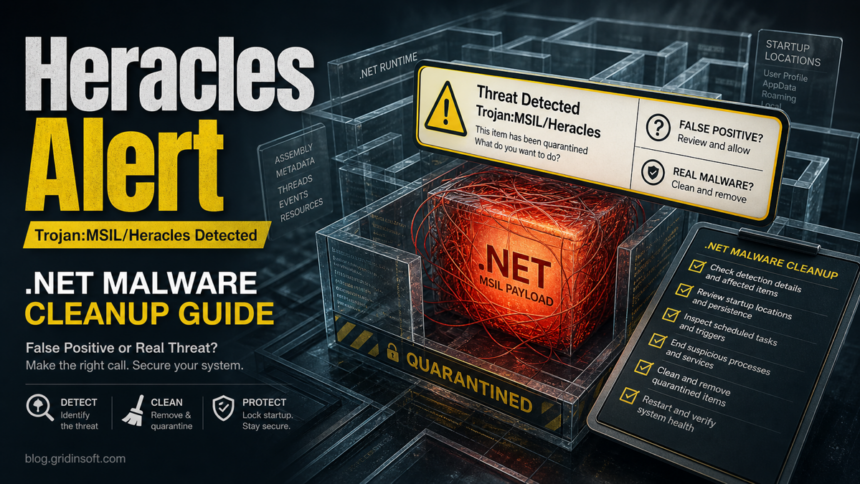
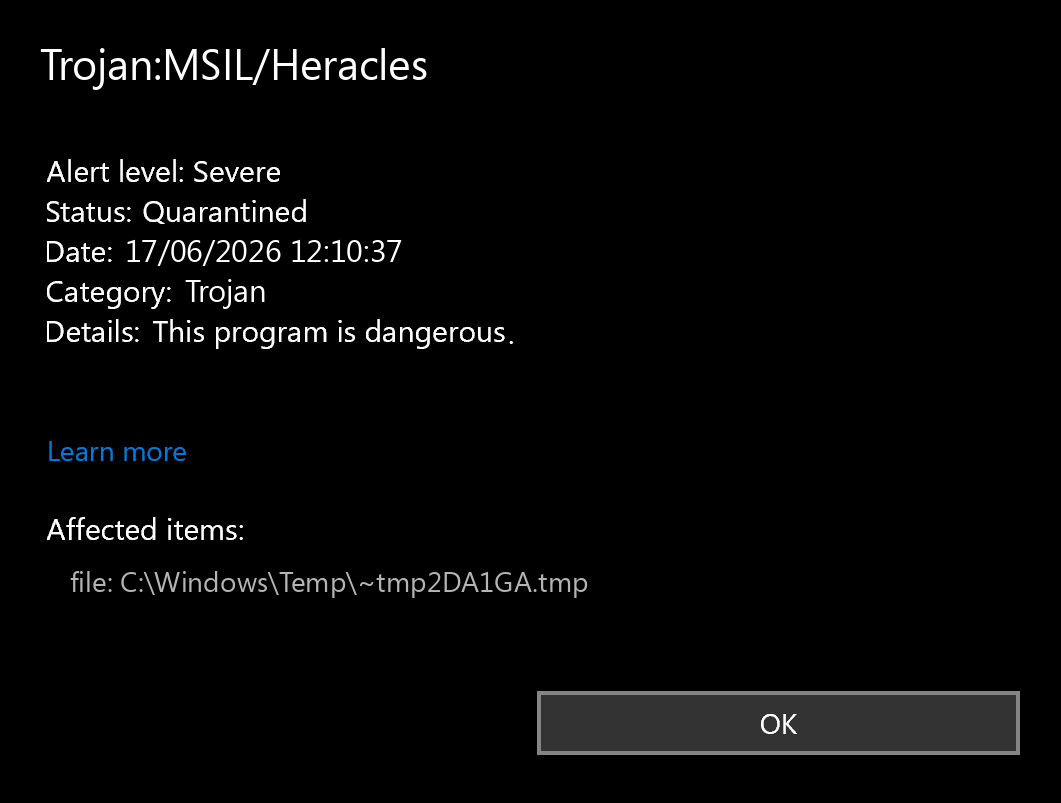
Trojan:MSIL/Heracles is a Microsoft Defender Trojan detection for managed .NET/MSIL code. If Windows shows a Heracles variant such as Trojan:MSIL/Heracles.MKA!MTB, Heracles.GZZ!MTB, Heracles.MBAR!MTB, !MSR, or !MTB, do not restore the file just because another scanner is quiet. First check the affected path, where the file came from, whether it ran, and whether the alert returns after quarantine.
Microsoft’s public threat entry for a Heracles variant says Defender detects and removes the threat, and describes it as capable of actions chosen by a malicious actor on the device [1]. That description is broad, so the practical question is not the suffix alone. The safe decision depends on source, behavior, persistence, and whether the file is a trusted developer/game build or an unsafe download.
What MSIL means in this alert
MSIL points to Microsoft Intermediate Language, the managed-code layer used by .NET programs. Microsoft explains that managed code runs under the Common Language Runtime before it is compiled and executed [2]. That does not mean every .NET file is malicious. It means the flagged program is in a format commonly used by legitimate tools, game launchers, installers, and also by malware loaders.
The suffix after Heracles, such as .MKA!MTB, .GZZ!MTB, .MBAR!MTB, !MSR, or !pz, is a Defender variant label. Do not read it as a full malware report. Use it as a starting point, then inspect the path, source, signature, and repeat behavior.
Check these details before restoring anything
| Evidence | What it means |
|---|---|
| Affected path | %USERPROFILE%\Downloads, %TEMP%, %LOCALAPPDATA%\Temp, extracted archives, and crack/repack folders are higher risk than a known signed program folder. |
| Source | A signed build from the developer’s site, Steam, GitHub release, or Microsoft Store is a stronger false-positive candidate than a torrent, mirror, Discord attachment, fake update, or keygen. |
| Execution | If the file ran before Defender quarantined it, check for persistence and account risk. If Defender blocked it before launch, the risk is lower but still not zero. |
| Recurrence | If Heracles returns after reboot, something may be recreating the file: a startup entry, scheduled task, service, browser extension, or dropped loader. |
| Other engines | One generic detection can be wrong. Many detections, sandbox warnings, or suspicious process behavior make restore unsafe. |
When Heracles may be a false positive
A false positive is plausible when Trojan:MSIL/Heracles appears on your own freshly compiled .NET program, a niche internal tool, an uncommon game helper, or a legitimate installer that has low reputation. This is especially true when the file is signed by a known publisher, downloaded from the official source, and does not reappear after quarantine.
Keep the file quarantined while you verify it. Download a fresh copy from the official source, check the digital signature, compare the hash with the publisher if available, and submit the exact file to Microsoft if you believe Defender classified it incorrectly. Microsoft’s submission portal accepts files that may be malware or files you believe were incorrectly detected [3].
When to treat it as real malware
Treat the alert as malware when the file came from a crack, keygen, trainer, repack, fake update page, unofficial mirror, message attachment, or unknown archive. Also treat it seriously if Defender reports the item from AppData, Temp, Startup, Task Scheduler, PowerShell, a browser profile folder, or a Run key such as HKCU\Software\Microsoft\Windows\CurrentVersion\Run.
If the alert followed a game, mod, launcher, or private build and you also saw account alerts, Discord spam, browser session issues, or Google/Steam login warnings, use our infostealer after a game or mod checklist. If the file was a crack or trainer, compare it with the GameHack risk guide before deciding that the detection is harmless.
Cleanup steps for a Heracles alert
- Leave the detection quarantined. Do not click Allow or Restore until the source and behavior are clear.
- Record the detection details. Save the exact name, affected path, time, and Defender action from Protection History.
- Delete the source package. Remove the installer, ZIP/RAR archive, extracted folder, or browser download that produced the alert.
- Update Defender and run a full scan. A quick scan is not enough when the file ran or the alert returned after reboot.
- Check persistence. Review Startup Apps, Task Scheduler, Services, browser extensions, Defender exclusions, and Run keys. Watch for commands launched from
%LOCALAPPDATA%,%TEMP%,C:\Users\Public, or unusual PowerShell paths. - Scan the file only from a safe state. If you need a second opinion, compare hash/reputation results without running the file again.
- Change passwords from a clean device if it ran. Prioritize email, Steam, Discord, banking, crypto, work accounts, and password-manager sessions.
Scan before you restore or allow the file
Defender may quarantine the visible .NET payload while a loader, scheduled task, service, browser change, Defender exclusion, or bundled module remains. That is most likely when the alert came from Downloads, Temp, a crack/repack folder, a fake update, or a file that already executed. A full Gridinsoft Anti-Malware scan can check for leftover detections, hidden files, startup entries, scheduled tasks, bundled apps, browser changes, and persistence before you decide whether the original file is safe to restore.
A false positive is possible, but restore only after checking that the system has no companion detections, startup entries, scheduled tasks, or hidden files tied to the same source.
Scan before restoring this fileFor conflicting scan results, use our VirusTotal and Hybrid Analysis false-positive guide. For another Defender machine-learning Trojan example with a similar restore-versus-remove workflow, see Trojan:Win32/Caynamer.A!ml.
Developer and game-file checklist
- If this is your own .NET build, reproduce the alert on a clean build output, not on a modified copy from a user machine.
- Sign the file when possible, keep version metadata clean, and publish hashes for official downloads.
- Submit the exact detected binary to Microsoft with a clear explanation of what the program does.
- Do not tell users to disable Defender or add a broad exclusion for
Downloads, the whole game folder, or your compiler output directory. - If you must offer a temporary workaround, make it narrow, reversible, and only after Microsoft or the publisher confirms the file is clean.
What not to do
- Do not restore a Heracles item from
%TEMP%,Downloads, a torrent, or a crack folder because one comment says it is common. - Do not clear Protection History before saving the affected path and timestamp.
- Do not run the file in your normal Windows account to “test” it.
- Do not assume a suffix such as
!MTBproves password theft, but do not ignore account checks if the file already ran.
FAQ
Is Trojan:MSIL/Heracles always malware?
No. It can be a false positive on uncommon .NET software, developer builds, or game tools, but it is still a severe Defender Trojan alert. Keep the item quarantined until source, signature, and recurrence checks support a restore decision.
What does the !MTB suffix mean?
It is part of Microsoft’s variant naming, not a complete behavior report. Use it to search for context, but make the restore/remove decision from the affected path, source, behavior, and whether the alert returns.
Why does Defender find Heracles but another scanner finds nothing?
Different products use different signatures, machine-learning models, and reputation data. A single detection can be wrong, but a quiet second scanner does not make an unsafe source safe.
What if Heracles keeps appearing after reboot?
Do not treat that as a normal false positive. Delete the source package and check Startup Apps, Task Scheduler, browser extensions, Defender exclusions, and suspicious files in AppData or Temp.
Should I reinstall Windows?
Usually no if Defender blocked the file before it ran. Consider deeper recovery only when the file executed, persistence remains, accounts show suspicious activity, or scans keep finding new threats.
References
- Microsoft Security Intelligence. “Trojan:MSIL/Heracles.MKA!MTB threat description.” Microsoft, published and updated December 29, 2025, accessed June 17, 2026. https://www.microsoft.com/en-us/wdsi/threats/malware-encyclopedia-description?Name=Trojan%3AMSIL%2FHeracles.MKA%21MTB&ThreatID=2147960198.
- Microsoft Learn. “What is managed code?” Microsoft, accessed June 17, 2026. https://learn.microsoft.com/en-us/dotnet/standard/managed-code.
- Microsoft Security Intelligence. “Submit a file for malware analysis.” Microsoft, accessed June 17, 2026. https://www.microsoft.com/en-us/wdsi/filesubmission.