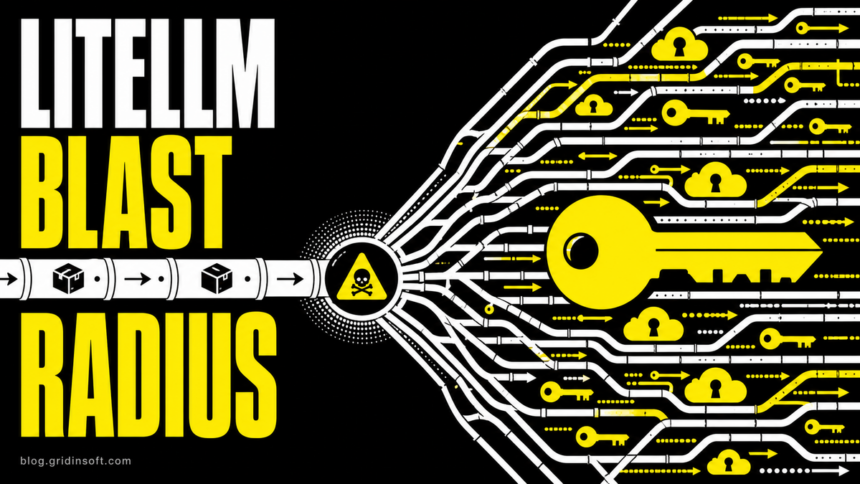
CloudSEK says a reconstructed exposure dataset linked to the March LiteLLM supply-chain attack includes more than 2,500 organizations and about 434,000 CI/CD pipelines. Those figures describe potential exposure, not proof that every listed organization lost credentials. But they make the response boundary clearer: if a system installed LiteLLM 1.82.7 or 1.82.8, removing the package alone is not enough.
The incident began with a compromised Trivy security-scanning path and reached LiteLLM’s PyPI publishing process. The malicious releases could collect secrets available to Python or the build runner, create persistence, and extend access into cloud and Kubernetes environments. Teams should verify historical installs, contain affected systems, and rotate every credential the process could read—not only an AI-provider key.
Who needs to check LiteLLM exposure
LiteLLM’s official incident notice identifies 1.82.7 and 1.82.8 as the compromised PyPI releases. They were published on March 24, 2026, starting at 10:39 UTC and were quarantined after a short window. Exposure is plausible when an unpinned pip install litellm, an image build, a CI job, or a transitive dependency pulled either version during that period.
The official LiteLLM Cloud service and the official LiteLLM Proxy Docker image were not affected by this package path. A lockfile reference also does not prove that malicious code ran. The decision should come from package caches, CI logs, image layers, runner history, and evidence of the exact installed version.
- Only a dependency or lockfile reference: Confirm whether
1.82.7or1.82.8was downloaded, installed, cached, or executed. - A build or host installed an affected version: Isolate the runner or host, preserve logs, and treat readable secrets as potentially exposed.
- The package is gone from the current environment: Do not assume the incident is closed; review old images, caches, logs, persistence, and token use.
- A credential was available to the affected process: Revoke and rotate it after containment, then audit for use from unfamiliar identities, networks, or workloads.
How a scanner compromise reached AI infrastructure
- Trivy became the upstream entry point. Attackers abused access around the security scanner’s release path and harvested credentials from downstream build environments.
- LiteLLM publishing credentials were exposed. The attackers used trusted access to place malicious releases on PyPI without a normal project release.
- Python started the payload. Version
1.82.8includedlitellm_init.pth, which Python could process at interpreter startup even when application code never imported LiteLLM. - The process exposed its secret neighborhood. Environment variables, SSH keys, cloud credentials, Kubernetes tokens, database passwords, and other accessible data became collection targets.
- Stolen access outlived the package. Removing a malicious wheel does not revoke copied credentials or remove persistence from hosts and clusters.
This is the practical difference between a package alert and a credential incident. The same ordering problem appears in the Keyv npm response guide: containment must come before broad token rotation, or an attacker may steal the replacement credentials too.
What to investigate and rotate
- Map historical installs. Search CI job logs, package caches, container layers, SBOMs, dependency resolver output, and developer environments for the two exact versions and the March 24 window.
- Contain before replacing secrets. Stop affected runners, isolate hosts and clusters, preserve relevant logs, and rebuild from known-clean sources before issuing new credentials.
- Check persistence and execution clues. Look for
litellm_init.pth,~/.config/sysmon/sysmon.py, unexpected systemd services, suspicious outbound traffic, unauthorized tokens, and privileged Kubernetes workloads that do not match deployment history. - Rotate the whole reachable set. Include model-provider API keys, AWS/GCP/Azure credentials, GitHub or GitLab tokens, package-registry credentials, Kubernetes service-account tokens, database passwords, SSH keys, signing keys, and SaaS secrets available to the process.
- Hunt for reuse. Review cloud, source-control, registry, cluster, and identity logs for unfamiliar IPs, service accounts, repositories, releases, sessions, and workload changes after the exposure window.
- Prevent the same path. Pin packages and CI actions to verified versions or hashes, shorten token lifetime and scope, separate build from publish credentials, and prefer workload identity over long-lived static secrets.
Do not let a current clean version erase historical evidence. For a related execution-boundary example, the NUL1DROPPER analysis explains why the presence of a package and the execution of its malicious path are separate questions. The Checkmarx Jenkins compromise checklist adds context for CI secrets and build-system exposure.
False assumptions that can leave access behind
- “We never imported LiteLLM.” The
.pthmechanism could run at Python startup. - “The package has been removed.” Copied credentials, active sessions, modified workloads, and persistence survive package deletion.
- “We rotated the OpenAI key.” The affected process may also have reached cloud, repository, cluster, database, SSH, and registry credentials.
- “Our organization appears in an exposure dataset, so compromise is confirmed.” The dataset is a triage lead; local logs and artifacts must establish what was installed and accessed.
- “Every LiteLLM deployment was affected.” Official LiteLLM Cloud and the official pinned Proxy Docker image were outside the compromised PyPI path described by the vendor.
References
- CloudSEK. “2,500+ Companies and 434,000 CI/CD Pipelines Exposed in the Largest AI Supply Chain Breach of 2026,” published August 11, 2026; accessed August 12, 2026. exposure analysis.
- LiteLLM. “Security Update: Suspected Supply Chain Incident,” published March 24, 2026; updated March 30, 2026; accessed August 12, 2026. official incident guidance.
- Aqua Security. “Update: Ongoing Investigation and Continued Remediation,” updated March 2026; accessed August 12, 2026. Trivy incident update.