The “Assistance In Claiming The Money” email is a scam. The sender claims to be a London attorney handling a $21 million estate and asks a stranger to pose as the deceased client’s next of kin. That is not a legitimate inheritance process. Do not reply, send identification, share bank details, sign a power of attorney, or pay a “tax,” “legal,” or “transfer” fee. The names, address, case number, and reference to EgyptAir Flight 990 are credibility props; they do not prove that an estate or account exists.
This version commonly uses the subject Re: FILE NO/6328/ OFFICIAL, the name Barr Cliford Jose, and a story about a supposed client named Robert Fitzpatrick. The message promises the recipient 40% of the money, keeps 50% for the sender, and assigns 10% to charity. The Federal Trade Commission warns that unsolicited inheritance offers built around a multi-million-dollar estate and a split with a law firm or charity are designed to collect personal information, bank details, or money. [1]
Why the $21 million inheritance story is fake
| Clue in the email | Why it is a warning sign |
|---|---|
| An unknown attorney contacts you unexpectedly | A genuine estate representative does not recruit an unrelated stranger by mass email to become a beneficiary. |
| You are asked to pose as “next of kin” | The proposal asks you to participate in a false legal claim. That alone is enough to stop. |
| The sender offers a 40/50/10 split | The large promised reward makes later “small” fees seem reasonable and creates a shared-secret feeling. |
| A real disaster and plausible street address appear | Scammers copy public facts, names, and addresses so the story survives a quick search. A real event does not authenticate the sender. |
| The message asks for secrecy or an urgent reply | Pressure prevents you from checking the story with a regulator, family member, bank, or independent attorney. |
| Legal forms and fees come after you respond | The promised money stays out of reach while new identity, tax, insurance, notarization, or transfer demands appear. |
The Solicitors Regulation Authority notes that criminals may use the names of real firms, solicitors, or other people without their knowledge. Its consumer guidance specifically describes false inheritance offers that require administrative fees and bank details. [2] Do not assume the sender is genuine because a matching person, chambers, address, logo, or legal phrase exists online.
Example
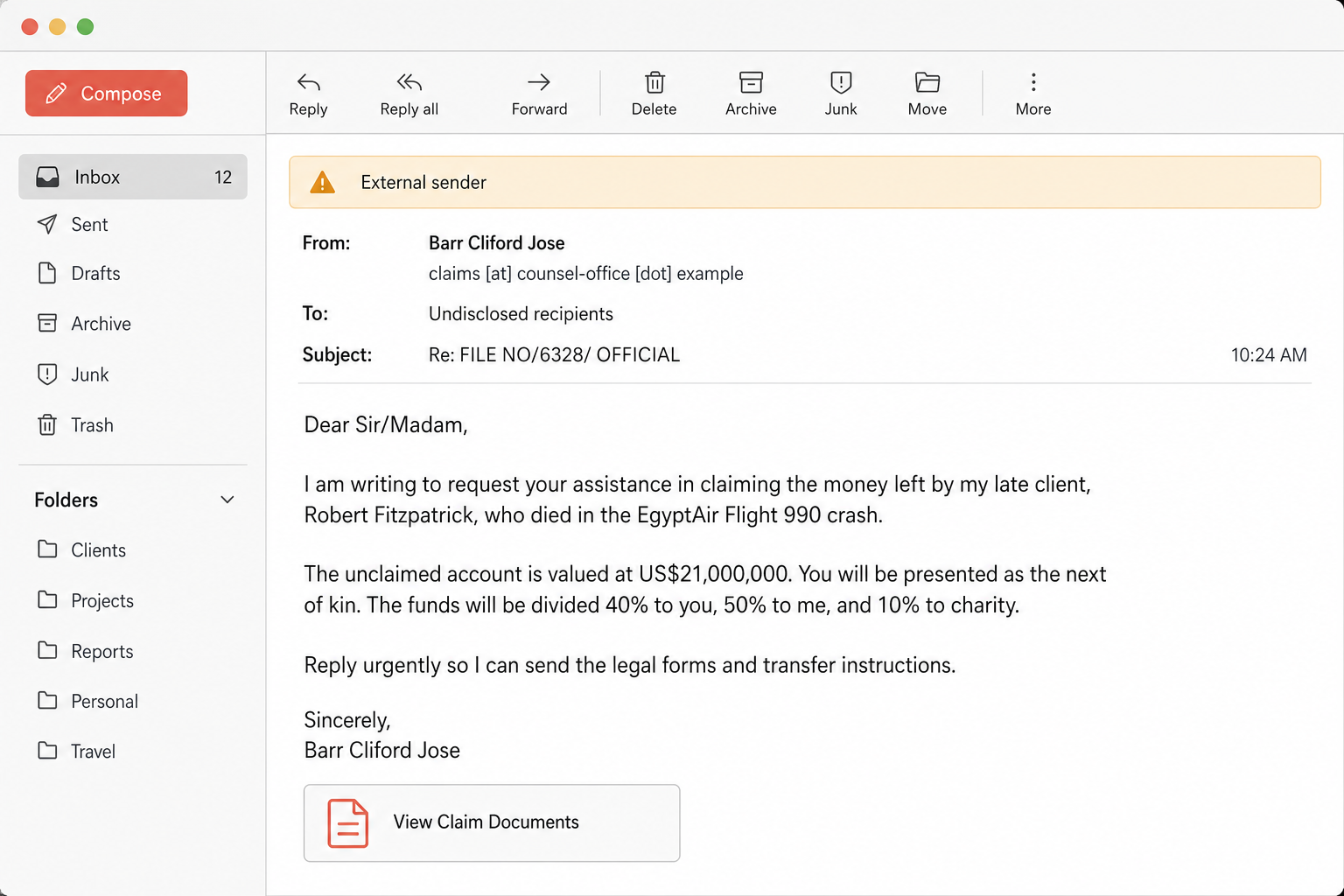
Subject: Re: FILE NO/6328/ OFFICIAL
From: Barr Cliford Jose <claims [at] counsel-office [dot] example>
Dear Sir/Madam,
I am writing to request your assistance in claiming the money left by my late client, Robert Fitzpatrick, who died in the EgyptAir Flight 990 crash.
The unclaimed account is valued at US$21,000,000. You will be presented as the next of kin. The funds will be divided 40% to you, 50% to me, and 10% to charity.
Reply urgently so I can send the legal forms and transfer instructions.
Sincerely,
Barr Cliford Jose
The sender address above uses the reserved .example domain and cannot receive mail. Real scam messages may rotate through free mailboxes or lookalike domains, so the story and requested action matter more than any single address.
What happens after you reply
- The sender confirms that you qualify. Almost any response is treated as acceptance. The scammer may ask for your full name, date of birth, home address, occupation, phone number, and a copy of your passport or driver’s license.
- Fake legal documents arrive. Letterhead, stamps, account statements, death certificates, affidavits, powers of attorney, and bank portals can all be fabricated or copied from unrelated organizations.
- The first fee appears. It may be called probate tax, an anti-money-laundering certificate, notarization, insurance, legal registration, transfer clearance, or courier cost.
- Each payment creates another obstacle. Once a victim pays, the criminals know that pressure works. A bank officer, tax agent, diplomat, courier, or recovery specialist may contact the victim as a second invented character.
- The promised transfer never arrives. The account balance and paperwork were part of the story. No fee unlocks the $21 million.
This is the same advance-fee logic seen in fake funds-recovery emails, but the inheritance version uses family, legal, and charitable language. A separate crypto inheritance scam replaces the attorney with a fake exchange balance and withdrawal fees.
What to do, based on what you already shared
If you only received the email
- Do not reply, call the number, open attachments, or use links in the message.
- Mark it as phishing or spam, then block the sender.
- Keep a screenshot or the original message if you plan to report it, but do not forward active links to friends.
- Use this phishing email checklist for sender, header, domain, and request checks.
If you replied but sent no sensitive information
Stop the conversation. Do not argue or reveal that you are investigating the sender. A reply confirms that your address is active, so expect more inheritance, compensation, investment, or recovery messages. Strengthen the mailbox password if it is reused anywhere and enable multi-factor authentication.
If you sent an ID document or personal information
Save the correspondence and write down exactly what you disclosed. Follow the IdentityTheft.gov steps for the exposed item: monitor and freeze credit when appropriate, replace compromised documents through the issuing authority, and watch for unfamiliar accounts or address changes. [3] Be especially cautious of follow-up calls that quote the information you already sent; knowing those details does not make the caller legitimate.
If you shared bank or card information
Contact the bank or card issuer through a number on your statement or the back of the card, not through the email. Ask the fraud team whether the account or card should be replaced, review recent transactions, and enable alerts. Change online-banking credentials from a clean device if any login or security answer was disclosed.
If you paid a fee
Contact the payment provider immediately and ask whether the transfer can be recalled, frozen, or disputed. Report the fraud to the FTC at ReportFraud.ftc.gov or the relevant national reporting service, and provide the payment reference, recipient account, wallet address, email headers, and documents. Ignore anyone who promises guaranteed recovery for another upfront fee.
If you clicked a link or opened a file
Reading plain email text does not by itself mean the computer is infected. Risk changes if you signed in on a page, enabled document macros, installed software or a browser extension, opened an executable, or allowed remote access. Disconnect remote-control software, change exposed passwords from a different trusted device, and review how HTML/Fraud email attachments can lead to credential theft. If a file was downloaded but not opened, use the downloaded-file decision guide before doing anything with it.
If the attachment, installer, extension, or remote-support tool ran, deleting the visible file may not remove scheduled tasks, startup entries, bundled apps, browser changes, or other persistence. Run a full Gridinsoft Anti-Malware scan, remove confirmed detections, reboot, and scan again if the behavior returns.
If the page or email made you download an invoice, coupon, tracking app, browser extension, or support tool, scan the PC before opening it again or logging into sensitive accounts.
Scan after a suspicious downloadHow to verify a real inheritance contact safely
- Do not use the phone number, website, or email address supplied in the message.
- Search the relevant legal regulator’s public directory for the firm and professional.
- Contact the firm through independently published details and ask whether it sent the letter.
- Ask for the court or probate case number, jurisdiction, executor, and a verifiable paper trail.
- Hire an independent attorney if a genuine estate may exist. Do not let the sender choose the professional who “verifies” the claim.
A legitimate verification process may take time. Urgency, secrecy, a profit split for posing as a relative, and fees paid to strangers are reasons to stop, not reasons to hurry.
FAQ
Is Barr Cliford Jose a real attorney?
The unsolicited $21 million message using that name should be treated as an impostor scam. A name, address, or legal title can be invented or copied. Verify any professional only through an independent regulator and contact details you found yourself.
Can an attorney legally make me the next of kin?
No legitimate attorney recruits a stranger to pretend to be a deceased client’s relative in exchange for part of the estate. The request is a proposal to make a false claim and is a decisive warning sign.
Why does the email offer a 40/50/10 split?
The split makes the story sound planned and charitable while giving the recipient a large imagined reward. That reward is used to justify later identity-document requests and upfront fees.
Can opening the email infect my computer?
Simply reading the text is usually not the main risk. Clicking a link, entering credentials, opening an attachment, enabling macros, installing software, or granting remote access requires additional response steps.
References
- Federal Trade Commission. “Contacted about a long-lost relative’s inheritance? Hold on a minute.” Consumer Advice, August 19, 2022; accessed July 22, 2026. FTC inheritance scam guidance.
- Solicitors Regulation Authority. “Scams.” SRA consumer guidance, reviewed November 25, 2019; accessed July 22, 2026. SRA scam guidance.
- Federal Trade Commission. “What To Do if Your Information Was Lost or Stolen.” IdentityTheft.gov, accessed July 22, 2026. identity exposure recovery steps.