
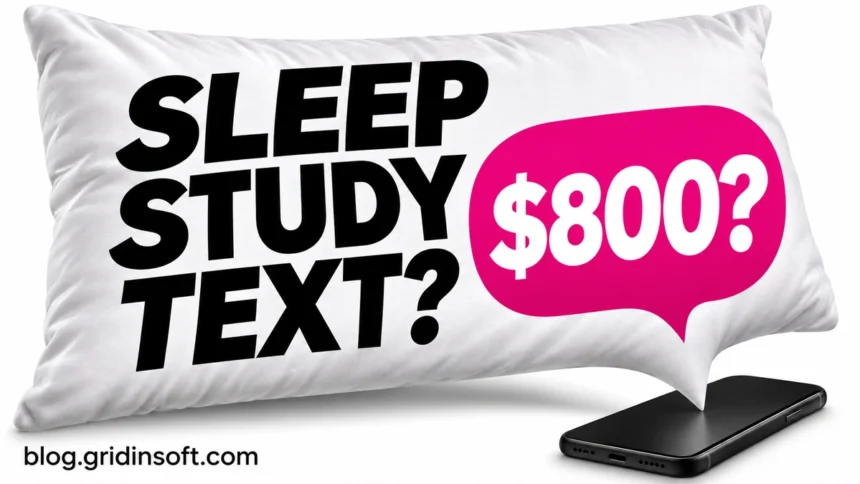
A ZammaLabs text reported by a recipient offered $800 for one night and claimed only three lab places remained. Yet the current website starts with a contact form, and its terms say submitting it does not guarantee a study invitation. Before sharing more information, ask which clinic is running the study and verify that answer through a contact you find independently. [1] [2]
Paid research can be legitimate. The amount offered, a familiar-looking website, or an unsolicited message cannot settle whether this particular invitation is genuine. Our checks did not authenticate the sender or establish fraud by the current Zamma Labs operator. The useful question is whether someone can connect your offer to a verifiable study, research team, and set of participation terms.
What the reported $800 sleep-study text leaves out
ScamPulse carries two recipient reports dated October 14 and October 17, 2026. One describes an unexpected sleep-study message despite never signing up. The other reproduces a personalized greeting, a claim of three available places, an invitation link, and the phrase “sleep study that pays 800 for one night.” These are user submissions, not independently verified findings about who sent the texts. [1]
The reproduced offer does not name a clinic, a study sponsor, a research protocol, or the work required to earn the payment. Its scarcity claim pushes the recipient toward a link before those details are available. That is the decision to slow down: obtain the study details first, rather than treating the promised amount as an appointment or a guaranteed payment.
In our November 16 check, the root addresses labs.zammalabs.com and unfoxy.zammalabs.com redirected to zammalabs.com. This was a check of those public root pages, not the personalized links reported in the messages. The current homepage describes support for clinical research and says Zamma Labs is not itself a clinic or medical provider. [3]
What you give the current Zamma Labs form
The visible signup form asks for a full name, phone number, and email address. Below those fields are separate boxes for accepting the site terms and privacy policy, receiving recurring automated service texts, and receiving marketing messages. A contact form can be an initial recruitment step; completing it is not the same as consenting to a particular research procedure. [3]
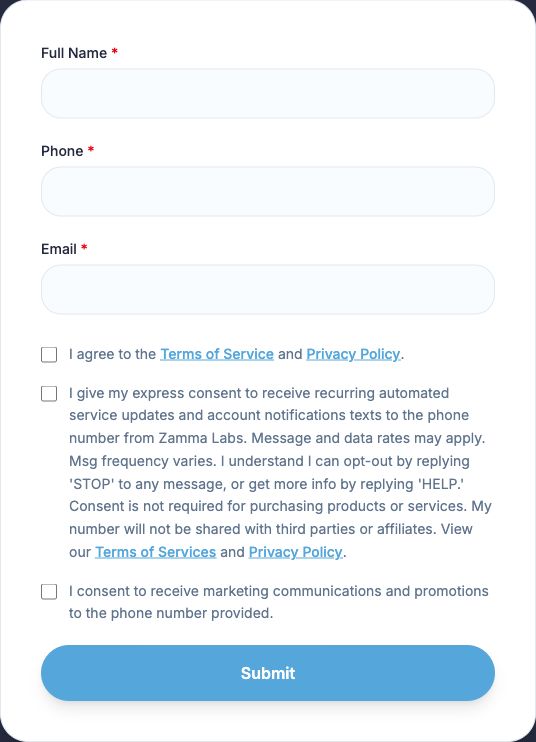
The distinction matters because the terms say eligibility and invitations are not guaranteed. Compensation varies by study and is to be explained before participation. The page therefore does not establish that the specific overnight offer exists, that you qualify, or that you will receive $800. [2]
The privacy policy says the site records contact details, communication preferences, and basic technical information. It says personal information is not sold, allows limited sharing with service providers, and describes marketing as a separate opt-in. Those are the operator’s published commitments; we did not submit the form or test its data handling. The policy also provides a route to request access, correction, deletion, or withdrawal of consent. [4]
Before filling anything in, save the wording you are agreeing to. If you only want study information, distinguish permission for study-related messages from permission for promotions. If a later page asks for health history, identity documents, or financial details, stop and verify who will receive them and why.
Verify the study through the clinic, not the SMS link
Use the offer to identify what needs checking, then leave the message and look up the organization independently. A recognizable recruiter name alone does not tell you who will perform the study.
- Get the study’s identity. Ask for its full title, sponsor, facility name and street address, researcher or study coordinator, and protocol number. If it is registered, ask for its ClinicalTrials.gov identifier, which begins with
NCT. Also ask whether the offer is research participation or a diagnostic sleep test ordered by a clinician; those are different arrangements. - Call the actual facility. Find its contact details on the hospital, university, or clinic’s own independently located website. Ask the research office to confirm both the study and the recruiter. Do not rely only on the number in the text or on the page it opens.
- Cross-check any registry record. Compare the study title, sponsor, recruiting status, eligibility, and location with the offer. Use the record’s Contacts and Locations section to reach the study team. A real study’s name or NCT number can be copied into an unrelated message; the team still needs to confirm the invitation. [6]
- Ask what earns the payment. Have the verified team explain the number and length of visits, overnight requirements, screening, payment timing, and what happens if you are ineligible or withdraw. Request the participant information and consent documents before agreeing to procedures.
A useful call is specific: “I received a text offering $800 for one overnight study. Does your facility conduct this study, is Zamma Labs authorized to recruit for it, and what must a participant complete to receive that amount?” If nobody can name the facility or connect the invitation to its research team, keep your data and money to yourself.
A missing registry result is not proof of a scam. The National Library of Medicine explains that ClinicalTrials.gov does not include every study; some are not required to register. Search using the actual study or sponsor name, not just a recruitment brand. Conversely, finding a record does not authenticate the sender. ClinicalTrials.gov does not recruit participants by text, and its records do not specify the costs or compensation associated with a study; ask the listed study contact. [7] [6]
The FTC’s research-recruitment guidance warns against paying for access to a trial or providing a Social Security number during recruitment or screening. Legitimate screening can involve contact and health questions, which makes independent verification especially important. A request to pay a deposit or “release fee” to unlock the promised reward is a reason to stop. This is different from checking ordinary billing for a doctor-ordered diagnostic test. [5]
For a separate link check, you can submit only the hostname, without a personal link token, to the Gridinsoft Website Reputation Checker. A domain report can flag technical warning signs; it cannot confirm a study’s existence, the sender’s authority, or your eligibility.
If you already clicked or shared information
Choose the branch that matches what happened. The public signup form we inspected requested contact details, not a password, Social Security number, or card.
- Only opened the page: close it and check whether anything downloaded or requested browser permissions. A visit alone does not establish that your account or device was compromised. Do not submit extra information just to find out what the offer is.
- Submitted your name, phone, or email: keep a record of the form and consent choices. Use the site’s independently located privacy contact to request withdrawal of consent or deletion if desired; its published address is
info [at] zammalabs [dot] com. Treat follow-up callers who know those details as unverified. Familiarity with your name is not authentication. [4] - Entered a password or sensitive identity information: change an exposed password through the real service and replace it wherever reused. For a Social Security number or identity document, follow the identity-theft response steps. Sharing only contact details is a different exposure from handing over account credentials.
- Paid or submitted card/bank information: contact the bank, card issuer, or payment service immediately through its official app or known number. Explain what happened and ask about securing the payment method and reversing the transaction. Save the message and receipt; recovery is not guaranteed. [9]
- Installed an app or ran a file: handle the device separately. Our phone malware checks can help identify the next step. Removing software cannot withdraw a marketing consent or reverse a payment.
For an unexpected, unverified SMS, report junk in the messaging app or forward it to 7726 where supported, then block it. Use a service’s STOP process only when you recognize and have verified that subscription; the STOP-versus-spam distinction explains why. The FTC recommends contacting a company through details you already know are real rather than those in the message. [8]
The deciding evidence is a research team that independently confirms the study, recruiter, requirements, and payment terms. Until those pieces connect, the $800 text remains an offer to verify—not a reason to disclose more information.
References
- ScamPulse contributors. “ZammaLabs Reports & Reviews.” Recipient reports dated October 14 and 17, 2026; accessed November 16, 2026. Reported sleep-study messages.
- Zamma Labs. “Terms of Service.” Updated 2026; accessed November 16, 2026. Participation and messaging terms.
- Zamma Labs. “Clinical Research Studies.” Accessed November 16, 2026. Public site and contact form.
- Zamma Labs. “Privacy Policy.” Updated 2026; accessed November 16, 2026. Data use and consent choices.
- Federal Trade Commission. “COVID-19 clinical trial: real or fake? Learn how to tell the difference.” October 2020; accessed November 16, 2026. Research recruitment checks.
- National Library of Medicine. “Common Questions.” ClinicalTrials.gov, updated June 29, 2026; accessed November 16, 2026. Study contacts, participation, and payment questions.
- National Library of Medicine. “What kind of web site is ClinicalTrials.gov?” Accessed November 16, 2026. Registry coverage and limitations.
- Federal Trade Commission. “How to Recognize and Report Spam Text Messages.” July 2022; accessed November 16, 2026. Independent verification and reporting.
- Federal Trade Commission. “What To Do if You Were Scammed.” Accessed November 16, 2026. Payment and account recovery.