A domain that looks like disposable text in a software manual can still belong to somebody. Manifold Security found third-party[.]com serving a fake Cloudflare check to Windows visitors, then traced two more example domains to advertising chains that sometimes delivered scams on Macs. Its September 23–24 reports expose a trust gap: the document can stay unchanged while the destination changes.
The distinction matters before copying a sample into a browser or a working application. A familiar-looking address is not automatically reserved for examples, and a verification page that asks you to run a command is asking for control of your computer.
A documentation link becomes a Windows command
Manifold’s investigation began when a domain reference in a public AI skill triggered a phishing alert. Its Windows test received a counterfeit verification page that placed a PowerShell command on the clipboard and directed the visitor to open the Run dialog, paste and execute it. Non-Windows requests received a decoy.
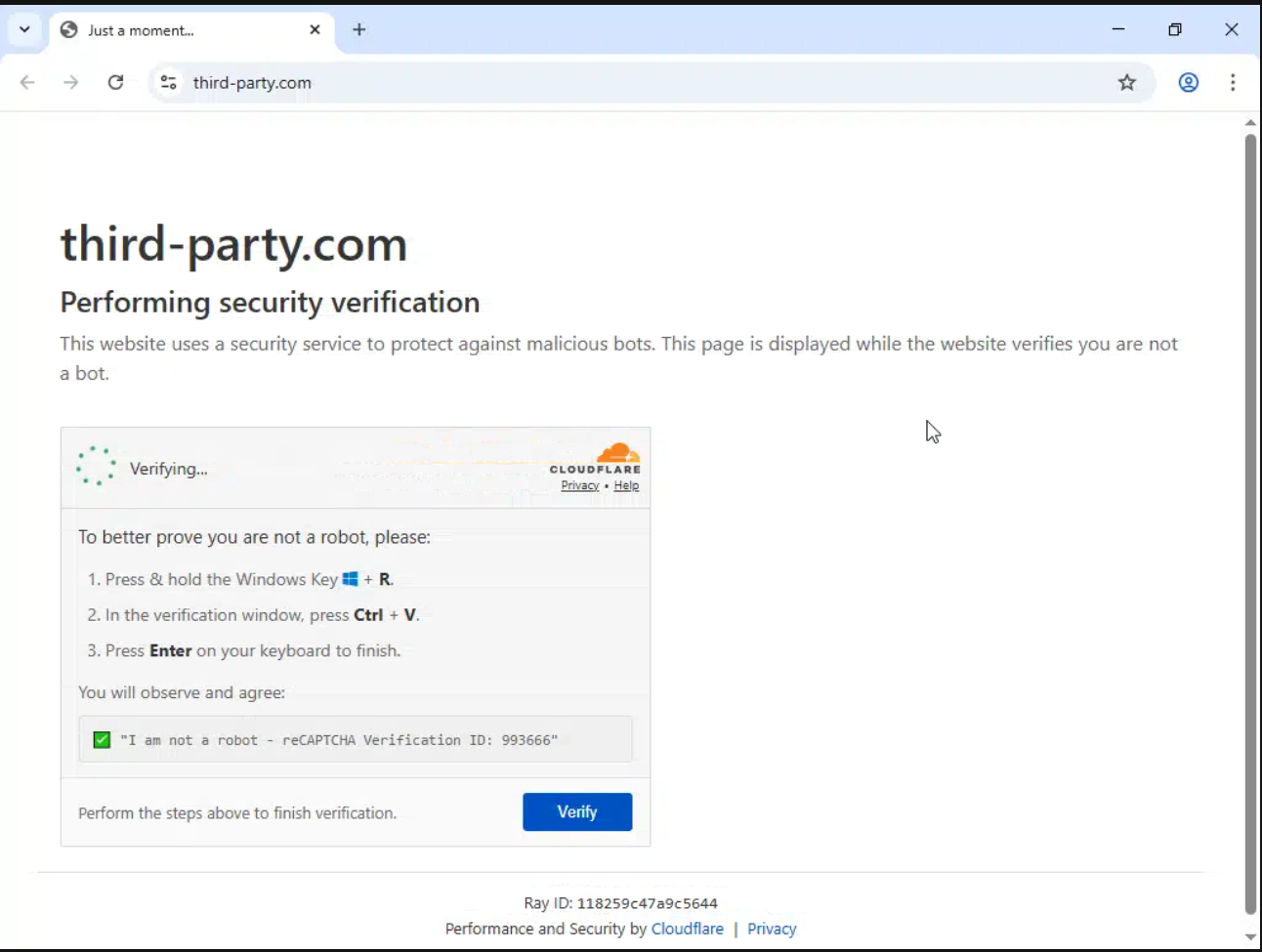
The clipboard command was meant to retrieve and execute a remote script. That second-stage host was offline during Manifold’s test; the report does not establish a completed infection or identify a delivered malware family. Nor does a domain reference prove that the repositories containing it were compromised.
This is the important boundary in ClickFix attacks: a webpage’s request becomes an operating-system action only when the person follows the execution instructions. A mention in a document, a browser visit and running a pasted command are different events.
The follow-up found scams behind ordinary ads
The September 24 follow-up examined yoursite[.]com and your-domain[.]com. Out of 24 browser renders, two reached scams, both on macOS: a counterfeit news investment pitch and a fake security warning. Other runs mostly saw parking pages or ordinary advertising; those observations are a limited test, not an infection rate.
Here the redirect happened after JavaScript ran. A text-only fetch could therefore miss the destination. Manifold also followed one scareware exit through affiliate tracking to a genuine McAfee page. It reported no evidence that McAfee participated in the deception. The legitimate final website did not make the preceding virus claims truthful.
That makes a single clean-looking visit a weak answer to a different question: what might another visitor see? The evidence supports variable advertising routes, not a claim that every request is malicious or that these domains share one attack campaign.
Reserved example domains solve a different problem
IANA maintains example.com and example.org for documentation; they cannot be registered or transferred. Its example-domain web service is provided on a best-effort basis and is not intended to support production applications. That is a specific reservation, not a rule covering any name that sounds illustrative.
For maintainers, the useful review is consequently about behavior as well as spelling. Does a URL appear only in explanatory prose, or does copied code load a script, make an API request or open a browser? Replace illustrative addresses with reserved examples. For executable tests, use a controlled fixture or mock; for a real integration, configure and verify the actual service endpoint.
These changes address different risks. A reserved name avoids handing an example to an unrelated owner. A controlled test endpoint also prevents a tutorial’s network dependency from silently becoming part of a running system.
If you followed the verification instructions
If you only viewed the page, close it and do not paste its clipboard contents into Run or a terminal. Viewing this lure alone is not evidence that its command executed. If you ran it on a work device, contact your IT or security team and retain the time and page address for investigation.
For a personal Windows PC where a command ran, check for malicious files and persistence. Removing a visible payload can leave a loader, scheduled task or browser change behind. Run a Gridinsoft Anti-Malware scan, and investigate any continuing activity; a clean scan cannot prove that no data was accessed.
If the page or email made you download an invoice, coupon, tracking app, browser extension, or support tool, scan the PC before opening it again or logging into sensitive accounts.
Check this PC after the commandThe lesson is precise: documentation can explain a URL without controlling it. Verify the destination before turning an example into a connection, and never turn a website’s human-verification request into a local command.
References
- Ax Sharma. Analysis of the third-party[.]com ClickFix lure. Manifold Security, September 23, 2026.
- Cody Nash. Investigation of scams reached through example-domain advertising. Manifold Security, September 24, 2026.
- IANA. Example Domains. Accessed September 25, 2026.