Old posts from Burger King and McDonald’s began sending readers somewhere their authors never intended after Bitly links inside them were repurposed. Bitly acknowledged the abuse on November 15 and said it had suspended the accounts involved and was disabling affected links. The important distinction is where trust broke: a genuine social post could keep its wording while the address behind its short link changed.
A 2011 post acquired a 2026 destination
Ransomnews investigated the redirects and compared the old posts with Bitly’s link-information records. Links in the brands’ 2011 posts showed creation dates in November 2026 and led to unrelated Wikipedia pages. The researchers later found those examples deactivated. The screenshot below records the earlier state; it is not evidence that the same destination remains active now.
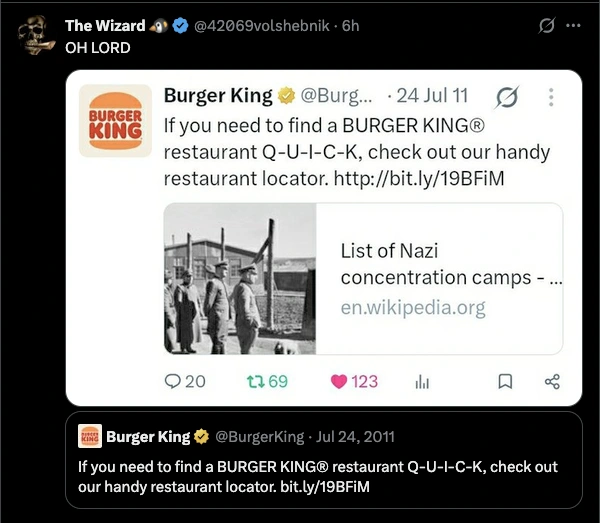
That mismatch between the age of the post and the age of its link record is more revealing than an offensive preview alone. It shows why checking only the author’s name or the original posting date can miss a change further along the route. The investigation does not establish a total number of affected Bitly links, and this case does not demonstrate that the brands’ social accounts were taken over.
The post and the redirect are different trust decisions
A short URL is an instruction to ask another service where to go next. The text surrounding it can remain unchanged for years while the destination is controlled elsewhere. An authentic post therefore establishes who published that text; it cannot, by itself, authenticate the page that a redirect opens today.
This is different from a lookalike account posting a new scam. The useful asset for an abuser is the old publication’s credibility: its familiar author and context encourage readers to carry their trust across the redirect. A visible destination that clashes with the post makes the break obvious. A plausible-looking sign-in page would make the same decision harder. That is a risk explanation, not a claim that this incident stole passwords or delivered malware.
Bitly’s statement confirms that certain old, inactive links could be repurposed and describes action against the accounts and links involved. It does not establish that every inactive Bitly address is available for reuse, identify the full technical cause, or prove that all legacy links are now safe.
Check the destination before giving it authority
If an old social post leads to an unexpected page, stop there. For a login, payment, download or wallet action, open the organization’s known official site independently and find the offer or service there. A familiar shortener hostname is only one stop in the journey; the final site still needs to match the task.
Following a redirect and entering credentials are separate events. If you already interacted with the destination, use the relevant branch of our guide to what to do after clicking a phishing link: an entered password, an approved permission and a downloaded file call for different responses. An unrelated page alone does not prove that your device was infected.
For publishers, review old posts and documents containing short links, especially those that still attract readers. Compare the intended destination with the current one and retire links you can no longer control. Keep a record of the source post and the unexpected route when reporting abuse; do not ask readers to test a suspicious destination by signing in.
The lesson is a specific one: old content can stay authentic while its outbound route stops being trustworthy. Recheck the destination at the point where it asks you to act.
References
- Ransomnews Research Team. “Old Bitly links hijacked in Burger King, McDonald’s and Trump tweets.” November 15, 2026; accessed November 16, 2026. Original investigation and dated checks.
- Bitly. Statement on repurposed inactive links. X, November 15, 2026, 19:13 UTC; public syndication copy accessed November 16, 2026. Company statement.