


A Windows stealer can turn a food-delivery receipt into intelligence about its victim. VOLTA-AUTODOXER, analyzed by Cisco Talos in research published October 31, collects passwords and sessions, enriches the haul with account information, and asks a language model to rank the person’s valuable assets. The AI stage comes after the theft: it helps the criminal decide what to pursue.
The report describes an analyzed malware sample, first seen October 11, rather than a newly measured infection wave. It does not establish a victim count or a universal delivery lure. Its most revealing detail is the use of stolen access to connect everyday purchases, online identities, and financial opportunities.
Stolen sessions turn receipts into an identity dossier
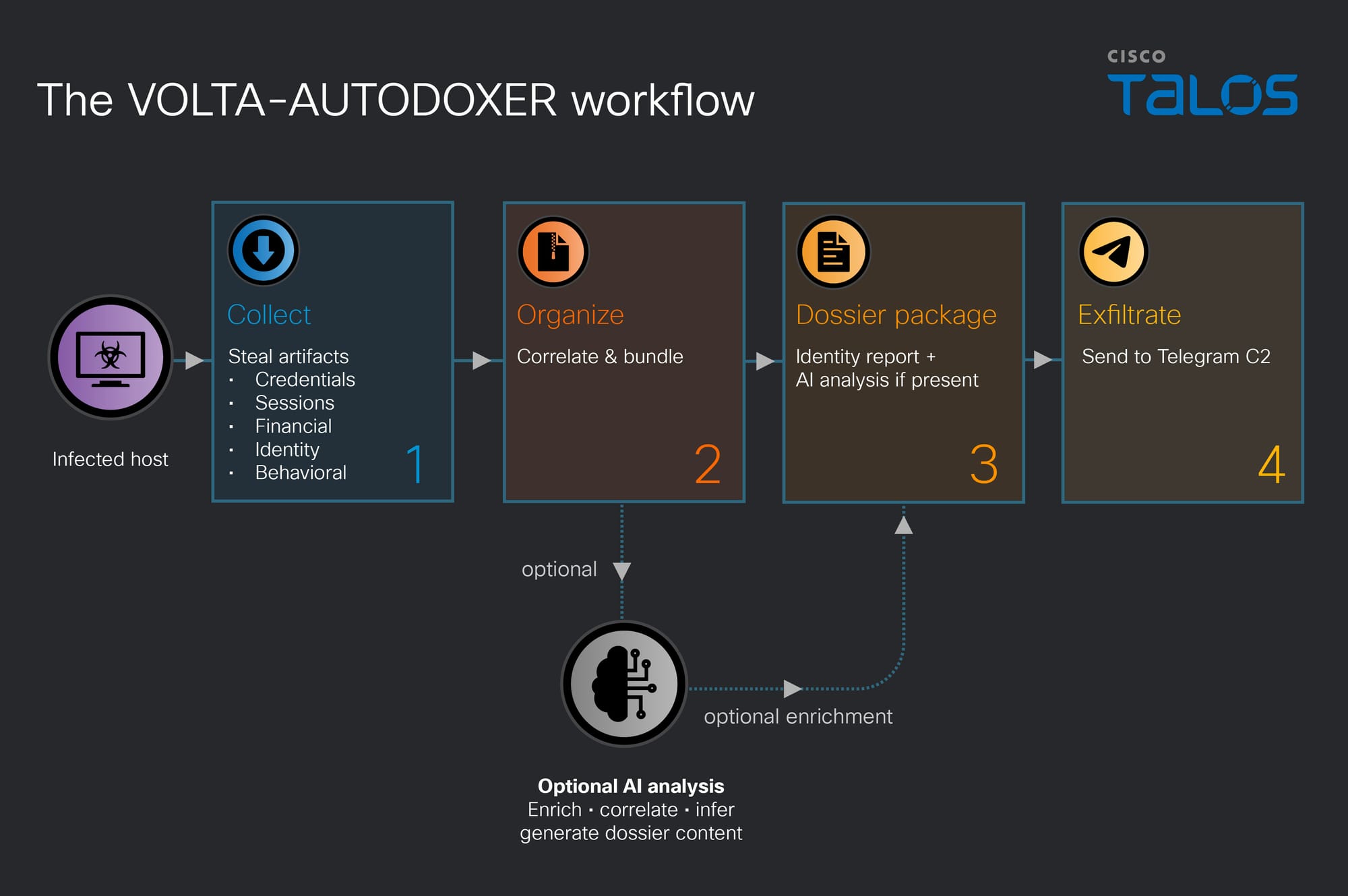
Talos describes collection from browsers, messaging and gaming accounts, wallets, and developer credential stores. VOLTA then reuses stolen sessions to look beyond the computer: Gmail receipts and food-delivery order history can help establish a home address, while account lookups add context about the person and their assets.
That changes what a seemingly ordinary receipt means. An isolated order confirmation has little obvious resale value. Connected to an authenticated mailbox, an address, and an account inventory, it becomes a way to identify someone and make a later approach more convincing. This is an interpretation of the mechanism, not evidence that every profiled person received a follow-up scam.
The useful distinction is between access and understanding. A stolen session can provide access without another password prompt. Correlating the records helps an operator understand which access might be worth exploiting. Protecting only the password leaves the first problem unresolved; dismissing delivery history as harmless overlooks the second.
The AI receives evidence that malware already stole
The sample assembles Identity_Report.txt, sends a structured bundle through OpenRouter, and stores the response as AI_Analysis.txt. The prompt requests an assessment of valuable assets and security habits. Talos found a configured model sequence from Claude Opus 4.6 to Kimi K2 and Gemini 2.5 Flash, with fallback logic for refusals. The analysis and identity report can leave together in volta_dox.zip.
A fallback is an attempt to get an answer, not proof that each provider accepted the request or that the resulting dossier was accurate. A model can infer a connection that is wrong. For the affected person, however, the underlying records have already been collected before that judgment is made.
This also explains why blocking the analysis step is an incomplete recovery strategy. The loss to address is the stolen account access and private information; an unsuccessful AI request would not put either back. Talos says the stealer can run without the optional model stage.
We previously covered Dolphin X’s operator-side AI profiling panel. VOLTA is a separate sample and research event, with a described collection-to-dossier sequence. Neither case justifies treating an AI product name as a malware indicator by itself.
A missing executable does not settle the incident
VOLTA can delete itself. Talos points investigators to %APPDATA%\volta_debug.txt, a harvest log that may record collection and whether the model call succeeded. Preserve it privately if present; do not post a potentially sensitive log to a public support thread. An absent log does not establish that a computer is clean.
If an unknown Windows program ran or there is concrete evidence of theft, separate the two recovery jobs:
- Contain and assess the computer. Disconnect the suspected device from sensitive activity. Preserve alerts and execution details before cleanup. A security tool may remove a visible payload while another loader, scheduled task, service, or browser change remains; this is a reason to inspect the whole system, not a claim that VOLTA installs all those components.
- Clean the Windows host. Download and install Gridinsoft Anti-Malware, update its database, run a Full Scan, review and remove detected threats, then restart. If the installer cannot run, use a trusted recovery or Safe Mode path and return to the full scan once access is restored. No scan guarantees detection of every sample or reverses data theft.
- Recover accounts from a separate trusted device. Revoke exposed sessions and tokens as well as changing passwords. Start with primary email and accounts that can reset others. Review connected applications, recovery settings, and unfamiliar activity. Where work credentials were present, involve the organization’s security team.
If a token stealer ran here, logging back in can hand the attacker your new Discord session, email cookie, Steam token, or wallet access. Scan this Windows PC first, then reset passwords from a clean device.
Scan the affected Windows PCFor the broader sequence, see our infostealer detection and recovery guide. If a wallet’s seed phrase was stored in plaintext on the affected machine, treat it as exposed: moving to a newly generated wallet from trusted equipment is a separate decision from cleaning Windows. Never enter the seed into a supposed refund or verification site.
VOLTA makes a familiar theft more personal. The model does not need to break into an account to help a criminal prioritize it; the stealer supplies the access and the context first.
References
- Ryan Fetterman. “Appraisal by AI: Model-driven victim prioritization in the VOLTA infostealer.” Cisco Talos, October 31, 2026; accessed October 31, 2026. Talos analysis of VOLTA.