A backdoor that keeps adding and removing a GitHub issue’s bug label is doing more than tidying a developer’s project. In Operation ShadowCloud, that repetitive action formed part of a continuous command-checking loop, while another repository supplied its next instructions.
Kaspersky’s November 17 investigation describes two previously undocumented Windows backdoors, GitDoor and GraphDoor, used against organizations in Asia and Africa, mainly in government. The researchers identified the campaign in early 2026. Its distinctive feature is how legitimate remote-management software and familiar cloud APIs become parts of the same intrusion.
A remote-management agent delivers three pieces
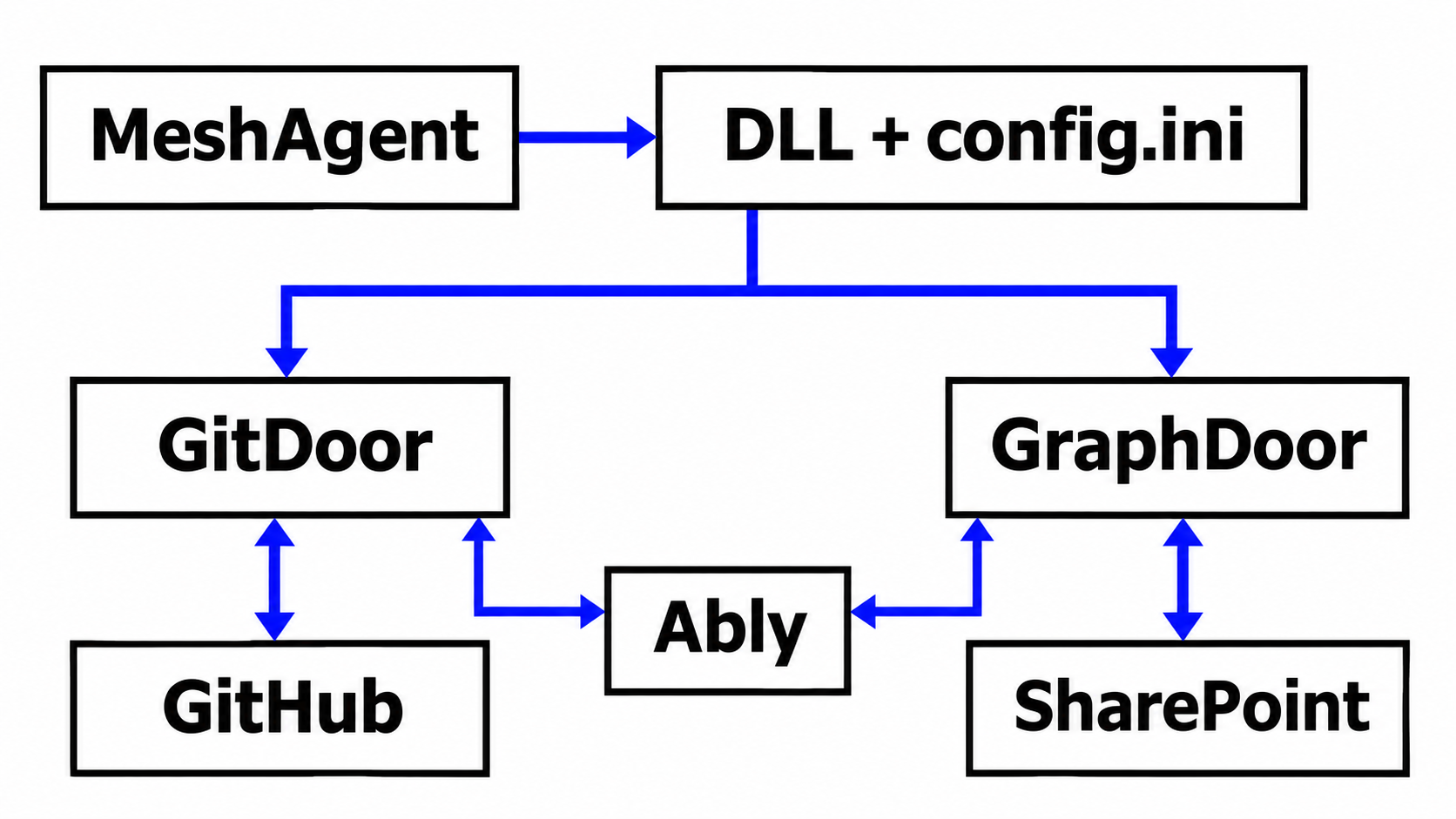
Inside one Taiwanese organization, investigators found two instances of MeshCentral’s MeshAgent. The legitimate tool supports remote desktops, command lines and file management. In this case, it connected to an attacker-controlled server and delivered a legitimate executable, a malicious DLL and an encrypted config.ini payload.
The first example paired Sandboxie’s start.exe with a malicious SbieDll.dll. Another used a Python application and python39.dll. Starting a trusted program caused it to load the attacker’s nearby library, a technique called DLL sideloading. The library then decrypted the payload and executed it in memory. A familiar executable name therefore concealed a different program’s behavior.
The initial access remains unresolved. Kaspersky says evidence points toward reuse of an infection already on the network, but does not establish exactly how MeshAgent first arrived. This is not evidence of a newly disclosed MeshCentral vulnerability.
GitHub becomes an inbox and a command loop
GitDoor separated incoming commands from outgoing results. In the analyzed sample, a public repository supplied command data and plug-ins; a private repository received the computer’s details and command output using a GitHub personal access token.
The implant created an issue, kept its returned issue number, and repeatedly added and removed the bug label. The report documents these changes as part of the recurring request sequence. Alongside those updates, it fetched repository contents and looked for command filenames containing the infected machine’s identifier. The changing issue labels accompanied polling; matching files carried the work.
Collected host details were packaged into encrypted data under names resembling JavaScript source maps. The important distinction is who is making the request and what repository it reaches: seeing a GitHub connection alone does not identify this malware, and the report does not say GitHub itself was compromised.
GraphDoor uses an application identity
GraphDoor took another route. It authenticated to Microsoft using an embedded application client ID and secret, obtained an access token, then used Microsoft Graph to exchange data through SharePoint. This authentication represented the application, rather than an interactive user login.
It wrote host information into a SharePoint document library under a filename shaped like main.<host-code>.js.map. That is a misleading file extension, not a reason to classify every source map as malicious. The implant also used a directory beneath C:\ProgramData\Intel_Log, with a separate randomly named subdirectory.
Both backdoors could obtain additional modules. The documented plug-in set includes keystroke logging, process enumeration, screenshots and proxy functions. Ably messaging and a modified reverse-proxy client provided further traffic channels. Those capabilities explain the surveillance risk; they are not a count of files or passwords actually stolen.
A related example is HOLLOWGRAPH’s use of Microsoft 365 calendar events: cloud traffic needs to be evaluated together with the application identity behind it.
Follow the process behind the cloud request
For defenders, the useful starting point is an unexpected MeshAgent deployment and its installation history. Correlate it with the executable that started, the DLL loaded beside it, the encrypted payload and subsequent cloud requests. A file called config.ini, an Intel_Log directory or a Microsoft login request needs that context before it becomes a finding.
Where the chain matches, preserve endpoint and network evidence, contain the host under the organization’s incident-response process, and investigate the related accounts and access. Blocking an entire cloud platform would disrupt legitimate work while leaving the original foothold unexplained.
Kaspersky observed overlaps with Chinese-speaking threat groups, including nearby deployment times and shared staging locations, but explicitly stops short of definitive attribution. ShadowCloud’s strongest lesson is the evidenced chain: trusted software can launch an untrusted library, and an allowed cloud destination can carry commands for it.
References
- Saurabh Sharma and Noushin Shabab. Operation ShadowCloud, Part 1: initial infection and GitDoor. Securelist, November 17, 2026.
- Saurabh Sharma and Noushin Shabab. Operation ShadowCloud, Part 2: GraphDoor, plug-ins and attribution. Securelist, November 17, 2026.