


If a work-from-home job asks you to receive someone else’s purchases, cover the shipping label and send the box to a new address, stop before the next handoff. This is a reshipping job scam. If you have the box, leave the original packaging and label intact. If you already handed it over, find the outbound tracking number and call the carrier that took it.
What makes this a reshipping scam?
A company might send you a laptop to use for work. The warning sign here is that moving someone else’s goods through your home is the work. The recruiter might call you a package inspector or ask for a photo of each delivery as proof you did your job. The FTC describes how scammers buy merchandise with stolen payment details and recruit someone else to send it onward. Your address ends up on the delivery record, and the promised paycheck may never arrive.
If the recruiter has only asked for your address
Pause the application. Look up the employer’s careers page yourself, find the exact opening, and use a contact listed on the company’s own website to ask whether it hired this recruiter for that role. A real company name on a job board proves little about the person messaging you. Our hiring scam guide explains how to verify a recruiter before sharing payroll or identity documents.
If you already gave a home address, tell anyone who accepts deliveries for you that an unexpected parcel may arrive. Ask them to decline it if they can. An address alone calls for different steps than a bank login or an ID document. Make a private note of exactly what you supplied. If a supposed Amazon recruiter also asked you to sign in, use the Amazon phishing guide to check the account separately.
If a shipping label arrives
Save the message and leave the attachment unused. A prepaid label tells a carrier where a box should go. It does not establish who bought the contents or whether the person directing the shipment can authorize a return.
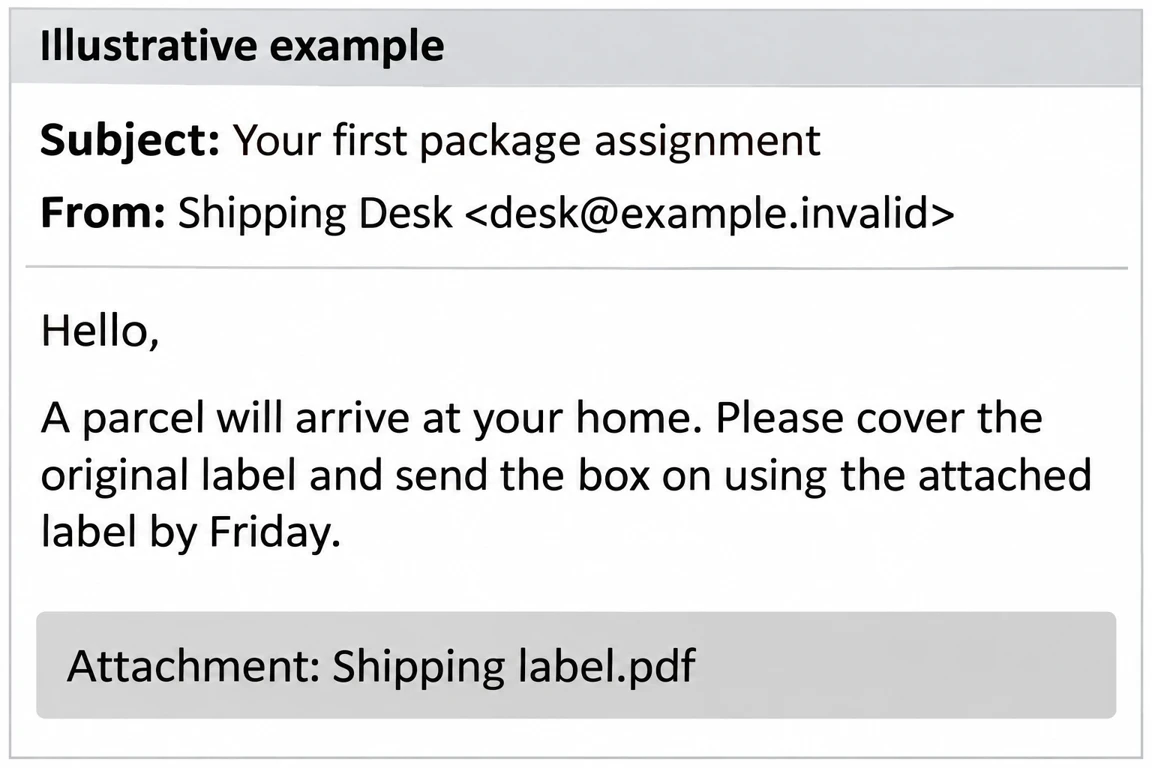
Example wording. Subject: “Your first package assignment.” From: Shipping Desk, desk [at] example [dot] invalid. “Hello, a parcel will arrive at your home. Please cover the original label and send the box on using the attached label by Friday.” Attachment: “Shipping label.pdf.” The request to replace the label is the warning sign, even in a message with polished spelling.
If the package is at your door
The U.S. Postal Inspection Service advises refusing unexpected packages from unknown senders or returning them to the sender. If delivery is in progress, tell the carrier you did not order the parcel and want to refuse it. If the driver has already left, keep the box intact and use the carrier’s official website or published phone number to ask how it handles a refused or misdirected delivery. Mention if you already opened the box.
Keep the original label and any packing slip. If you can identify the retailer, contact its fraud or customer service team through its own site and ask for instructions tied to that order. A second label supplied by the recruiter could send the goods to the same person who arranged the fraud. Wait for independently verified instructions before releasing the box or paying a fee.
If you already forwarded the parcel
Start with the drop-off receipt. There may be two tracking numbers for the same box. The incoming number records its trip from the seller to your home and may already say “delivered.” The outgoing number on your receipt or the second label tracks the trip you need help with now.
- Contact the outbound carrier promptly. Open its site yourself. Give the outbound number and ask whether the parcel is still in transit, whether a hold is available, and who can request it. The carrier may need the person or business that purchased the label to act.
- Contact the original retailer. Give it the original order or inbound tracking number through a verified channel. Explain how the parcel left your address. Keep the reference numbers for both conversations.
- Stop further collections. Save new pickup instructions, but decline further handoffs. For multiple parcels, make one row per box with the delivery date, incoming number, outgoing number and drop-off location.
You can tell the carrier: “I forwarded a parcel for what I believed was a job. My drop-off receipt shows this tracking number. I suspect fraud. Can you check its status, tell me who can request a hold, and give me a case number?” A stop request is time-sensitive, and recovery depends on the carrier and the parcel’s status.
What to keep and where to report it
Keep the original job listing or its URL, the recruiter’s contact details, messages, original and replacement labels, tracking history, and any receipts. Take copies before a listing disappears. Share them privately with the carrier, retailer or investigator. Posting a label online can expose addresses and tracking numbers belonging to other people.
In the United States, report the job offer at ReportFraud.ftc.gov. If US mail was involved, report it at uspis.gov/report or call the Postal Inspection Service at 1-877-876-2455. If you gave the recruiter banking details, call your bank using the number on your card. If you shared a Social Security number or an ID, the FTC’s identity-theft service provides steps for the specific information exposed.
References
- Federal Trade Commission. Can you unbox the signs of a reshipping scam? Consumer Advice, December 3, 2025.
- U.S. Postal Inspection Service. Be Smart! Reshipping Scams (PDF). Accessed November 19, 2026.
- Federal Trade Commission. IdentityTheft.gov. Accessed November 19, 2026.