
Phantom hacker scams is a specific type of fraud that aims at convincing the victim to transfer the funds due to the non-existent hacker threat. Over the last few months, such scams started targeting senior citizens, which can lead to significant financial losses. Let’s have a look at how this works, and how to avoid being scammed.
The Phantom Hacker Scams
In its September 29, 2023 advisory, the FBI warned of a nationwide increase in phantom hacker scams, an evolution of tech support fraud that particularly affects senior citizens. The advisory reported that IC3 received 19,000 complaints related to tech support scams between January and June 2023, with estimated victim losses of over $542 million. It also stated that, as of August 2023, losses had exceeded those in 2022 by 40%.
According to the statistics, scammers often target older adults. Around 66% of total financial losses are suffered by victims over 60. Seniors usually have much more savings than younger age groups, making them more attractive targets for criminals. Additionally, older adults are more mindful of potential life-saving risks, making them vulnerable to calculated scams.
How Do These Scams Work?
The scam process is divided into three stages, each aiming to increase the victim’s level of trust. The perpetrators behind phantom hacker scams employ social engineering to deceive their victims.
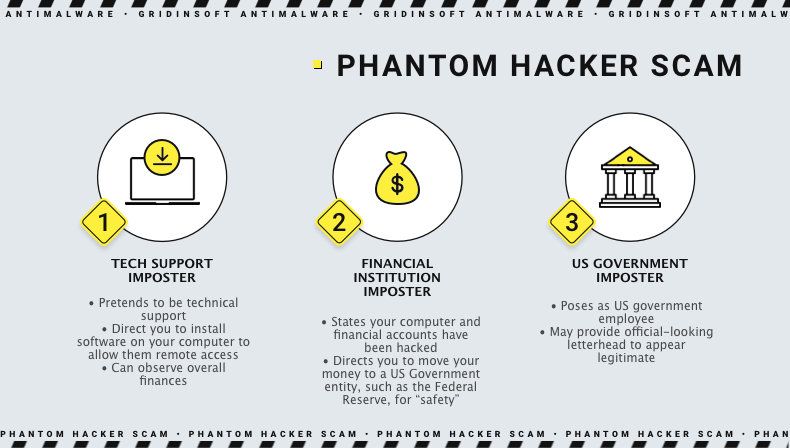
1. Initial Contact. Fraudsters pose as computer technicians from well-known companies. They convince victims that their computers have serious issues, particularly malware, and that their financial accounts are also at risk due to foreign hackers.
2. Follow-Up. Accomplices then impersonate officials from financial institutions or even the U.S. government. They persuade victims to transfer their money from supposedly vulnerable accounts to new “safe” accounts, all under the guise of government protection of their assets.
3. The Deception. Obviously, there was never any foreign hacker. Instead of safe accounts, the scammers now fully control the victims’ money. The funds vanish together with the “technicians” and “govt agents”, leaving victims devastated.
A September 2026 Mykolaiv bank-impersonation case used a supposed reserve account to persuade people to transfer their savings to scammer-controlled cards. It illustrates the same false-protection pretext; no link between the groups is established.
Safety Recommendations
To summarize, it is worth remembering the rules of telephone communication again. Here is a list of “Don’ts” that you should follow to minimize the risk of financial loss:
- Don’t Trust Unsolicited Calls. Be cautious when receiving an unexpected call claiming to be from tech support or a financial institution. Scammers often impersonate legitimate organizations to gain your trust. To protect yourself, please end the call without providing any personal details. Additionally, consider setting up a blocker for such calls.
- Don’t Share Personal Information. Never share sensitive information when you receive a phone call unless you initiate the call. Sensitive information includes your credit card information, bank account number, social security number, or passwords. Before sharing any sensitive information, verify the identity of the person independently.
- Don’t Rush Decisions. Scammers often use urgency to pressure victims into making hasty decisions, resulting in funds being transferred without understanding the situation. Take your time. Ask questions, seek advice from trusted sources, and don’t let anyone rush you into making financial commitments.
- Don’t Transfer Funds. Proceed cautiously if someone asks you to transfer money based on an unsolicited request. Contact your financial institution directly using official contact information to confirm the transaction.
- Instruct Your Elderly About the Threats. Aside from showing more trust towards strangers, older generations often struggle to find security news in time. Consider explaining the dangers and the ways to understand they’re talking to a fraudulent person.
If you manage a relative’s Windows PC, use our remote-access scam lockdown guide to combine a standard daily account, built-in download protection, a family verification rule, and safely tested application control.
References
- Federal Bureau of Investigation, Internet Crime Complaint Center. “Phantom Hacker” Scams Target Senior Citizens and Result in Victims Losing their Life Savings. September 29, 2023. Accessed September 16, 2026.