
A federal court has temporarily halted Digital Forensics Corporation LLC and its CEO at the FTC’s request, after the regulator alleged that people seeking help with sexual blackmail paid at least $60 million for misleading promises of protection. The October 13 announcement describes a second financial trap: victims afraid of an intimate image being shared were sold an investigation, then pressured to buy another stage of help. The allegations remain before the court; this is not a final judgment. [1]
The search for help became a sales call
The FTC says the business reached people through advertising on Google, YouTube and X. Its consumer notice identifies websites including BlackmailHelpline.com, DigitalForensics.com, CyberBlackmail911.com and SecurityBreach911.com. Those names matter because someone searching in a panic may encounter a reassuring service name before understanding which company operates it. [3]
The first purchase, called Phase 1, was presented as a way to stop the blackmail. According to the complaint, it promised communication with the attacker, a tracking campaign, an investigative report and contact with law enforcement. Five tiers cost $1,499–$20,000; the complaint says staff normally recommended the $4,999 tier and collected an initial payment during the call. Contracts typically arrived after that payment. [2]
That sequence moved the urgent decision ahead of the written terms. The reader-facing distinction is simple: paying for a promised investigation does not establish that an attacker has been identified, contacted or stopped.
A report could conceal the missing investigation
The complaint describes customers checking their own accounts despite instructions not to log in. Some found that the company had simply blocked the blackmailer, although its sales pitch had warned them against doing exactly that. Former employees cited by the FTC described staff fabricating conversations with colleagues posing as attackers, then placing screenshots in customer reports. These are allegations supported in the complaint by employee accounts and consumer reports, not findings from a Gridinsoft test. [2]
The alleged tracking results had a similar problem. The FTC says employees reused stored geographic coordinates when a tracking link failed or produced no useful information. A map pin inside a report therefore could appear to answer “who is threatening me?” without evidence that it located that particular person. [2]
No identity found — but another paid phase recommended
Figure 9 in the complaint captures the contradiction. The reproduced Phase 1 report says the suspect’s true identity was not found and communication could not be established within 72 hours. It nevertheless predicts renewed blackmail and strongly recommends Phase II. The screenshot shows what the FTC is challenging; it does not independently validate the report’s prediction. [2]
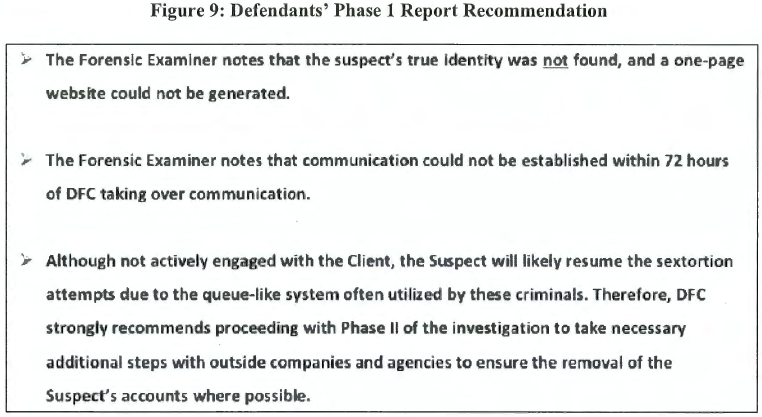
The complaint alleges that a service initially described as rarely necessary became a routine additional sales pitch. Phase 2 usually cost another $2,000–$5,000 or more, according to the filing, and purported to provide monitoring and police contact. Former employees told the FTC that promised monitoring was not performed and that even bounced emails to law enforcement could be left without further action. [2]
This explains why a professional-looking report is not the same as a verified outcome. The alleged product was reassurance backed by documents, while the next sale relied on fear that the threat would return.
What the action establishes, and where real help starts
The complaint was filed on October 6; the FTC published its announcement and case documents on October 13. The agency’s case page still lists the proceeding as pending. [4] A temporary halt does not mean a final liability ruling or a guaranteed refund. Nor does this case establish that every paid assistance provider is fraudulent. [1]
In its accompanying advice, the FTC recommends stopping communication, blocking the blackmailer, not paying them and not giving them access to devices or financial accounts. It also recommends talking to someone trusted and reporting threats to law enforcement. If an intimate image has been posted, use the platform’s reporting channel; the FTC explains the applicable US removal process in its notice. [3]
Our sextortion guide explains the broader threat and response. The specific lesson from this case is to distinguish a promise of rescue from evidence of completed work. A second invoice cannot itself prove that someone else has stopped the blackmail.
References
- Federal Trade Commission. “FTC Sues Operator of Sextortion Relief Scheme for Misleading Consumers into Believing it Would Identify Criminals and End Sextortion Attacks.” October 13, 2026; accessed October 16, 2026. Official announcement.
- Federal Trade Commission v. Digital Forensics Corporation LLC et al. Complaint, No. 1:26-cv-02615-PAG, filed October 6, 2026, pp. 24–33 and Figure 9 on p. 31. Accessed October 16, 2026. Complaint and reproduced report.
- Federal Trade Commission, Consumer Advice. “How to avoid deceptive sextortion assistance services and find real help.” October 13, 2026; accessed October 16, 2026. Official consumer guidance.
- Federal Trade Commission. Digital Forensics Corporation LLC et al., FTC v., case 252 3163. Case status pending; accessed October 16, 2026. Case status and document timeline.