A Financial Assistance Department email is unsafe when it offers money you did not apply for and tells you to call, reply, send documents, or pay before funds are released. One version uses an 855 or 833 callback number. Others promise an unusually large CRK GROUP business loan, a multimillion-dollar crypto cashback payout, or a 20% commodity-trade commission. Do not use contact details from the message; verify the organization and offer independently. A message can still be phishing when it contains no link or attachment: the callback number may be the trap.
The name in an email is not proof that the sender represents a real company. Unrelated legitimate businesses can share similar names, so the verdict here applies to the specific unsolicited message pattern and its claims, not to every organization called CRK GROUP or every business-finance offer.
Debt-Relief Phishing Without a Link or Attachment
On August 25, 2026, Check Point reported approximately 24,700 debt-relief and financial-hardship phishing emails targeting more than 9,000 organizations over 14 days. The message pushes the recipient into a phone conversation, where the caller may request personal, financial or payment details or move the conversation elsewhere. A routine-looking sender and the absence of a malicious attachment do not authenticate that request. [3]
The useful check is who controls the next step. Do not call the number supplied in the offer. If you have an existing loan or application, use the creditor’s app, a recent statement, or an independently located official contact. A claimed deadline does not replace verification. The FTC recommends contacting creditors directly and warns that a debt settlement company cannot collect its fees before settling your debt. [4]
Example
Subject: Financial hardship assistance
From: Assistance Department — support [at] assistance [dot] example
Hello,
You may qualify for reduced debt payments. Call the number in this message today to discuss your eligibility.
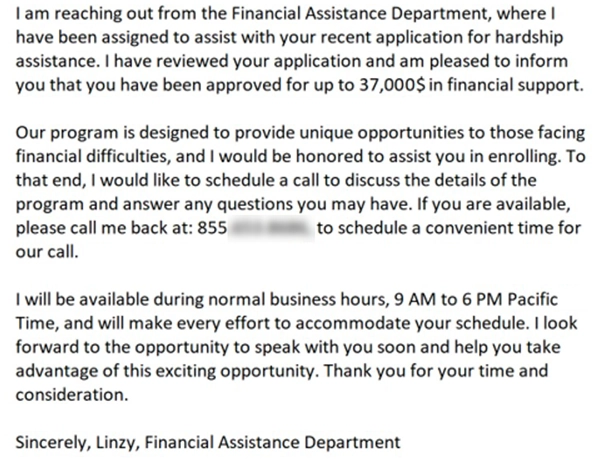
The older callback screenshot below shows the same decision: a promise of financial support followed by a request to telephone the sender. It is not evidence that the pictured message belongs to the August campaign.
How the Financial Assistance Department scam works
The older callback version claims to come from a financial-aid or hardship-assistance department. It says the recipient has been approved for support, then asks them to call a number in the email. The caller may request a Social Security number, bank or card details, identity documents, or a payment to complete the supposed application.
Real organizations can contact applicants about an existing case, but an unexpected approval is not proof. A generic department name, no application history, a free-mail sender, a callback number that cannot be verified on an official website, or a demand to act quickly are reasons to stop and investigate.
Business Funding Opportunities and CRK GROUP email example
The newer variant targets business owners instead of people seeking personal assistance. It claims that “CRK GROUP,” described in the message as a Hong Kong lender, can provide USD 1 million to USD 500 million at 3% annual interest, with a 10–15 year repayment term and up to two years before repayment begins. The first email may ask only for a reply or project details. Later messages can introduce processing, insurance, legal, certificate, or transfer-tax fees and requests for identity or bank documents.
Example
Subject: Business Funding Opportunities
From: Lucia — CRK GROUP <lucia [at] crk-funding [dot] example>
Dear Business Owner,
CRK GROUP can provide funding from USD 1 million to USD 500 million at 3% annual interest. Repayment terms are 10–15 years, with up to 2 years before repayment begins.
Reply with your project details if you wish to proceed.
Kind regards,
Lucia
CRK GROUP
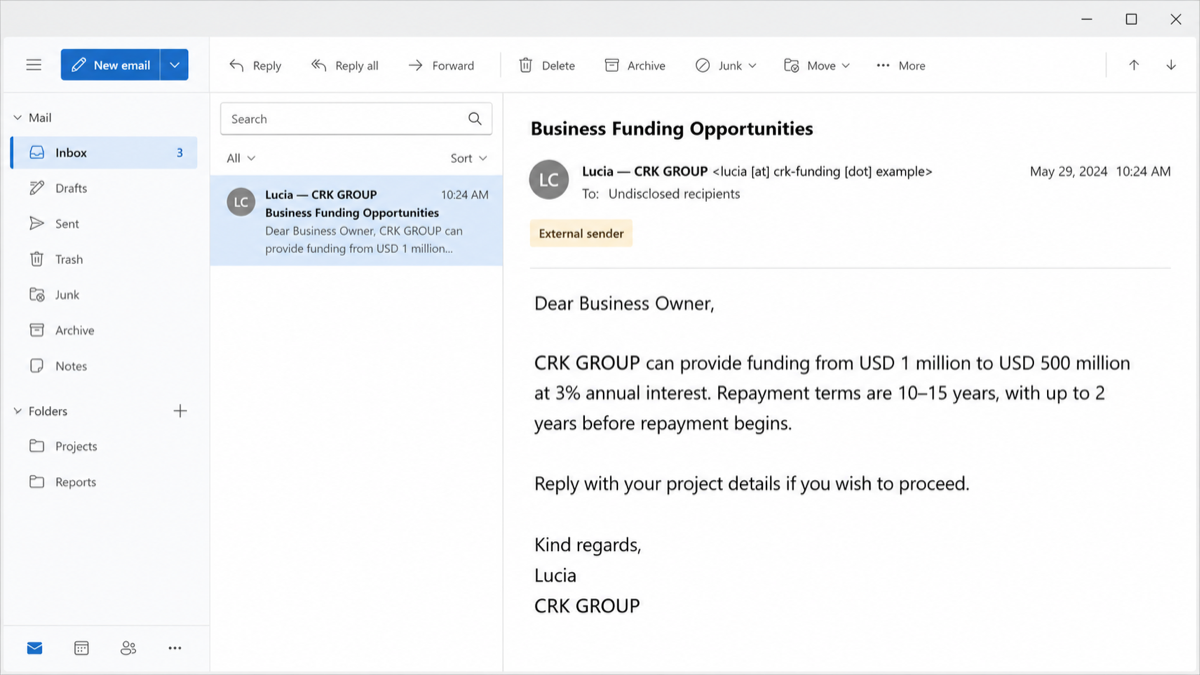
This example is intentionally obfuscated. Do not search for or contact the sample address. Scammers can change the sender name, country, amount, rate, and signature while keeping the same advance-fee structure.
Crypto Cashback Reward and fake MMF payout variant
This version claims that a fabricated “Digital Money Market Funding System” or “Tokenized Money Market Fund Provider” assigned the recipient a 1% share of a $714,632,516.87 managed fund. The supposed payout is $7,146,325.16 USDT, and a progress indicator says the verification is “75% Complete.” The message then tells the recipient to continue through Signal.
Example
Subject: Finalize – [wallet address] – MMF Distribution ($7,146,325.16)
Your 1% share of the managed fund has been allocated. Payout verification status: 75% Complete.
Contact the assigned settlement representative on Signal to finalize the distribution.
A large number, a wallet address, and a nearly complete progress bar do not prove that any fund or payout exists. After contact, the sender can invent taxes, compliance charges, processing costs, or wallet-validation fees. Do not pay to release the supposed reward, connect a wallet, share a seed phrase, or send identity and banking documents.
Business Accompany coltan and 20% commission variant
The “Business Accompany” version uses a different story but the same pay-first structure. A supposed military general in the Democratic Republic of Congo claims to control a coltan stockpile and says his son in South Africa needs help meeting local buyers. The recipient is offered a 20% commission for arranging the deal.
Example
Subject: Business Accompany
I am a military general in the Democratic Republic of Congo. My son is in South Africa with a coltan business opportunity and needs a trusted person to meet buyers.
You will receive 20% of the completed sale for your assistance.
A reply can be followed by requests for accommodation, transport permits, customs clearance, legal documents, or other invented costs. The sender may also request a passport copy, company papers, or bank details. Do not reply or pay; preserve the message and use the response steps below if information or money was already sent.
Why the offer is suspicious
- What the email claims: Funding from USD 1 million to USD 500 million
Risk and safe check: A firm commitment at that scale should follow underwriting, identity checks, financial review, and written terms. An unsolicited message cannot replace those checks. - What the email claims: A fixed 3% annual rate and long repayment period
Risk and safe check: Extremely favorable terms offered before reviewing the borrower or project are bait. Ask for the legal lender name, registration, total cost, security requirements, and complete written term sheet through an independently verified channel. - What the email claims: Up to two years before repayment begins
Risk and safe check: A long grace period makes the offer feel low-risk, but it does not prove that funding exists. - What the email claims: Reply with project or company details
Risk and safe check: The first reply confirms that the mailbox is active and gives the sender material for a more convincing follow-up. - What the email claims: Processing, insurance, legal, certificate, or transfer-tax payment
Risk and safe check: This is the core advance-fee warning. The FTC says scammers often promise credit, then demand money for processing, insurance, an application, or paperwork before the loan is delivered. [1] - What the email claims: Identity documents or bank details by email
Risk and safe check: Documents can support identity theft, account takeover, fraudulent applications, and later targeted scams. - What the email claims: A 1% crypto-fund share and “75% Complete” payout status
Risk and safe check: Numbers, wallet text, and progress bars are easy to fabricate. A request to continue on Signal and pay tax, compliance, processing, or wallet fees is an advance-fee warning. - What the email claims: A military general, coltan stockpile, son in South Africa, and 20% commission
Risk and safe check: The dramatic backstory and oversized commission are designed to win a reply. Accommodation, permit, customs, and document requests are the likely escalation path.
How to verify a lender without trusting the email
- Do not reply first. Save the message, but do not use its phone number, reply address, website, QR code, or attached document.
- Identify the exact legal entity. Ask for the registered legal name, physical address, licensing or registration number, and the jurisdiction where it lends.
- Check the relevant official registry. In the United States, verify state lender registration with the state banking or financial-services regulator. For another country, use that jurisdiction’s official company and financial regulator records.
- Compare contact details. A registry record is not enough if the email domain, phone number, representative, or bank instructions do not match independently published details.
- Demand full written terms. Review the interest rate, fees, total repayment, collateral, guarantees, governing law, and disbursement method with an accountant or attorney before sending money or documents.
- Walk away from payment-for-a-promise pressure. A fee that supposedly guarantees release of the loan is a classic advance-fee pattern. The FTC’s guidance explains that legitimate lenders do not guarantee credit simply because an upfront payment was made.
For a different loan-themed lure that uses a copied financial brand and a verification link, see the American Express Personal Loan Approved email scam. The broader phishing email checklist shows how to inspect the sender, links, headers, and reply path.
What to do if you received the email
- Do not call, reply, click, scan a QR code, or open an unexpected attachment.
- Mark the message as phishing or spam and warn anyone else copied on it.
- Preserve the original email and headers if it targeted a work mailbox or if money or documents were requested. Record the callback number, call time, information disclosed and any payment request; send these through your organization’s usual security-reporting channel.
- Verify any real application from the official lender website, app, or a known contact you already used—not from the message.
- Report an advance-fee loan attempt to the appropriate consumer-protection or financial regulator. In the United States, the FTC accepts reports through ReportFraud.ftc.gov.
If you already replied, paid, or sent documents
- Called but shared nothing: end the call, block the number, and keep the email and call time if you need to report it. A call alone does not mean malware was installed. Do not continue through a replacement number, messaging app or remote-support session.
- Only replied: stop the conversation, block the sender, and expect follow-up messages that know your name, business, or project.
- Sent bank or card details: contact the financial institution through an official number, explain exactly what was shared, and follow its account-protection steps.
- Shared identity details or sent documents: follow the identity-theft warning and recovery steps, monitor credit and accounts, and preserve the email as evidence.
- Paid a fee: contact the bank, card issuer, wire service, crypto exchange, or payment provider immediately. Recovery depends on the method and timing. Do not pay a second “recovery” fee.
- Entered a password: change it from a clean device, secure the email account first, enable multi-factor authentication, and remove unknown sessions.
- Received a follow-up link, file or support request: close it and do not install anything. If a file was downloaded, the Gridinsoft Online Virus Scanner can check it; scan the computer if you ran a file, added an extension, enabled macros, or installed a support tool.
FAQ
Is CRK GROUP a real lender?
The display name alone cannot answer that. Different real businesses may use similar names, while scammers can type any name into an email. Treat this specific unsolicited funding message as unsafe until the exact legal entity, lending authorization, domain, representative, and written terms are independently verified.
Does every unsolicited business-loan email mean fraud?
No, but an offer that promises approval without underwriting, hides the legal lender identity, uses unverifiable contacts, or demands money before releasing funds has the warning signs of an advance-fee scam.
Can a real lender charge an application fee?
Some legitimate lenders can charge disclosed application or appraisal fees during a real review. The dangerous pattern is a surprise fee that supposedly guarantees approval or releases already-promised funds. Verify the lender and written terms before paying.
What if the email says it is a government grant?
Grants.gov warns that the U.S. government does not contact people to award federal grants they never applied for, does not charge an application fee, and does not require a federal grant application by phone or email. [2]
References
- Federal Trade Commission. “What To Know About Advance-Fee Loans.” Consumer Advice, July 2022, accessed July 10, 2026. https://consumer.ftc.gov/articles/what-know-about-advance-fee-loans
- Grants.gov. “Grant-Related Scams.” U.S. Department of Health and Human Services, accessed July 10, 2026. https://www.grants.gov/learn-grants/grant-fraud/grant-related-scams.html
- Check Point Team. “Check Point Blocks Large-Scale Debt-Relief Email Phishing Campaign Targeting More Than 9,000 Organizations.” Check Point Blog, August 25, 2026. Campaign report
- Federal Trade Commission. “How To Get Out of Debt.” Consumer Advice, accessed September 8, 2026. Creditor contact and debt-settlement guidance