A real dealership name, real vehicle photos, and real customer reviews do not prove that the website or salesperson belongs to that dealer. The FTC is warning about fake car dealership websites that copy legitimate businesses and ask buyers to pay up front for vehicles that do not exist. Before sending a deposit, verify three things through sources you found independently: who controls the website, who controls the exact vehicle and VIN, and who will receive the money [1].
The danger is the identity split. Search results and reviews may describe the genuine dealership while the phone number, email address, and payment instructions on the cloned page lead to an impostor. A polished design, HTTPS lock, written return policy, or familiar logo is not enough.
Inside the Clone: Where the Story Stops Matching the Records
According to the FTC, scammers reproduce dealer branding, vehicle listings, photos, policies, and even testimonials. Rare muscle cars and hard-to-find classics create urgency, while a detailed buying process or flexible return policy makes the transaction feel routine. But recent investigations show that a clone rarely invents one complete fake identity. It assembles believable pieces from different real places.
A real dealer name did not mean a real sale
In July 2026, KIRO 7 investigated a website using the name Harber Motors. The name belonged to a licensed dealer, but Mike Harber told the station that he had not sold vehicles in years and had not created the Ellensburg operation. A Louisiana buyer nearly sent more than $41,000 before contacting the real license holder and recalling the transfer. The address shown online led to a warehouse, not the claimed showroom [2].
Even the VIN described a real truck
The most revealing detail was not a typo or a bad photo. KIRO reported that a vehicle-history report matched the truck’s description, so the VIN looked reassuring. A deeper search showed the truck had been listed in Virginia in December 2025 and later bought by someone in Pennsylvania. The vehicle was real; the seller’s claim to possess it was not established. That is why checking that a VIN exists is weaker than confirming the vehicle’s current location and control.
The second invoice arrived after the first loss
A separate June 2026 BBB investigation in Omaha followed another path. A buyer found a listing on TikTok, communicated with a supposed representative for months, and wired $1,500 for the vehicle and shipping. When delivery failed, a purported shipping company asked for another $1,500 for “shipping insurance.” Investigators said the website used stolen photos and a real address associated with a similarly named business. The supplied bill of sale omitted the VIN, mileage, and vehicle color [3].
The same trust package can be reused at scale
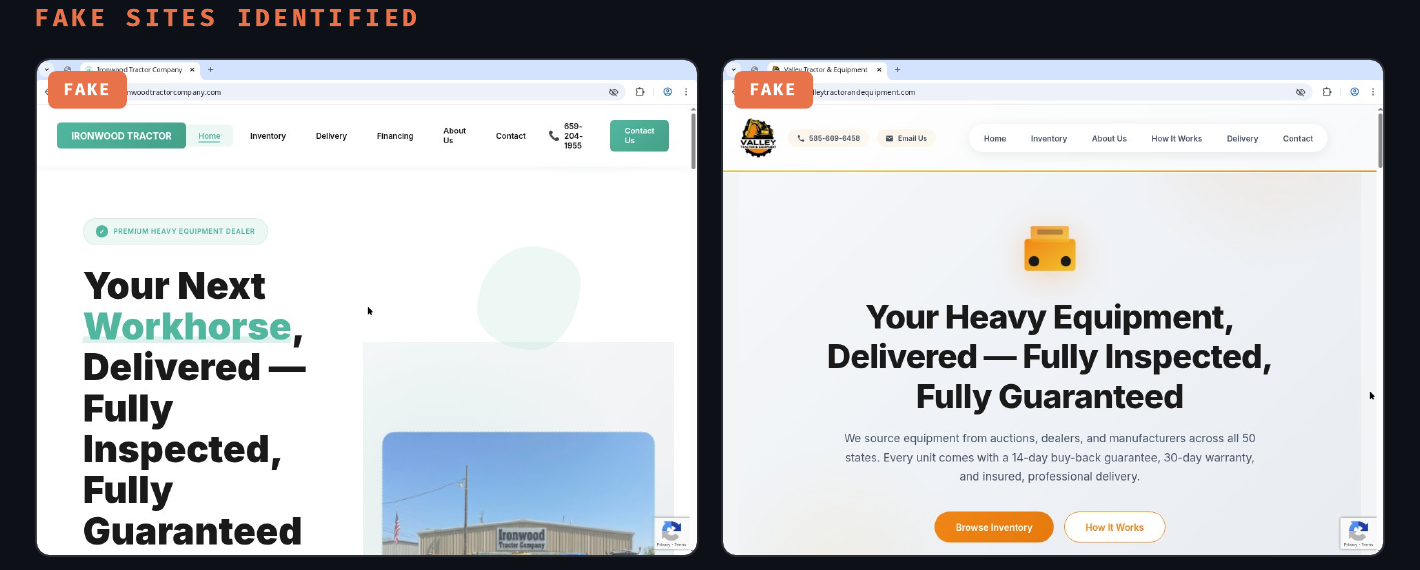
Point Predictive reported identifying a coordinated network of more than 101 suspected cloned dealer sites built from the same template. Its 2026 report says the sites reused a “14-Day Buy-Back Guarantee” and a fabricated “Trust Kit,” advertised vehicles 30–50% below market, and could disappear and reappear under another domain within two weeks [4]. Those figures come from the company’s investigation, not an official nationwide loss count, but the repeated template explains why several polished sites can share the same persuasion script.
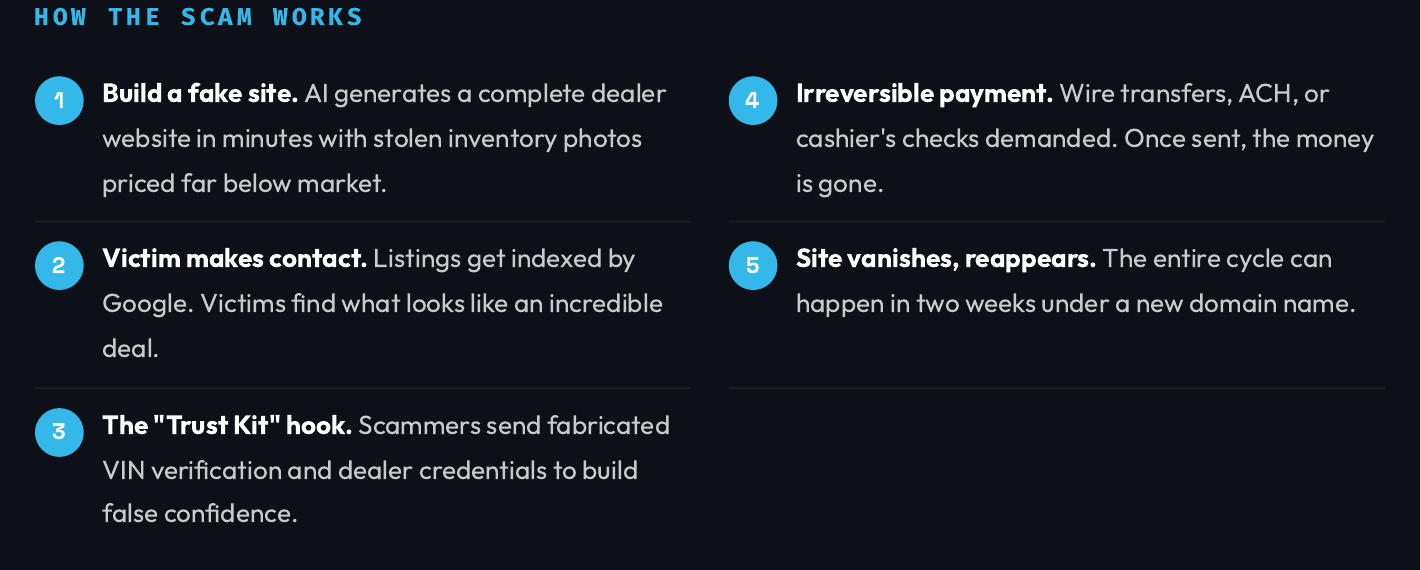
Artificial intelligence can make cloning faster, but “looks AI-generated” is not a reliable verdict. Content may be copied directly from a real dealer, and authentic records can be attached to a false sales story. The useful question is whether independently contacted parties confirm this domain, this salesperson, this exact vehicle, this contract, and this payment account.
Verify the Dealer, Vehicle, and Payment Separately
| Check | Proof to require before paying |
|---|---|
| Website and dealer | Find the dealer through a manufacturer locator, state licensing record, or another trusted directory. Call the main number from that independent source and ask whether the domain and salesperson are theirs. |
| Exact vehicle | Ask the real dealer to confirm the full VIN, stock number, location, mileage, and current possession of the vehicle. Compare the VIN across the listing, inspection, history report, and contract. |
| Inspection | See the car and dealership in person, or select and hire the mobile inspector yourself. Do not accept only a prerecorded video, a seller-chosen “inspector,” or a promise that inspection becomes possible after payment. |
| Contract | Require the legal dealer name, vehicle/VIN, total price, fees, deposit terms, refund terms, and delivery details in writing. Confirm the contract through the dealer’s independently found main office. |
| Payment recipient | The beneficiary must match the verified dealership or a financing/escrow arrangement that the real dealer confirms. Stop if instructions name an unexplained person, unrelated company, or newly substituted account. |
A seller may have a legitimate reason to request a deposit, and a wire transfer is not automatically fraudulent. The deal becomes unsafe when payment must happen before independent verification or inspection, when a wire is the only accepted method, or when the beneficiary cannot be tied to the verified dealer. The FTC specifically advises buyers to walk away from a wire-only upfront demand [1].
Remote Buyers Need Independent Eyes on the Car
If the vehicle is too far away to visit, choose the inspection service yourself and pay it directly. Ask for a live video call that shows the vehicle, full VIN plate, current odometer, surrounding lot, and a detail you request in real time. Then confirm the result with the independent inspector and the dealership’s main office. A live video is useful evidence, but it does not replace a title/history check or validate the bank account.
Search the dealer name with words such as scam, review, and complaint, but interpret the results carefully. Positive reviews can belong to the legitimate business being copied. No complaints may simply mean the clone is new.
Use a Domain Check as One Signal, Not a Verdict
Compare the address character by character with the domain confirmed by the real dealer. You can also inspect an unfamiliar address with the Gridinsoft Website Reputation Checker for age, reputation, hosting, and content signals. A warning is a reason to stop; a clean result cannot prove that the seller controls the car, VIN, salesperson, or receiving bank account.
The same boundary applies to other copied shopping flows. Our fake Walmart store investigation explains why HTTPS and familiar checkout icons do not validate a merchant, while the Facebook Marketplace scam guide covers deposit pressure and off-platform payment.
What to Do After You Used the Fake Site
You only viewed the website
Close it and do not return to “test” the checkout. Save the full URL and a screenshot only if it is safe to do so. Merely opening a page is not proof that money, identity documents, or accounts were stolen.
You shared contact information
Expect follow-up calls, texts, invoices, shipping messages, or “fraud recovery” offers that reuse details from the vehicle conversation. Block the sender, preserve the messages, and verify every new contact through a number you found independently.
You uploaded a driver’s license or other identity document
Preserve what you submitted and when. Use IdentityTheft.gov to build a response for the exact information exposed, check and freeze credit when appropriate, and contact the relevant motor-vehicle agency about exposed driver’s-license information [6].
You entered card or bank-account details
Contact the issuer or bank through its official app or the number on the physical card or statement. Explain that the data was entered on an impersonation site and ask whether the card or account needs to be locked, replaced, or monitored. Do not call a number supplied by the fake seller.
You paid a deposit or sent a wire
Contact the bank, card issuer, payment app, or wire company immediately. Report fraud and ask whether the transaction can be recalled, frozen, reversed, or disputed; recovery is not guaranteed, but delay reduces the options [5]. Save the URL, messages, listing, VIN, contract, payment instructions, receipts, beneficiary details, and timestamps. Notify the real dealership through its verified main number, report the scam at ReportFraud.ftc.gov, and follow local law-enforcement instructions for a high-value loss.
Do not pay a “recovery agent” who promises to retrieve the vehicle or money for another fee. That is a common second-loss opportunity after the original scam.
References
- Federal Trade Commission. “Scammers are spoofing car dealership websites: What you need to know.” FTC Consumer Advice, September 1, 2026. consumer alert.
- KIRO 7 News. “Car shoppers share their experience trying to buy vehicles from a dealership that appears to be fake.” July 22, 2026. Harber Motors investigation.
- WOWT / Gray Local Media. “BBB warns of fake car website claiming Omaha address.” June 1, 2026. Omaha case report.
- Point Predictive. “2026 Auto Lending Fraud Trends Report.” 2026. dealer-cloning investigation.
- Federal Trade Commission. “What To Do if You Were Scammed.” FTC Consumer Advice, accessed September 6, 2026. payment and account recovery guidance.
- Federal Trade Commission. “What To Do if Your Information Was Lost or Stolen, or Part of a Data Breach.” IdentityTheft.gov, accessed September 6, 2026. identity information recovery guidance.