A genuine Google login can still lead to a counterfeit seller. Researchers at Malwarebytes reported more than 100 linked subscription sites on September 21, including pages borrowing the names of DaVinci Resolve, PixAI and OpenCut. Some plans exceeded $2,000 a year. The investigated flow protected the Google password while leaving a different question unanswered: who was taking the customer’s money?
The login worked; the product remained out of reach
The researchers followed product pages through real Google authentication to a paywall, rather than a working demonstration. In the inspected examples, the requested data was limited to a name, email address and profile picture. They found neither Gmail/Drive access requests nor malware downloads.
That distinction matters. Google can identify the person signing in without vouching for the company receiving that identity. A buyer who treats the familiar login window as proof of an official partnership has answered the wrong question. The account may authenticate correctly while the storefront’s brand claim remains unverified.
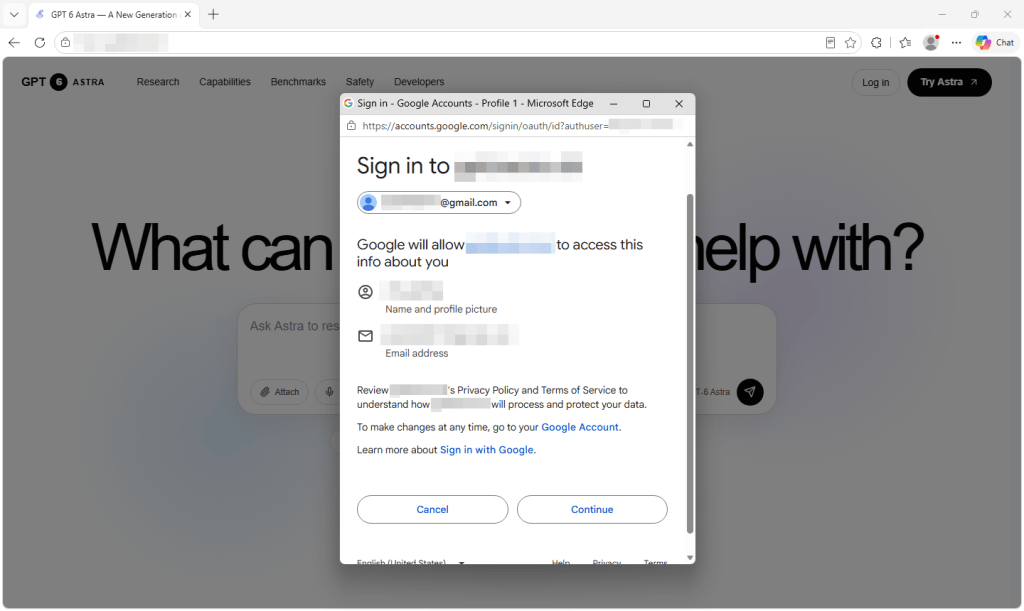
The screenshot shows the two decisions sitting on top of each other: a branded website in the background and Google’s account-sharing prompt in front. Read the application and developer details against the business you intended to visit. A matching logo in the background cannot resolve a mismatch in the identity of the recipient.
The copies left a trail beneath the branding
Identical software files connected the sites to a legitimate $249 starter kit. More tellingly, Google developer contacts reused a name with small variations. Researchers also found demonstration material presented as business credentials. Those observations suggest common or closely connected operators, rather than proving a single named owner.
Shared code alone would be weak evidence: independent businesses can buy the same template. The significance comes from combining a technical match with separately registered developer details and copied credibility claims. This is why a polished subscription dashboard is easy to mistake for a mature business. Account settings and billing can be ready before a seller has demonstrated the product—or established who stands behind it.
The same distinction helps when assessing other online scam warning signs: a seller’s own testimonials are claims to check, not an independent reference.
Separate the Google connection from the purchase
Before paying, locate the product through an independently verified publisher page and compare the exact domain. Read the seller identity, renewal period and total charge together. An annual charge is a different commitment from the monthly figure a landing page emphasizes. If the company cannot be independently identified, stop before uploading work documents, voice recordings or payment information.
If you already signed in, review the service on your Google Account’s linked-apps page. Google’s current instructions distinguish Sign in with Google from permission to access other account data. Remove the connection you no longer trust; if there are multiple connection types, review each one. Removing a sign-in link stops automatic login but does not erase data already held by the service.
Keep the receipt and cancellation information before disconnecting an app. Removing a Google connection is not a subscription-cancellation request. Deal with billing through the actual merchant or payment provider, and contact your bank about an unrecognized charge. Do not pay a new “verification” fee to someone promising a refund.
A separate fake Claude Max giveaway illustrates a different risk: its Google-looking window is drawn by the phishing page itself. Check whether you used a genuine provider login or typed credentials into an imitation before choosing the account-recovery steps.
This investigation does not establish that every visitor lost money, that every advertised feature was nonfunctional, or that a Google password was stolen. Its useful warning is narrower: reliable authentication and an unreliable seller can coexist. Verify the business before turning a successful login into a purchase.
References
- Stefan Dasic. The fake sites using a cheap toolkit to sell $2,000 AI subscriptions. Malwarebytes, September 21, 2026.
- Google. Manage links between your Google Account and apps from other developers. Google Account Help, accessed September 21, 2026.