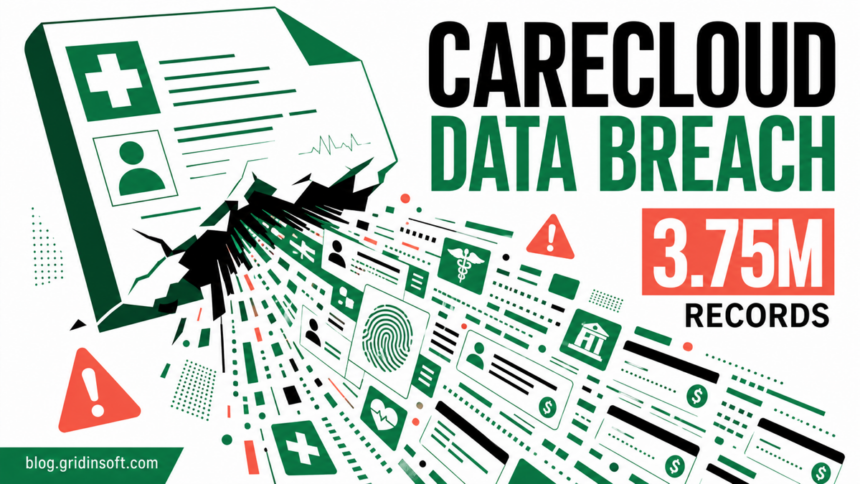
The U.S. Department of Health and Human Services now lists 3,756,469 people as affected by the CareCloud data breach. CareCloud says an unauthorized third party accessed one of its Amazon Web Services environments between March 10 and March 16, 2026, and claimed to have taken data from databases there. The practical response depends on what your individual notice says was involved: medical records, a Social Security number, and bank details require different checks.
This does not mean every patient whose provider uses CareCloud had the same data exposed. Act if you received a CareCloud notice, if your healthcare provider confirms that you are in the affected group, or if an explanation-of-benefits statement shows care you did not receive.
What CareCloud confirmed
The incident affected one electronic health record environment in CareCloud’s Health division. CareCloud detected a network disruption on March 16, engaged outside incident-response specialists, and reported the incident to law enforcement. Its notification says the third party had access for six days and claimed to have exfiltrated data. That wording matters: it supports treating the information as potentially stolen, but it does not identify a threat group or prove that every record in the environment was downloaded.
CareCloud says it secured the affected environment and has found no evidence of continued unauthorized activity after March 16. The company also says it is not aware of identity fraud or misuse directly tied to the incident as of the notice date. Neither statement makes long-lived identifiers such as Social Security numbers or medical history safe again.
Which information may be involved
The exact combination differs by person. Read the section titled What Information Was Involved? in your own letter rather than assuming that every category below applies to you.
Information in your notice — Risk and first response
- Social Security number or government ID: Consider a security freeze at all three U.S. credit bureaus and watch for new accounts, tax fraud, or identity-verification mail.
- Bank account or payment card data: Call the institution using the number on your card or statement. Ask whether the account or card should be replaced and enable transaction alerts.
- Medical or health-insurance information: Review insurer claims and explanation-of-benefits statements for unfamiliar providers, services, prescriptions, or equipment.
- Address, phone number, or email: Expect more convincing healthcare-themed phishing. Treat unexpected enrollment, refund, or billing messages as untrusted until verified independently.
A data breach is not the same as proof of identity theft. It changes the checks you should perform and how long you should keep watching. The recent ClarityCheck exposure is another example of why the response must match the type of information involved rather than the headline number alone.
What affected patients should do now
- Verify the notice without using an unexpected email link. Compare the sender and incident dates with the official state breach-notice listing or contact the healthcare provider that holds your record. A real notice should not ask you to pay, send a password, or provide a one-time code.
- Keep the letter and note your exposed fields. The activation code and enrollment deadline are person-specific. Store the notice securely; do not post the QR code or enrollment code online.
- Enroll in the offered monitoring if it matches your letter. CareCloud’s sample notice offers 12 or 24 months of IDX identity-protection services and gives an enrollment deadline of December 17, 2026. Use the URL or phone number printed in your verified paper notice.
- Freeze credit when an SSN or government ID was involved. A credit freeze is stronger than monitoring for preventing many new-account applications. Place it separately with Equifax, Experian, and TransUnion, then keep the recovery credentials somewhere safe.
- Contact your bank for financial fields. Monitoring a credit report will not catch every bank-account withdrawal or card charge. Use the institution’s official app, statement, or card number to ask about replacement and alerts.
- Check medical identity signals. Review explanations of benefits and year-to-date claims. Dispute an unfamiliar service with both the insurer and the named provider; ask for the medical record associated with the questionable date if necessary.
- Use IdentityTheft.gov if misuse appears. The FTC recovery plan helps document identity theft and organize reports, freezes, account closures, and disputes.
Watch for CareCloud breach phishing
A large breach creates a useful pretext for criminals even when they did not obtain the stolen database. A caller or message may claim that it can “finish your enrollment,” recover compensation, reverse an insurance claim, or confirm an SSN. Do not provide an activation code, password, payment, or remote access.
Open your provider’s known website or call a number from an earlier statement. If a follow-up message contains a different enrollment domain, inspect it before opening it; the Gridinsoft URL Scanner can help check a suspicious link, but it does not replace verification with the provider. Our phishing-email checklist explains how display names, urgent deadlines, and lookalike domains can make breach notices convincing.
The McKesson data breach update is another reason to separate an attacker’s raw-record claim from the affected-person count and data fields an organization has actually confirmed.
What remains unknown
The public notices do not name the attacker, describe the initial-access method, or establish that all 3.75 million records contained the same fields. They also do not show confirmed identity fraud caused by this incident. The defensible conclusion is narrower: one CareCloud AWS environment was accessed, the actor claimed data exfiltration, HHS lists 3,756,469 affected people, and recipients should follow the branch that matches the data named in their individual notice.
References
- U.S. Department of Health and Human Services, Office for Civil Rights. “Breach Portal: Notice to the Secretary of HHS Breach of Unsecured Protected Health Information.” HHS, accessed August 21, 2026. https://ocrportal.hhs.gov/ocr/breach/breach_report.jsf
- CareCloud, Inc. “Notice of Data Breach.” Published by the California Department of Justice, 2026, accessed August 21, 2026. https://oag.ca.gov/system/files/CareCloud_-_SSN_39739837v1.pdf
- U.S. Federal Trade Commission. “Identity Theft: A Recovery Plan.” IdentityTheft.gov, accessed August 21, 2026. https://www.identitytheft.gov/