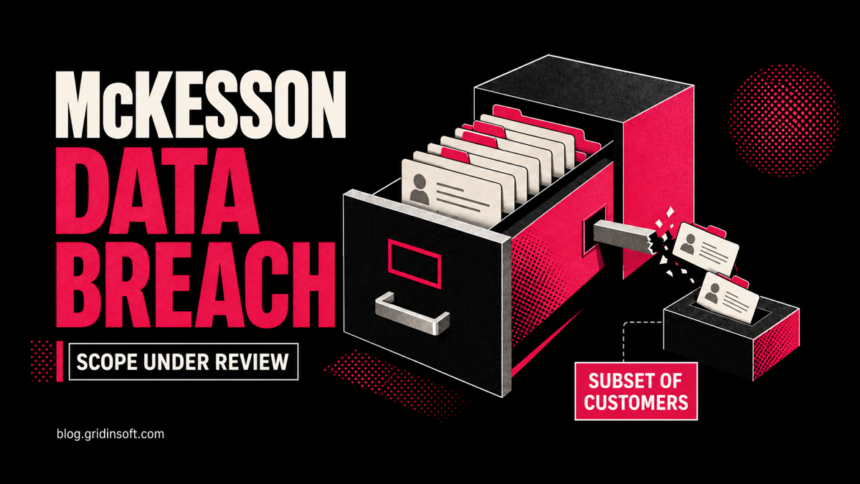
McKesson has confirmed a data breach involving unauthorized access to certain third-party applications and the exfiltration of data associated with a subset of customers. Its August 29 update narrows the affected business areas to Oncology & Multispecialty and Medical-Surgical, but the company has not yet disclosed the number of people involved or the specific data fields taken.
That boundary matters. ShinyHunters has separately claimed it stole roughly 284 million raw records, but this is not a confirmed count of unique patients. McKesson has not confirmed the group’s reported entry path, the record count, or the claimed data categories. People should base their response on a verified notice, not on the largest number in a headline.
What McKesson has confirmed
McKesson says it discovered the incident on August 25, 2026. The company’s public updates now confirm four points:
- Unauthorized access involved certain third-party applications.
- Data associated with a subset of customers was exfiltrated.
- The affected scope currently concerns the Oncology & Multispecialty and Medical-Surgical businesses.
- McKesson says it has reasonable assurance that there is no ongoing unauthorized activity.
McKesson says its business lines, ordering systems, and distribution centers remain operational. The earlier August 28 notice mentioned intermittent service degradation, but the latest update says operations continue. The company expects to offer complimentary credit monitoring and identity-protection services to affected partners, customers, or patients once the investigation identifies who needs them.
Confirmed facts vs ShinyHunters claims
| Point | Current status |
|---|---|
| Third-party application access | Confirmed by McKesson. The company has not named the applications. |
| Data exfiltration | Confirmed by McKesson. It concerns data tied to a subset of customers in two business areas. |
| Ongoing access | McKesson says it has reasonable assurance that unauthorized activity is no longer ongoing. |
| 284 million records | Claimed by ShinyHunters. The figure refers to raw records or rows, not 284 million confirmed unique patients. |
| Vishing, SSO, Salesforce, and Snowflake | Claimed by ShinyHunters. McKesson has not confirmed this entry path or application chain. |
| Names, contact, identity, insurance, or health data | Claimed by ShinyHunters. McKesson has not publicly confirmed which fields were taken. |
A raw-record count can include multiple rows for the same person, duplicate entries, transaction records, or records not belonging to patients at all. It should not be converted into an affected-person count without a verified deduplication method. This is the same distinction explained in our guide to a data breach versus a data leak: the existence of exposed data and the population affected are separate questions.
Who should act now
McKesson customers and healthcare organizations
Organizations using McKesson’s Oncology & Multispecialty or Medical-Surgical services should route questions through their established McKesson account or support channel. Preserve any incident-related service notifications, identify which third-party integrations your organization uses, and prepare a contact for McKesson’s investigation. Do not assume every McKesson service or every customer database was involved.
Patients
A public breach announcement does not tell an individual patient whether their data was present. Wait for a verified notice from McKesson, your provider, pharmacy, or insurer. Independently contact that organization through a number or portal you already know if a message asks you to enroll, verify identity, or provide insurance details.
People who only saw the headline
Do not enter your personal information into a “McKesson breach check” page merely because it appears in an ad or social post. McKesson has not published a public lookup that confirms individual exposure. The headline alone is not evidence that your record was involved.
What to do if you receive a notice
- Verify the sender outside the message. Open McKesson’s cybersecurity information center by typing the address yourself, or contact your provider, pharmacy, or insurer through a known portal or phone number.
- Use enrollment details only after verification. McKesson says complimentary credit monitoring and identity protection are expected. A legitimate offer should not require payment, remote access, gift cards, cryptocurrency, or an account password.
- Respond to the fields the notice actually names. If identity numbers are confirmed, consider a credit freeze and monitor credit reports. If insurance or healthcare identifiers are named, review explanations of benefits, pharmacy activity, and provider records. If only contact data is named, expect targeted phishing. Change passwords or revoke sessions only if account credentials or tokens are actually implicated.
- Preserve suspicious contact. Save the full email, text, voicemail, caller number, and destination URL before reporting it to the organization being impersonated.
- Document fraud quickly. Keep dates, amounts, case numbers, and screenshots. Contact the relevant bank, insurer, provider, or credit bureau using a trusted channel.
For a broader checklist, see the warning signs and recovery steps in our identity theft guide. Organizations should also treat this as a reminder that a third-party data breach needs an owner, a data map, and notification evidence—not just a vendor status update.
Watch for fake McKesson breach support
Public breach news gives scammers a credible pretext. A caller may claim to be an investigator, a credit-monitoring agent, a pharmacy representative, or an insurance specialist. An email may say that a benefit expires today or that a patient must “confirm” a Social Security, Medicare, insurance, or payment number.
Do not use the number, QR code, or login link supplied by an unsolicited message. Find the official organization independently. If you need to inspect a suspicious domain without opening it, use the Gridinsoft Website Reputation Checker; a reputation result is supporting evidence, not proof that a sender is authorized to handle the McKesson incident.
What remains unknown
McKesson has not publicly named the affected third-party applications, confirmed the attacker’s claimed access method, listed the data fields taken, or provided a deduplicated count of affected people. It also has not said whether every affected customer has been identified. Those details may change as forensic review and notification work continue.
The practical rule is simple: treat McKesson’s incident page and a verified organization-specific notice as the source of truth. Treat the 284 million figure and the reported data categories as attacker claims unless McKesson or a regulator independently confirms them.
References
- McKesson. “Customer Cybersecurity Information Center.” Updated August 29, 2026; accessed August 29, 2026. Official incident updates.
- McKesson Corporation. “Form 8-K.” Filed with the U.S. Securities and Exchange Commission on August 28, 2026. SEC filing.
- BleepingComputer. “McKesson discloses breach after ShinyHunters claims patient data theft.” August 29, 2026; accessed August 29, 2026. Attributed attacker claims and record-count context.