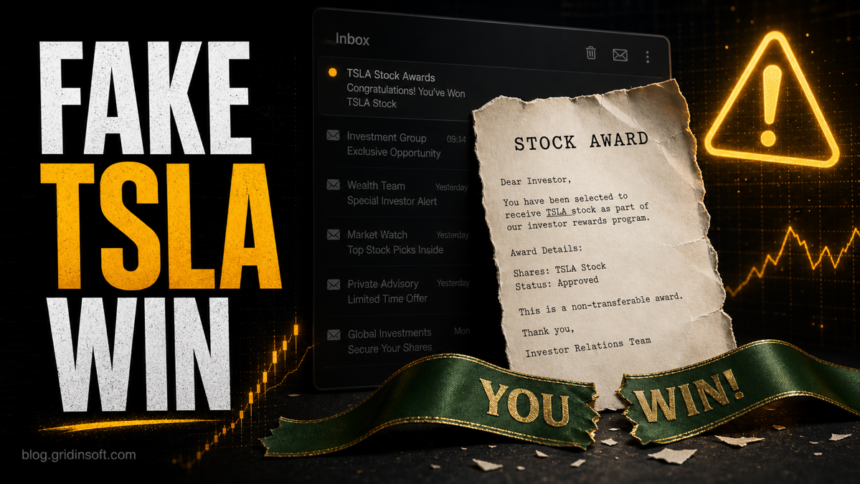
The You’ve Won Tesla Stock email is a scam, not a real award from Tesla or Elon Musk. The message claims you were randomly selected to receive Tesla or TSLA shares worth millions of dollars, then tells you to contact a supposed support address to claim the prize. Do not reply, do not send identity documents, and do not pay any fee to unlock the shares.
This is an advance-fee and personal-data lure dressed up as a stock award. A recent version says the recipient won 18,087.71 TSLA shares worth about $4,093,260 and points the victim toward elonmusksupport.com. The exact numbers can change, but the pattern is the same: the scammer creates a large prize, asks you to make contact, and then tries to collect fees, payment details, login credentials, or identity information.
What the fake Tesla stock email claims
The wording may vary, but these details belong together in the scam pattern:
- A surprise stock prize: you are told you won Tesla or TSLA shares even though you did not enter a real Tesla investor program, sweepstakes, or brokerage promotion.
- Celebrity or brand pressure: the message leans on Tesla, Elon Musk, or a fake Tesla Stock Market team to make the offer feel official.
- Large dollar value: the reward is worth millions, which makes the victim feel that a small fee or quick reply is worth the risk.
- Off-channel contact: the email asks you to contact a support address or domain that is not a normal Tesla account, investor-relations, or brokerage route.
- Claim-first logic: instead of telling you to sign in through a real account you already control, it asks you to start a conversation with the sender.
Why it is a scam
Real stock awards do not arrive as random email prizes that require you to contact an unofficial domain. Tesla’s account-security guidance warns that phishing tricks people into sharing personal information through messages and says Tesla will never ask for your username or password to verify your identity.1 A legitimate stock grant, brokerage transfer, or investor communication would use a known account, formal tax and brokerage paperwork, and verifiable official channels.
The prize language also matches a classic fee trap. Scammers often say you have won something, then ask for taxes, processing, delivery, verification, or transfer fees before the prize can be released. The FTC warns that if someone says you won a prize but must pay fees or charges with a gift card, it is a scam; the same warning applies when the requested payment method is crypto, wire transfer, payment app, or bank transfer.2
Red flags in the You’ve Won Tesla Stock email
- You did not enter anything. Random selection for millions in stock is not how legitimate equity awards work.
- The sender route is unofficial. A domain such as
elonmusksupport.comis not proof of a Tesla connection. - The message asks for a reply before verification. Scammers want a conversation where they can request fees, documents, or one-time codes.
- It uses awkward brand wording. Phrases like Tesla Stock Market, Telsa spelling mistakes, or generic support teams are warning signs.
- It promises a huge reward for no reason. The unrealistic payout is the hook that makes victims ignore basic checks.
What to do if you received the email
- Do not reply. A reply confirms your mailbox is active and can bring follow-up pressure.
- Do not click or open attachments. You do not need to inspect a scam link to prove it is unsafe.
- Do not pay a fee. Taxes, unlocking fees, verification payments, shipping charges, gift cards, crypto deposits, and wire transfers are all scam signals in a surprise-prize message.
- Verify through official routes only. If you have a real Tesla account, open Tesla’s website or app yourself. If the message claims to involve shares, check with your actual brokerage or employer stock-plan provider, not the email sender.
- Mark it as phishing or spam. This helps your mail provider filter similar messages.
- Check suspicious links without visiting them. If you copied a domain from the email, use the Gridinsoft URL Scanner instead of opening it in your browser.
If you replied, sent documents, or paid
Treat the situation according to what you shared. If you only replied, stop the conversation and block the sender. If you sent money, contact your bank, card issuer, payment app, gift-card issuer, or crypto exchange immediately and say it was a scam. The faster you report, the better the chance of stopping a transfer or preserving evidence.
If you shared personal data, assume it may be used for identity fraud. Change reused passwords from a trusted device, enable multi-factor authentication, review email forwarding rules, and watch for new account-opening attempts. The FTC directs identity-theft victims to IdentityTheft.gov and fraud victims to ReportFraud.ftc.gov for recovery steps and reporting.3
If the email led you to download a file, install a browser extension, run a remote-support tool, or open an attachment, scan the device before signing back into sensitive accounts. A security scan can help find suspicious downloads, bundled apps, browser changes, startup entries, or persistence that may remain after the email itself is deleted. You can also upload a downloaded file to the Gridinsoft Online Virus Scanner before deciding whether to keep it.
How this differs from Elon Musk crypto giveaway scams
This email uses the same celebrity-trust trick as many Elon Musk and Tesla-themed crypto scams, but the immediate lure is different. A crypto giveaway scam usually asks you to send cryptocurrency or connect a wallet. The Tesla stock email starts with a fake share award and then moves the victim into a private conversation where fees, documents, or account details can be requested.
If the message you received mentions doubling crypto, a promo code, or a fake exchange balance, read our guide to Elon Musk crypto giveaway scams. If it claims you won TSLA shares by email, stay with the stock-prize checks on this page. For an airline-branded version of the same unsolicited-prize pattern, compare the All Nippon Airways and IATA £6 million raffle email scam.
How to avoid the next version
- Keep a simple rule: if you did not enter a real promotion, you did not win a surprise stock award.
- Do not trust a domain because it contains a celebrity or company name.
- Never pay to receive a prize, stock transfer, refund, or compensation award.
- Use bookmarks or typed addresses for Tesla, banks, brokers, and email accounts.
- For suspicious messages that look more like login theft than prize fraud, compare the signs with our phishing email checklist.
FAQ
Is the You’ve Won Tesla Stock email real?
No. A random email saying you won Tesla or TSLA shares and must contact an unofficial support address is a scam. Do not reply or pay any fee.
What if the email says Elon Musk selected me?
That is still a red flag. Scammers often use Elon Musk, Tesla, SpaceX, and similar names to make fake prizes look credible.
Can I safely check the link?
Do not open the link just to test it. If you need to preserve evidence, copy the domain without visiting it, scan the URL, and save screenshots of the email header and body.
What if I already sent money?
Contact the payment provider immediately, save the email and payment records, report the scam, and watch for follow-up recovery scams. Anyone who claims they can recover the money for another fee should also be treated with suspicion.
References
- Tesla. “Tesla Account Security.” Tesla Support, accessed June 15, 2026. https://www.tesla.com/support/tesla-account-security
- Federal Trade Commission. “Avoiding and Reporting Gift Card Scams.” FTC Consumer Advice, accessed June 15, 2026. https://consumer.ftc.gov/articles/avoiding-and-reporting-gift-card-scams
- Federal Trade Commission. “Report Identity Theft.” FTC, accessed June 15, 2026. https://www.ftc.gov/news-events/topics/identity-theft/report-identity-theft