

Ukraine’s Air Alert app was temporarily shut down after unauthorized interference on November 1, turning a channel used for urgent safety information into a source of false warnings. Its team has since restored push notifications and the map’s danger levels, while keeping target tracking suspended. The Ukrainian Air Force rejected the radiation warning circulating during the incident. A false message in this episode does not make subsequent air-raid alerts safe to ignore: follow current instructions from the Air Force and local authorities. [1][2][3]
The warning channel became the problem
The first official response focused on information people were seeing, rather than on an identified software flaw. At 21:02 UTC on November 1, the Air Force said the application had likely been subjected to hostile interference and stated that there was no radiation threat. Ukraine’s Cyberpolice subsequently relayed the warning and told users not to follow outside links or spread unverified information.
At 22:17 UTC, the app’s own team confirmed unauthorized interference. It disabled push notifications and temporarily suspended the application. That sequence matters: operators interrupted delivery of messages from the affected service instead of asking users to decide which individual notification was authentic. Their statement also warned against opening links in suspicious notifications.
The published statements do not identify the entry point, an exploited vulnerability, or the account or infrastructure used by the intruders. A compromise of a notification channel is not evidence that every phone receiving its messages was itself infected. Equally, a familiar application name on a notification cannot establish that its content is trustworthy during an incident.
Push returned before the full map
In a second statement at 23:52 UTC—01:52 on November 2 in Ukraine—the team described a gradual return of service. Yellow and red danger levels were available on the map, and push alerts were arriving again. Display of targets on the map remained temporarily suspended. The team also said it was adding protective measures, without publishing their technical details.
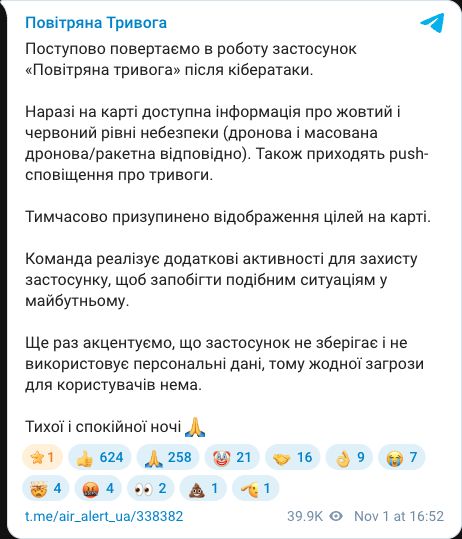
This is a partial restoration announcement, not a claim that every function is back. The distinction helps users interpret a map that shows a danger level but no moving targets: that missing feature was explicitly listed as suspended. It should not be read as proof that there are no airborne threats.
No stored personal data is a narrower assurance
The developers said the app does not store or use personal data and used that point to reassure users. That statement addresses the application’s data handling; it does not erase the separate problem of false information appearing in an urgent warning channel. The disclosed incident concerns the integrity and availability of alerts, while the initial access method and any wider access remain unexplained publicly.
For a person who only received a notification, the verified statements do not establish a need to reset the phone or change every password. Following a link and then supplying an account code would be a different exposure requiring a response for that account. Do not turn an unverified “fix” distributed in comments or messages into another trust decision. The same use of urgent, familiar wording also appears in fake Ukrainian aid offers that seek bank-access codes; that is a separate scam, not an identified payload in this incident.
Keep an independent route to real warnings
Cyberpolice’s published fallback guidance points to the Air Force’s official channels, working sirens, and smartphone emergency notifications. For Kyiv residents it also names Kyiv Digital as an available source. It instructs people to go to shelter on an air-raid warning and remain there until the official all-clear. Emergency-notification settings vary by phone, so use the device’s settings search to find them rather than assuming one menu path fits every model. [4]
The practical lesson is specific: check an unusual warning through an independently opened official source, avoid links embedded in suspect alerts, and retain more than one way to receive genuine instructions. The app team’s restoration message is useful progress; it does not replace current local safety guidance or explain how the intrusion began.
References
- Air Alert team. Unauthorized interference and temporary suspension notice. November 1, 2026, 22:17 UTC; accessed November 2, 2026. Official suspension statement.
- Air Alert team. Partial restoration after the cyberattack. November 1, 2026, 23:52 UTC; accessed November 2, 2026. Official restoration statement.
- Ukrainian Air Force. Warning about interference with Air Alert and false radiation information. November 1, 2026, 21:02 UTC; accessed November 2, 2026. Air Force warning.
- Cyberpolice of Ukraine. Alternative ways to receive air-raid warnings. November 1, 2026; accessed November 2, 2026. Official fallback guidance.