An old USB worm is delivering a newer Windows malware loader by calling server names that attackers brought back into use. In research published on November 16, Kaspersky describes Retadup infections distributing CoffeeLoader, years after French authorities dismantled the worm’s botnet. The important action in its documented USB spread is opening a malicious shortcut on the drive—not simply connecting a flash drive.
The case shows why a takedown and a clean-looking storage device answer different questions. Taking control of a botnet can interrupt its commands; it does not establish that every copy of the worm has disappeared from every computer or removable drive.
The server names returned before the new loader did
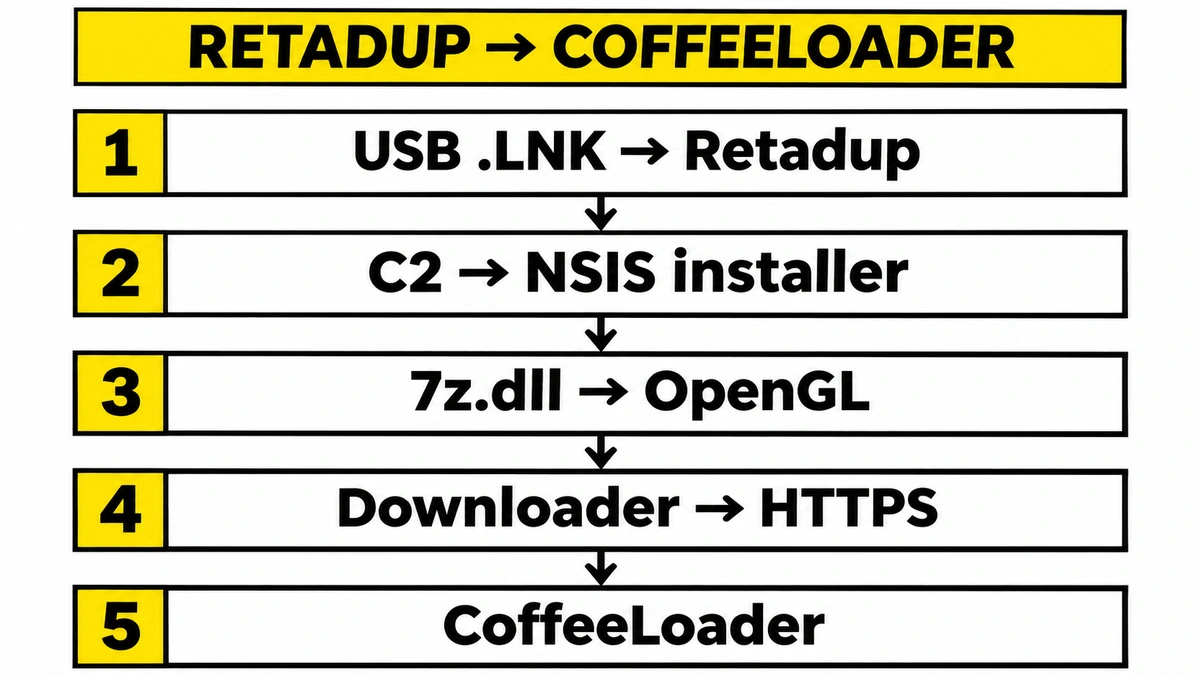
Retadup spread through hidden files and Windows shortcut files on removable media. In 2019, authorities used its command infrastructure to remove the worm from more than 850,000 computers. Kaspersky now reports that someone began registering its former command-server domains again in 2024. Those servers initially supplied SmokeLoader and started serving CoffeeLoader in early 2025. The researchers do not know whether the returning operator is the original author.
The revealing evidence is a 2017 Retadup variant exchanging commands with a server in August 2026. Old client code could still understand the revived infrastructure. The novelty was not a new trick for automatically executing everything on USB: an existing infection and an old command relationship had acquired a new purpose.
A familiar library name hides another download
The CoffeeLoader variant detected in August arrived in an NSIS installer that placed a modified 7z.dll in a temporary directory and launched it through rundll32.exe. This was an altered copy of a 7-Zip library inside the malicious package. It is not evidence that the official archiver’s distribution was compromised, or that every file with that name is malicious.
Inside the library, the Armoury packer now uses OpenGL rather than the previously used OpenCL to decrypt code with the GPU. What it reveals is an intermediate downloader, rather than just the final CoffeeLoader module. That extra component establishes startup persistence and retrieves the main module over HTTPS.
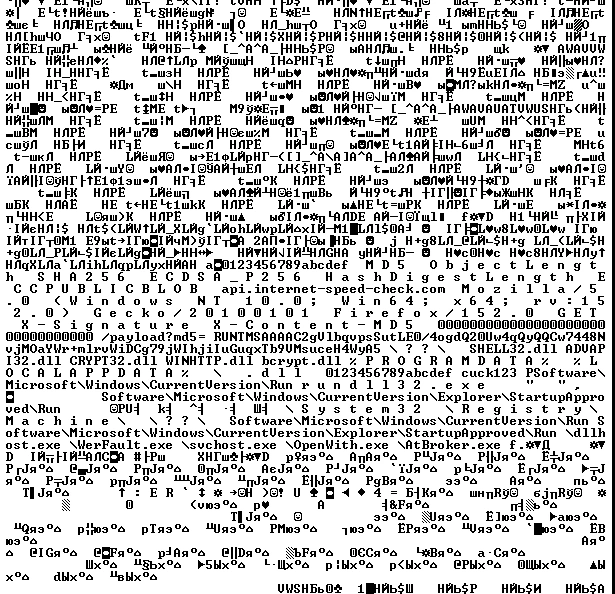
The downloader’s signature and checksum checks deserve attention: they help it verify the payload supplied by its own operator. A correctly signed response within a malicious protocol is not a certificate of safety. Likewise, seeing a familiar Windows process name does not settle whether the code running inside it is legitimate.
What the detection figures actually count
Kaspersky says its products blocked Retadup infection attempts on about 15,000 systems during the first three quarters of 2026, especially in Peru, Angola, Russia and Bolivia. That is a product-observed blocked-attempt cohort, not a count of 15,000 successfully compromised computers or a complete worldwide infection total. It also cannot be compared directly with the 2019 disinfection figure.
CoffeeLoader’s purpose is to run additional code supplied by its controller. Finding this chain therefore raises a second question after removing the visible USB shortcut: what else ran on the computer? The report does not establish that every affected machine suffered password theft or ransomware.
If you find a shortcut on an old USB drive
Do not launch an unfamiliar shortcut to find out what it opens. Scan the removable drive first and use the USB shortcut-virus guide to distinguish cleaning an infection from restoring hidden files. Restoring a folder’s visibility is not the same as making the host safe.
If you already ran the suspicious file, a security tool may remove the visible installer while a startup entry or another downloaded component remains. One practical route is to install or update Gridinsoft Anti-Malware, run a Full Scan, review the detections, apply cleanup, restart Windows and check whether the original symptom returns. Do not reconnect the suspect drive to other computers during that process.
If accounts were used on the potentially compromised PC, follow account recovery from a clean device as a separate decision. A scan does not invalidate stolen sessions or prove that no data was taken.
The practical lesson is specific: the age of a drive—and the age of a successful botnet takedown—does not tell you what an executable shortcut can fetch today.
References
- Oleg Kupreev. “A USB worm’s second life: Retadup spreading CoffeeLoader.” Kaspersky Securelist, November 16, 2026. Retadup and CoffeeLoader research.