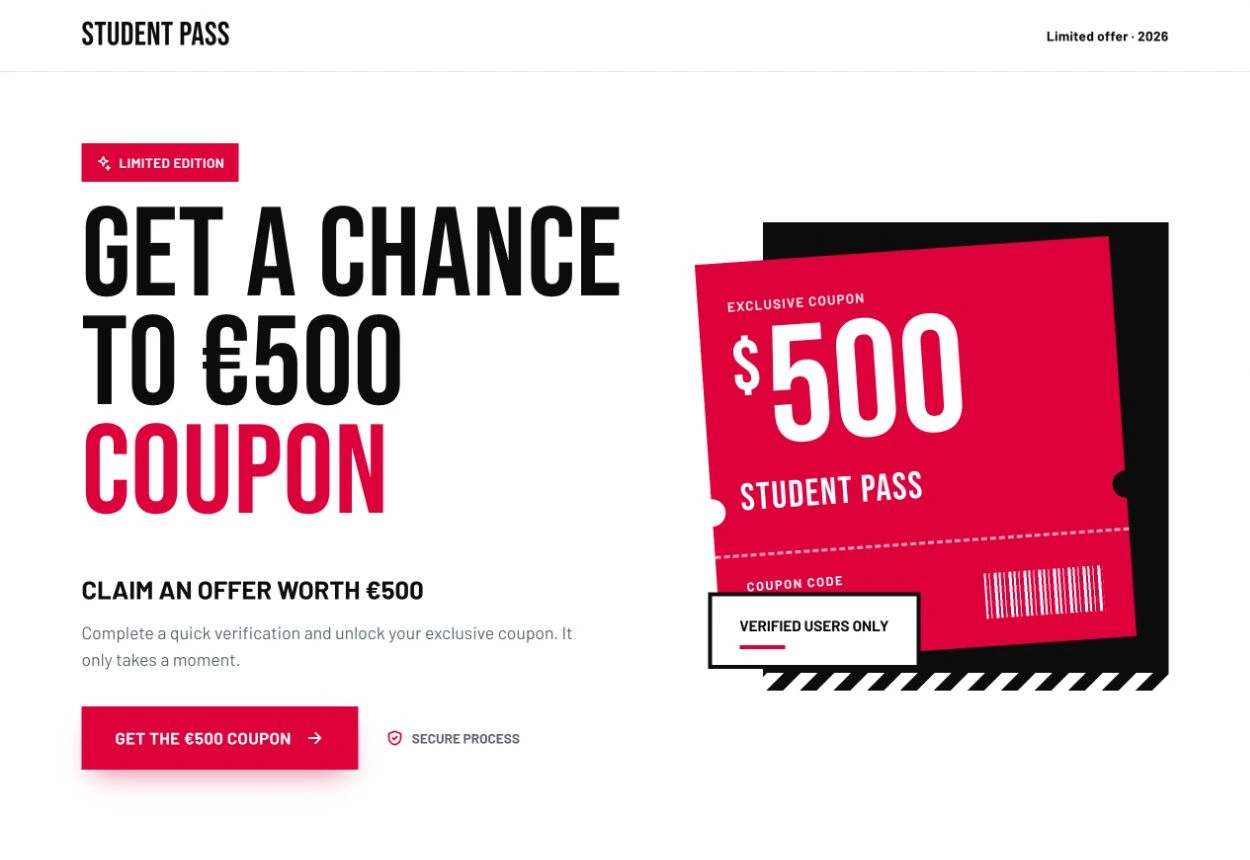
Eglamio’s €500 “Student Pass” offer looks more convincing when small messages announce that other people have received coupons. The page’s own code generates those recipients, amounts and recent-looking times at random. They are not a record of successful redemptions. The code PASS-2026 is displayed before any verification, yet the captured page does not name a retailer that accepts it. Do not submit information simply to unlock this promise: first establish who issues the coupon, where it works and what the next page actually offers.
Our review of the public page on November 16, 2026 found two separate mechanisms: a simulated recipient feed and a button that sends visitors away. A separate HTTP request to that button’s destination reached an Ipsos iSay registration address. That destination does not establish that Ipsos made, endorsed or will fulfill Eglamio’s €500 promise.
The recipient messages do not come from coupon redemptions
The decisive setting in the captured JavaScript is mode: "mock". In that mode, the page selects from lists containing 48 name pairs, 24 cities and a small set of amounts. Math.random() supplies the choices. The page shortens a selected surname to an initial and attaches a randomly chosen time label such as “Just now” or “2 min ago.”
That last detail matters. A message saying someone received a coupon two minutes ago sounds like a report about a recent transaction. Here, the time is another piece of generated display text. The amount, city and name do not establish that anyone redeemed anything.
The source also contains an alternative server-feed implementation, with an address named /api/coupon-feed. Its presence could look reassuring if you read only that part. But its conditional check exits unless the configured mode is server; the captured configuration selects mock. A possible future source of real activity is not the source selected by this page.
We established this by reading the saved HTML and JavaScript, without executing the page’s scripts. The conclusion is specific: these generated notifications cannot substantiate the advertised reward. It does not require assuming that every person with one of those names is fictitious or proving that no coupon has ever been issued anywhere.
What the “Verify now” button is programmed to do
The page’s verification dialog tells visitors to complete the next form or follow offer instructions. In the inspected button handler, clicking would disable the button, change its label to “Verifying…,” wait 700 milliseconds, and set window.location.href to an external address. There is no coupon-verification response checked in that handler.
The configured destination is verifycodedeals[.]com/sl/kgvx1. In our November 16 HTTP check, following its redirects reached www.ipsosisay[.]com/join/ with affiliate-tracking parameters. The final response was a Cloudflare security challenge with HTTP status 403. We did not submit a form, create an account, complete a survey, make a payment or receive a coupon.
This is one recorded route from our network at that time. It does not tell us what every visitor, country or later session will see. It also does not establish who arranged the referral or whether anyone earned a commission. What it does show is why the word verification needs scrutiny: the inspected code initiates a handoff to another site, while the €500 benefit remains unexplained.
A survey account and a retailer coupon are different offers
Ipsos iSay’s reward guidance describes redeeming accumulated points for rewards. That is a separate proposition from having a €500 retailer coupon ready to unlock. Survey participation itself is not evidence of fraud, and landing on a known service does not validate promises made by the page that sent you there.
- A retailer discount or voucher needs a named issuer or accepting retailer, eligible purchases, the discount or credit you receive, expiry and any minimum spend. Confirm the campaign on the retailer’s own site or through its established support channel.
- A survey rewards account has its own participation rules: how points are earned, the redemption threshold and available rewards. Opening an account and receiving a particular voucher are separate events.
- Eglamio’s captured €500 offer shows
PASS-2026and generated recipient messages, but supplies no named redeeming retailer or linked substantive campaign terms that connect that code to a usable €500 benefit.
A useful stopping question is: “If I complete this next step, which organization owes me exactly which benefit?” If the next page describes only joining a panel, entering a draw or signing up for an offer, evaluate that on its own terms. Do not carry the €500 assumption forward just because you arrived through the coupon button.
For example, a voucher requiring a qualifying purchase is different from €500 in cash, and a points balance that must be earned is different from a voucher already awarded. Neither a familiar logo nor the printed code resolves those differences. The Gridinsoft Website Reputation Checker report for Eglamio can help with the separate domain-check question; a reputation result cannot confirm a retailer’s redemption contract.
If you already clicked or supplied information
Base your response on what you actually did. The captured page and our limited HTTP check do not establish that a visitor’s device was infected, that card details were collected, or that a payment occurred.
- You only opened the page or followed the link: close it rather than completing extra steps to chase the coupon. Merely reaching a signup page is not proof that you opened an account or accepted a subscription.
- You submitted an email address or phone number: save the address of the site that received it and any confirmation. Treat later reward messages as separate claims. If you knowingly joined a service, use that service’s official account or privacy controls to manage the registration; do not rely on another “unlock your coupon” link.
- You reused a password: change it on the affected legitimate account and anywhere else it was reused, using the official app or a separately opened site. Enable multifactor authentication. A school or email password deserves attention even if no money changed hands.
- You entered card details or paid on a later page: identify the actual merchant, amount and any recurring terms from the receipt and account statement. Contact your card issuer or bank promptly through its official app or the number on your card if you suspect fraud, explain what happened and ask about protecting the card and disputing the payment. Keep the offer and transaction evidence; a refund is not guaranteed.
If a different reward page also gained browser-notification permission, the StudentDealHub notification and reward guide explains that separate cleanup task. We did not test or observe such a permission request on Eglamio.
The useful test is the connection between the promise and the benefit: a real issuer, a place to redeem it and terms that explain what you receive. Eglamio’s generated recipients do not supply that connection, and a redirect to a recognizable service does not supply it either.
Sources and scope
Gridinsoft inspected Eglamio’s public HTML and inline JavaScript, captured November 16, 2026 at 17:29 Pacific time, and a separate HTTP redirect check at 17:31. The page image below the introduction is a rendering of the captured markup with scripts disabled. The review did not execute the promotion, test enrollment or verify fulfillment. The source and destination addresses are written as inert text to avoid sending readers into the offer.
- Ipsos iSay. “Rewards & Redeeming Points.” Official help, accessed November 16, 2026. Reward redemption guidance.
- Federal Trade Commission. “What To Do if You Were Scammed.” Consumer Advice, accessed November 16, 2026. Payment and account recovery guidance.