


People were told their crypto investments were growing while their money was being moved out through bank accounts and into a wallet controlled in Cambodia. That is the contrast at the heart of a case the U.S. Justice Department described on October 23, when Zheng Zhao appeared in a California federal court after extradition from the Netherlands. Prosecutors say more than $36.9 million passed through a single bank account in the alleged laundering chain.
Zhao, 44, faces a money-laundering conspiracy charge filed in August 2025. His extradition and court appearance are the new development; the investment scheme itself is older. The allegations against him remain unproven, and the Justice Department says defendants are presumed innocent unless convicted.
The relationship came before the trading screen
According to the DOJ’s account of court documents, overseas participants approached U.S. victims through social media, calls, texts and online dating services. They built trust before promoting digital-asset investments. The supposed opportunity then led to websites designed to resemble genuine cryptocurrency trading platforms.
Those sites supplied the story victims saw: their investments were increasing in value. Prosecutors describe a different reality, in which the money had been stolen. The important failure was treating information supplied by the people seeking the payment as independent confirmation that an investment existed. A convincing balance on their website could keep that story alive while the actual funds left the victim’s control.
This is different from malware silently emptying a wallet. The published account describes people being persuaded to transfer money. For the checks that belong before that decision, see our guide to verifying a trading platform independently.
The real route crossed banks before becoming USDT
The DOJ says the network moved victim funds through U.S. shell companies, international bank accounts and digital-asset wallets. More than $36.9 million went from U.S. accounts controlled by participants to one account at Deltec Bank in the Bahamas. Zhao and others allegedly arranged for the bank to convert the funds into Tether, or USDT, and send them to a wallet controlled in Cambodia. From there, participants allegedly distributed USDT to scam-center leaders in the region.
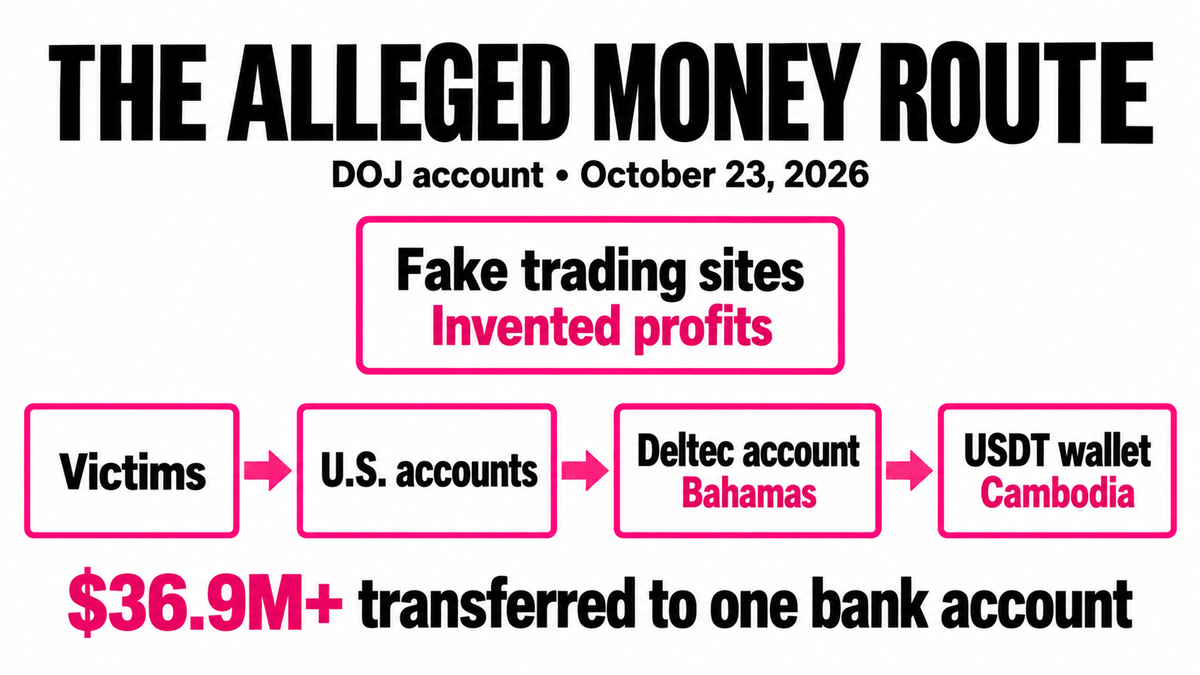
The distinction between the screen and the transfer is the revealing detail. Victims were being shown a growing investment; investigators describe money being consolidated, converted and sent onward. USDT was a transfer instrument in that account, not the reason the investment was fraudulent. Naming Deltec as a bank in the route does not, by itself, establish wrongdoing by the bank.
Two numbers also need their boundaries. The 174 U.S. victims identified by the government are not a worldwide victim count. The $36.9 million-plus figure describes transfers into one bank account. The announcement does not say that this amount has been recovered or returned.
An extradition is a new step, not a refund
The DOJ says eight co-conspirators have pleaded guilty in the wider case. Those outcomes are separate from Zhao’s charge. If convicted, he faces a statutory maximum of 20 years in prison; that is not a sentence already imposed.
For someone looking at an unsolicited investment offer, this case exposes a useful question: who controls the money after the payment, and what independently verifies the claimed trading? A working website and an increasing balance cannot answer that question on their own. Our coverage of a separate Prague crypto-investment investigation examines the same control decision in a different case.
If this pattern matches transfers you have made, stop additional payments and preserve the messages, website addresses and transaction records. The DOJ directs victims of digital-asset investment fraud to report through the FBI’s Internet Crime Complaint Center. A prosecution can establish responsibility; this announcement makes no promise of repayment.
References
- U.S. Department of Justice, Office of Public Affairs. Chinese National Extradited for Alleged Role in Multimillion-Dollar Cryptocurrency Scam Targeting U.S. Citizens. October 23, 2026.