
The subject of one email offered 22,075 “verified” attendees for a medical congress in Paris. Another offered 6,825 contacts for a transport exhibition in Puebla. In both, the sender invited the recipient to reply for a discounted price. If an email offers you a trade show attendee list, hold the purchase until the organizer confirms the seller and the exact data package. Use the exhibitor portal from your booking confirmation or call your usual event contact.
Three attendee lists offered to one inbox
In November 2026, Gridinsoft reviewed 11 messages in one spam folder whose subjects advertised attendee, exhibitor or client lists or directories. Below are three offers we checked against the email bodies. We removed sender and recipient details, signatures and links. The figures are the sellers’ claims. We had no access to registration records and did not buy a list.
| Event named in the email | Contacts claimed | Who the sender promised to reach |
|---|---|---|
| Maison&Objet Premier 2027 | 24,485 | Designers, buyers, retailers and wholesalers |
| IMCAS World 2027 | 22,075 | Dermatologists, surgeons and clinic owners |
| Expo Proveedores del Transporte y Logística 2027 | 6,825 | Transport operators, freight forwarders and fleet owners |
Read one email and the industry vocabulary sounds informed. Read the three side by side and the sales pitch barely changes. Each promises company names, job titles, email addresses and websites. Each describes the contacts as available “under an exclusive fee.” None of the three establishes how the seller obtained permission to distribute those addresses. The repeated wording gives an exhibitor a reason to verify the offer even when the event name and venue are familiar.
What the list offer looks like in an email
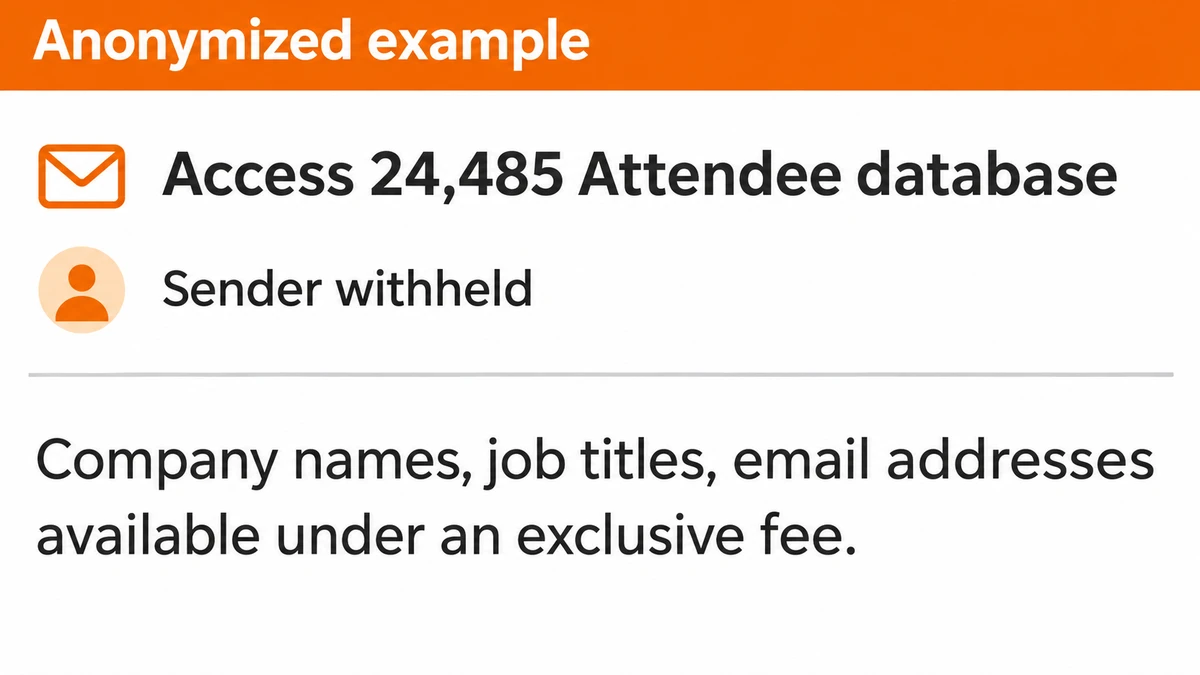
Here are short excerpts from the Maison&Objet offer, in the order they appeared. The subject and body are shortened. The seller and recipient are withheld.
Subject excerpt — “Access 24,485 Attendee database”
Opening — “Hi, Hope you’re doing well.”
What was offered — “company names, job titles, email addresses, company websites, and professional contact details”
Price wording — “available under an exclusive fee.”
The next step was a reply to obtain the discounted fee. That matters if you screen suspicious mail by looking for a bad link. A list seller can start a conversation, learn who approves purchases and send an invoice later. Our review established only what the messages offered.
Why a real event name and a sample row can look convincing
Another message in the folder used the name of NRF Retail’s Big Show. On its own website, NRF publishes a sample of companies registered to attend. Anyone can read it. If a seller sends you a sample row naming one of those retailers, you can confirm the company appears on the public page. You still have two unanswered questions: is the named individual registered, and did they agree to share their email with you? [1]
NYSAIS, an association that hosts conferences, describes sellers using public event information to approach exhibitors. It says it shares attendee information with sponsors only when an attendee explicitly opts in. That is NYSAIS’s own policy. For your event, the source of truth is your exhibitor agreement and the organizer who issued it. Receiving a tailored pitch alone does not establish that a registration system was breached. [2]
One question to send the organizer before paying
Open your existing exhibitor portal or use the contact on your original booking. Ask: “Did you authorize this company to sell our booth team a downloadable list of individual attendee email addresses for this edition of the show? If so, where is that exact package described in our portal or agreement?” Share the seller’s name and the subject privately with the organizer. You don’t need to forward a sample containing other people’s contact details.
Check the scope of the answer. An official event app might let you message participants who opted in. A badge scanner might give you details of people who visited your booth. Neither arrangement by itself gives an outside seller permission to export the entire registration database. If the organizer cannot confirm that particular seller and package, decline the offer and flag the sender to the event team.
If you already replied, received a file or paid
- Replied for pricing. A text reply alone does not give the seller access to your mailbox. Let the colleague who approves invoices know which event and vendor name to watch for. Keep the correspondence if the organizer wants to investigate.
- Received a sample. Leave unexpected attachments unopened. If a file asks you to enable macros, install a viewer or sign in to your work account, stop and report it to IT. Keep sample addresses out of your CRM and marketing campaigns while their origin and permissions are unresolved.
- Received an invoice or paid. Put any pending approval on hold. If money has moved, contact your bank or card issuer promptly through its usual channel, explain the circumstances and ask what recovery options are available. Keep the invoice and transaction reference. If the seller changes payment instructions, follow your independent invoice verification procedure before anyone sends more money.
- Entered a work password on a linked page. Open the account through your normal sign-in route, change the password and contact IT to revoke active sessions. Tell them what information you entered and whether you approved a sign-in prompt.
For a January show, the practical test is straightforward: your organizer should be able to tell you which contacts your booth package includes and where to access them. A precise headcount in an unsolicited email cannot answer either question.
References
- National Retail Federation. Who Attends NRF 2027: Retail’s Big Show. Accessed November 27, 2026.
- New York State Association of Independent Schools. Fraudulent Emails Claiming Access to Attendee Lists. Accessed November 27, 2026.