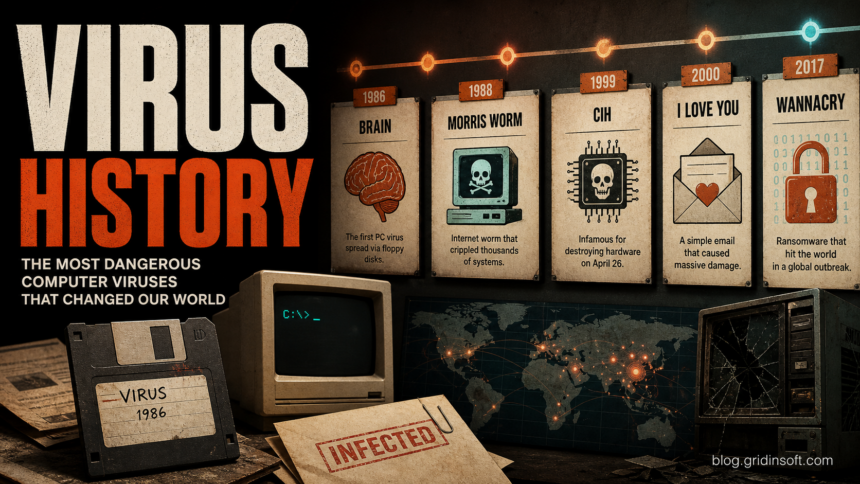
The most dangerous computer viruses were not always the most technically advanced. They became infamous because they spread widely, damaged data, disrupted businesses, abused trust, or forced the security industry to change. This list uses “virus” in the broad search sense: it includes classic viruses, worms, ransomware, and malware families that ordinary users still search for as computer viruses.
| Malware | Why it mattered |
|---|---|
| Brain | One of the first widely known PC viruses and an early lesson in boot-sector infection. |
| Morris Worm | Showed how quickly self-replicating code could disrupt connected systems. |
| CIH/Chernobyl | Became known for destructive payloads that could make PCs unbootable. |
| Melissa and ILOVEYOU | Turned email trust and social engineering into mass-spread malware channels. |
| Code Red and Sasser | Exposed the cost of unpatched network-facing Windows services. |
| Mydoom | Showed how email worms and botnet behavior could scale globally. |
| Conficker | Used weak passwords, removable media, and network exploitation at huge scale. |
| Stuxnet | Changed the way defenders think about malware against industrial systems. |
| WannaCry | Made ransomware a global public-safety and business-continuity issue. |
| Emotet | Demonstrated how modular malware can become an access broker for other threats. |
1. Brain
Brain is often remembered as one of the first PC viruses to spread widely. It targeted boot sectors on floppy disks, which made sense in an era when software moved physically between machines. Its long-term lesson is simple: the way people share files becomes the way malware spreads.
2. Morris Worm
The Morris Worm spread across early internet-connected systems and caused major disruption. It showed that self-replicating code did not need a human to copy infected files manually once networks became the delivery path.
3. CIH, also called Chernobyl
CIH became infamous because its payload could overwrite data and, on some systems, damage the BIOS enough to prevent booting. It remains a useful historical example of why backups and firmware recovery matter.
4. Melissa
Melissa used email and Microsoft Office macros to spread through address books. It made one lesson unavoidable: malware does not need to exploit only software bugs when it can exploit trust between people.
5. ILOVEYOU
ILOVEYOU spread through an emotional email lure and a script attachment. Its success came from curiosity, social pressure, and file-extension confusion, patterns that still appear in phishing and attachment scams today.
6. Code Red
Code Red targeted vulnerable web servers and spread quickly across the internet. It is a reminder that exposed services must be patched, monitored, and isolated when possible.
7. Mydoom
Mydoom became one of the most notorious email worms, combining mass mailing with backdoor behavior. Its lesson still applies: a single attachment campaign can become both a malware outbreak and an access problem.
8. Conficker
Conficker spread through a Windows vulnerability, weak passwords, and removable media. It showed how one family can persist when organizations patch slowly and leave simple passwords in place.
9. Stuxnet
Stuxnet is remembered for targeting industrial-control environments rather than ordinary home PCs. It changed public understanding of malware from a personal-computer nuisance to a tool that could affect physical processes.
10. WannaCry and Emotet
WannaCry showed the global impact of ransomware when unpatched systems meet worm-like spreading. Emotet showed another modern pattern: malware that starts as one infection can become a delivery platform for more serious payloads.
How to read this list
Older lists often mix viruses, worms, trojans, ransomware, and botnets. That is technically imprecise, but it matches how people search. A classic virus infects other files, a worm spreads across networks, a trojan hides inside something the user runs, and ransomware extorts the victim after access is gained. The practical lesson is usually the same: understand the spread path and remove the weakness that made the outbreak possible.
Spread paths that repeat across decades
| Spread path | Examples from history |
|---|---|
| Removable media | Brain, CIH, Conficker variants, and many later USB worms. |
| Email attachments | Melissa, ILOVEYOU, Mydoom, and many modern phishing loaders. |
| Unpatched services | Code Red, Sasser, WannaCry, and other worm-like outbreaks. |
| Credential abuse | Modern botnets, stealers, ransomware affiliates, and cloud-account attacks. |
| Software supply chain or trusted tools | More advanced campaigns where the trusted channel becomes the delivery path. |
Why “old viruses” still matter
Many famous outbreaks are no longer common on modern Windows systems, but their patterns survive. Social engineering, file-extension tricks, macro abuse, unpatched network services, weak passwords, and poor backups still appear in modern incidents. Studying old malware is useful when it explains a current habit: pause before opening attachments, patch exposed services, keep backups isolated, and verify suspicious files before running them.
What these outbreaks teach today
- Patch operating systems and internet-facing services quickly.
- Keep offline or versioned backups that ransomware cannot encrypt.
- Do not trust attachments only because they came from a known contact.
- Scan suspicious files before opening them, especially archives, scripts, and installers.
- Treat repeated alerts, disabled security tools, and strange startup items as signs of incomplete cleanup.
Why this is not a simple damage ranking
Historic malware damage estimates are often inconsistent because outbreaks affected different regions, industries, reporting standards, and currencies. A useful list should not pretend that every old number is exact. It is more helpful to compare the security lesson: how the malware spread, what trust habit it abused, and which defense would have reduced the impact.
Modern protections inspired by old outbreaks
| Old outbreak lesson | Modern control |
|---|---|
| Email worms abused trusted contacts. | Attachment sandboxing, mail authentication, and user reporting. |
| Network worms abused exposed services. | Patch management, segmentation, and least-exposed remote access. |
| Macro and script malware abused office workflows. | Block untrusted macros and scan scripts from email or archives. |
| Ransomware made backups a survival issue. | Immutable backups, restoration tests, and endpoint monitoring. |
FAQ
What is the most dangerous computer virus ever?
There is no single objective winner. ILOVEYOU, Mydoom, Conficker, Stuxnet, WannaCry, and Emotet are often discussed because each changed how defenders think about spread, disruption, or impact.
Are ransomware attacks computer viruses?
Strictly speaking, ransomware is not always a virus. Searchers often use “virus” broadly for malware, so this history includes major malware outbreaks as well as classic viruses and worms.
References
- MITRE ATT&CK. “Stuxnet (S0603).” MITRE, accessed June 13, 2026. https://attack.mitre.org/software/S0603/
- MITRE ATT&CK. “WannaCry (S0366).” MITRE, accessed June 13, 2026. https://attack.mitre.org/software/S0366/
- MITRE ATT&CK. “Emotet (S0367).” MITRE, accessed June 13, 2026. https://attack.mitre.org/software/S0367/