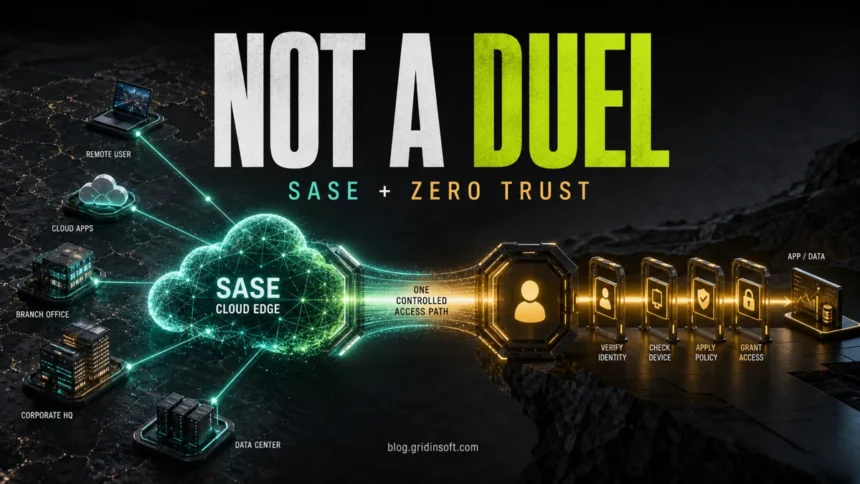
SASE and Zero Trust should not be treated as rival security models. SASE is a cloud-delivered networking and security architecture; Zero Trust is the access model that tells the architecture who should reach which resource, from which device, and under what conditions. In practice, mature SASE deployments usually include Zero Trust Network Access (ZTNA), while a Zero Trust program can start without buying a full SASE platform.
SASE vs Zero Trust in one minute
- SASE combines network connectivity and cloud-delivered security controls such as SD-WAN, secure web gateway, CASB, firewall as a service, DLP, and ZTNA.
- Zero Trust removes implicit trust and checks identity, device health, context, and policy before granting access.
- ZTNA is the practical access-control part where the two often meet.
- SSE is the security-services part of SASE without the SD-WAN/WAN component.
- The real choice is usually not “SASE or Zero Trust” but whether to start with ZTNA/SSE controls or move toward a full SASE architecture.
SASE vs Zero Trust: main difference
| Question | SASE | Zero Trust |
| What is it? | A cloud architecture that converges networking and security delivery. | A security model based on continuous verification and least privilege. |
| Primary goal | Route and secure users, branches, cloud apps, and private apps through a common edge. | Make every access request explicit, verified, limited, and logged. |
| Typical components | SD-WAN, SWG, CASB, FWaaS, DLP, ZTNA, DNS security, remote browser isolation. | Identity, MFA, device posture, policy engine, policy enforcement point, segmentation, monitoring. |
| Best first use | Distributed companies replacing appliance-heavy WAN and security stacks. | Organizations reducing implicit trust, VPN sprawl, and broad internal access. |
| Common mistake | Buying a SASE label while keeping old broad-access policies. | Treating Zero Trust as only MFA or only a vendor product. |
Why stronger pages rank above simple comparisons
The current search results reward pages that answer the relationship directly: SASE and Zero Trust overlap, and ZTNA is the bridge between them. Pages that stop at definitions or frame the topic as a winner-takes-all choice feel less useful because buyers and administrators are usually trying to solve a deployment problem, not memorize two acronyms.
A better answer has to cover the practical decision: whether the reader needs full cloud-delivered network/security convergence, a smaller SSE stack, or a focused ZTNA/VPN replacement project. That is why the useful angle is “SASE plus Zero Trust”, not a shallow “SASE versus Zero Trust” fight.
What searchers are usually trying to decide
People who search for this topic are often security leads, system administrators, MSPs, or business owners dealing with distributed users and legacy access. They may not describe themselves as “victims”, but they are reacting to concrete pain:
- VPN access gives users too much internal network reach after login.
- Remote workers, contractors, and BYOD devices need safer app access.
- Cloud apps, SaaS tools, and private applications are spread across several environments.
- Security teams want fewer appliances and more consistent logging/policy control.
- Leaders are comparing vendor pitches that use SASE, SSE, ZTNA, and Zero Trust almost interchangeably.
- Admins need to know whether SASE replaces VPN, whether Zero Trust comes first, and what breaks during rollout.
What is SASE?
Secure Access Service Edge, or SASE, is a cloud-delivered architecture that combines wide-area networking with security services. Instead of sending remote and branch traffic back to a central data center for inspection, SASE moves security enforcement closer to users, devices, branches, cloud apps, and private applications.
A full SASE platform usually brings together SD-WAN, secure web gateway, cloud access security broker, firewall as a service, data loss prevention, DNS security, and ZTNA. The strength of SASE is consolidation: one policy and inspection layer can protect many access paths. The risk is that a poorly planned rollout can simply move old perimeter assumptions into a new cloud service.
What is Zero Trust?
Zero Trust is a security model, not a single product. NIST describes Zero Trust as a shift from static network perimeters toward users, assets, and resources. The core idea is that no user, device, or workload receives trust just because it is inside a network, connected to a VPN, or owned by the company.
A Zero Trust design checks identity, device state, resource sensitivity, behavior, and policy before access is granted. It should also limit what the session can reach. This matters after stolen credentials, phishing, malware infection, unmanaged devices, insider misuse, or a compromised VPN account.
How SASE and Zero Trust work together
Zero Trust tells the organization how access should be decided. SASE provides a common place to enforce and inspect that access across users, branches, SaaS, cloud workloads, and private apps.
- ZTNA hides private applications from broad network exposure and grants app-level access after policy checks.
- SWG and DNS security apply web and domain controls before users reach risky destinations.
- CASB and DLP help control sensitive data movement in SaaS and cloud apps.
- SD-WAN handles branch and WAN connectivity when the project includes networking, not only security services.
- Endpoint health checks help stop infected or unmanaged devices from receiving the same access as trusted devices.
SASE vs SSE vs ZTNA vs VPN
| Term | Use it when |
| SASE | You need both cloud-delivered security and WAN/branch networking in one long-term architecture. |
| SSE | You need cloud security services such as SWG, CASB, DLP, and ZTNA, but not the SD-WAN part. |
| ZTNA | You want to replace broad VPN access with identity-aware access to specific private apps. |
| Traditional VPN | You need simple encrypted network connectivity, but can tolerate broader network access and separate security controls. |
When to start with Zero Trust or ZTNA
Start with Zero Trust controls when the most urgent problem is access risk rather than WAN redesign. This is common when contractors need one internal app, privileged users need tighter segmentation, or a company wants to reduce the blast radius of stolen credentials.
- Map private applications and remove unnecessary network-level access.
- Require MFA and conditional access for sensitive resources.
- Check device posture before granting access to high-risk apps.
- Separate admin access from normal user access.
- Log access decisions so unusual behavior can be investigated.
When to move toward SASE
Move toward SASE when the organization needs a broader platform change: many branches, remote users, cloud apps, SaaS usage, and internet-bound traffic that should be governed consistently. SASE is usually a larger project than “turn on Zero Trust” because it touches routing, inspection, identity, device posture, operations, and user experience.
- Remote and branch traffic should not be backhauled through one overloaded data center.
- Security teams want common policy across web, SaaS, private apps, and branch access.
- Legacy appliances are expensive or inconsistent across sites.
- Cloud adoption has made the old perimeter a poor control point.
- There is a real need to combine SD-WAN with security enforcement.
Common rollout pitfalls
The dangerous part is not the acronym. It is assuming the project is complete after a vendor console is deployed. Watch for these failure points:
- Too much access after login: ZTNA should grant access to named apps, not recreate a flat VPN tunnel.
- Weak device checks: identity alone is not enough if a laptop is infected, unmanaged, or missing security controls.
- Legacy protocol surprises: old client-server apps, file shares, printers, and admin tools can break or force exceptions.
- Blind spots in split tunneling: bypassed traffic may skip inspection, logging, or data controls.
- Policy sprawl: rushed migrations create duplicate rules that nobody can audit later.
- No endpoint response plan: Zero Trust reduces blast radius, but it does not clean compromised machines by itself.
Simple decision path
- If the immediate pain is VPN overexposure, start with app inventory, identity, MFA, device posture, and ZTNA.
- If the pain is web/SaaS/data control, evaluate SSE capabilities such as SWG, CASB, DLP, and DNS security.
- If the pain includes branch networking and WAN modernization, evaluate SASE rather than treating it as only a security add-on.
- If endpoint trust is part of the policy, define what “healthy device” means and how suspicious devices are scanned, isolated, or remediated.
- If users still need broad internal network access, document why and add compensating controls instead of calling it Zero Trust.
For smaller teams, the practical starting point is usually not a full SASE transformation. Begin by reducing broad access, enforcing MFA, checking device health, and cleaning suspicious endpoints before they receive privileged application access. If a device shows malware symptoms, unexpected browser redirects, unknown startup items, or recurring security alerts, scan it before trusting it in a Zero Trust policy.
FAQ
Is SASE the same as Zero Trust?
No. SASE is a cloud-delivered network and security architecture. Zero Trust is an access model that removes implicit trust and verifies each request before granting access.
Does SASE include Zero Trust?
Most SASE platforms include ZTNA, which is a major practical part of Zero Trust access. A SASE product does not automatically make the whole organization Zero Trust unless the policies, identities, devices, logging, and segmentation are designed that way.
Which comes first, SASE or Zero Trust?
Zero Trust principles usually come first. Many organizations start with MFA, identity cleanup, app inventory, device posture, and ZTNA, then expand toward SSE or SASE when they need broader security and networking convergence.
Is SASE better than VPN?
SASE can be better for distributed companies that need cloud-delivered inspection, identity-aware access, and branch connectivity. A VPN can still fit simpler connectivity needs, but broad VPN access should be restricted carefully.
What is the difference between SASE and SSE?
SSE is the security-services portion: secure web gateway, CASB, DLP, ZTNA, and related cloud security controls. SASE includes SSE-like security capabilities plus the networking side, especially SD-WAN and WAN access architecture.
References
- MEF. “MEF 117: SASE Service Attributes and Service Framework.” Mplify Alliance, accessed June 7, 2026. https://www.mplify.net/resources/mef-117-sase-service-attributes-and-service-framework/
- Rose, Scott; Borchert, Oliver; Mitchell, Stu; Connelly, Sean. “Zero Trust Architecture.” NIST Special Publication 800-207, August 2020, accessed June 7, 2026. https://csrc.nist.gov/pubs/sp/800/207/final
- Cybersecurity and Infrastructure Security Agency. “Zero Trust Maturity Model Version 2.0.” CISA, April 2023, accessed June 7, 2026. https://www.cisa.gov/sites/default/files/2023-04/zero_trust_maturity_model_v2_508.pdf