
Gridinsoft’s file scanner found no threats in the copy of main.js we retrieved from NFSU2.xyz on November 21, 2026. Kaspersky’s Threat Intelligence Portal also rated those exact bytes Clean. On November 3, a player’s Kaspersky log had named that same script address in a HEUR:Trojan.Script.Generic warning. The screenshot records a blocked download. It gives us the URL and the detection name, but no hash with which to identify the older file.
What Gridinsoft and Kaspersky found in the current main.js
On November 21 in Vancouver (November 22 UTC), the server returned HTTP 200 and identified the response as JavaScript. Two fetches produced the same 1,437,639-byte file. We calculated its SHA-256 fingerprint before submitting it to either scanner. You can use the full value below to check whether a later report covers the same build.
SHA-25616ca30406a5c499a5bec41d406fd04a8ae82302e7516bbc98223542b93ba799e
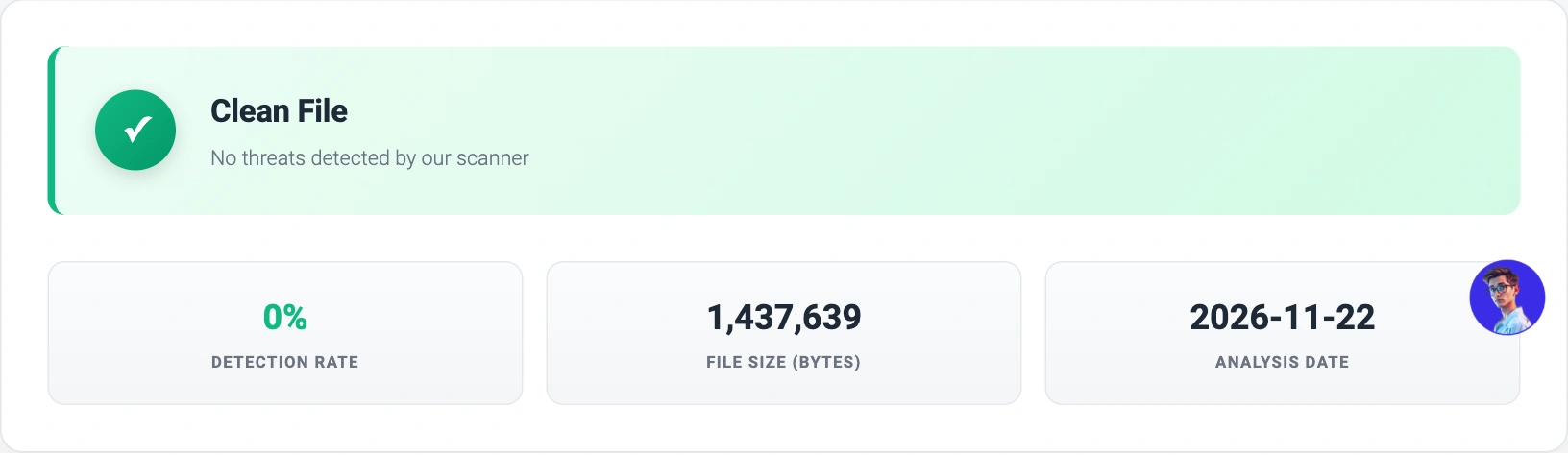
Gridinsoft Online Virus Scanner returned Clean File for main.js. Its report lists the matching byte count and uses the SHA-256 as the report ID. The analysis date shown below is in UTC. View the Gridinsoft file report.
Kaspersky Threat Intelligence Portal identified the submitted file as JavaScript, displayed the same SHA-256 and size, and returned Clean with zero detections. We reopened the completed sample report to verify the result. This was a portal analysis of the file. The original player saw a warning in a browser session protected by a desktop product. [2]
A URL can keep the same name when its contents change. The project’s maintainer archived the public repository on November 9 and said development would continue privately. Without the November 3 hash or a vendor decision on that particular sample, we cannot tell whether the code changed, whether the detection changed, or whether both did. [3]
What Kaspersky blocked on November 3
The player’s Portuguese-language report has two columns worth reading together. Under Nome do aplicativo (application name), it lists chrome.exe and firefox.exe. Under Objeto (object), every visible row points to nfsu2[.]xyz/main.js. Chrome and Firefox were the programs requesting the script. The screenshot identifies no Windows game installer. [1]
The visible entries run from 16:47:44 to 16:49:14. At each timestamp, the log pairs a detection with Download negado (download denied) and Bloqueado (blocked). That explains how someone could see several Trojan warnings while trying to open one game. The log records Kaspersky intervening in the browser request. It contains no entry showing that a Trojan started on the PC.
The developer replied that they believed the warning was a false positive and had reported it to Kaspersky. The reply described a submission and gave no case outcome. The two current scans give us an independent result for the later download.
Why a browser racing game requests a script before you play
The Underground 2 Revived landing page includes main.js as a JavaScript module. In the copy we inspected, the script signals that startup has begun and contains code for background workers, including one for preloading game data. This gives the file a recognizable job in the fan-made Need for Speed: Underground 2 port. The browser can request the script while preparing the page, before a player chooses to save or run anything from their Downloads folder. We inspected the page and script as text, without launching the game.
What to do if your browser shows the warning today
- If protection blocked the request, leave it blocked. Open the event details and record the object URL, detection name, action and time. If a SHA-256 is shown, compare it with the one above. A different hash means the two reports cover different files. You can give those details to the vendor without restoring the script or adding an exception.
- If you previously allowed the site to get past the warning, review the exception you added. Remove an unwanted allowance and leave web protection enabled. A clean report for one script gives you no evidence about every page, advertising destination or future version on a domain.
- If you separately downloaded a Windows installer, leave it unopened and check its own name and hash. If you already ran an unfamiliar program on Windows, run a Full Scan and review the findings. The script fingerprint above cannot identify that installer.
Our FivePlay browser-game investigation shows another way this distinction matters. There, the game page displayed a download advertisement before the visitor had requested any file.
References
- OllatiW and lantaarnappel. “Is nfsu2[.]xyz safe? My antivirus is flagging it as a trojan.” r/NFSU2, November 2026. Player’s event log and developer reply.
- Kaspersky. File analysis for SHA-256
16ca3040…93ba799e. Threat Intelligence Portal, accessed November 21, 2026 (Vancouver). Report for the submitted JavaScript file. - th0mk. “Need for Speed: Underground 2 in the browser.” Project README, GitHub, archived November 9, 2026. Project description and archive notice.