Manchester Airports Group’s data breach creates a reason to distrust unexpected parking-payment or booking-verification requests—even when they quote real details. MAG says an unauthorized party obtained contact, postcode and vehicle-registration data connected to parking, lounge, Fast Track and Wi-Fi services at Manchester, Stansted and East Midlands airports. It says bookings remain valid, operations continue normally and the accessed system did not hold bank or payment details. [1]
What the breach count does and does not tell you
Have I Been Pwned added the incident on September 2 and lists about 8.8 million affected addresses, along with categories including names, purchases and vehicle plates. An address count is not a verified count of unique travelers, and the listed categories do not establish that every person’s record contained every field. [2]
A correct registration number can make a message feel specific to you. It still does not authenticate the sender. Contact data can help someone ask for information that was not in the breach, including a card number, password or one-time code.
Keep your booking check separate from the message
What a message claims — How to check safely
- Your parking needs another payment: Open the airport’s official booking service independently and compare the payment status with your original confirmation.
- A refund requires card verification: Reach the booking provider through your existing confirmation or its official site. Do not submit card details to the message’s form.
- A caller knows your vehicle or postcode: End the call and initiate contact yourself through a known number. Treat the detail as knowledge, not identity proof.
- Your Wi-Fi account needs an urgent reset: Verify that the service and account exist through the official airport website before following any recovery process.
These are possible pretexts inferred from the exposed information, not a report that MAG has confirmed each scam. The airport’s published notice says it will not unexpectedly request payment-card details, banking information or passwords. Keep the original booking confirmation so you can check a later claim without using its links.
Recognize a plausible payment lure
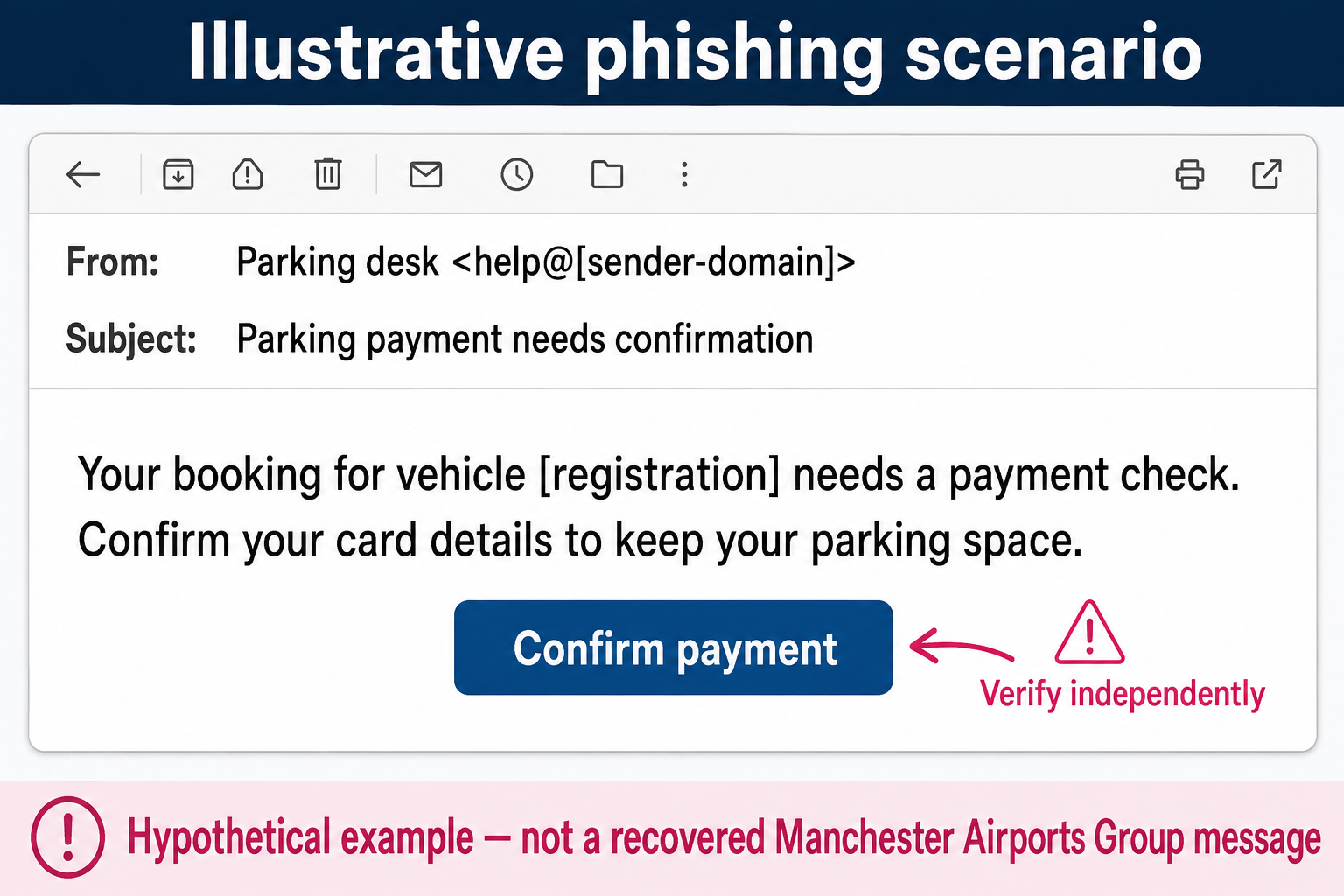
This fictional example illustrates the risk; it is not a recovered MAG phishing message:
From: Parking desk <help@[sender-domain]>
Subject: Parking payment needs confirmation
Your booking for vehicle [registration] needs a payment check. Confirm your card details to keep your parking space.
The placeholders deliberately avoid real contact or customer information. The warning is the demand to supply fresh payment details through an unsolicited route. A familiar airport name, a vehicle reference and a deadline can be combined without the sender controlling your legitimate booking.
If you already interacted
If you only received the message, preserve and report it; there is no reason to treat receipt as a device infection. If you opened a link, close it and record whether you entered information, downloaded a file or granted any permission. Do not reopen the page to investigate.
If you entered a password, change it through the real service from a trusted device and change any other account using the same password. Review account activity and authentication settings. If you supplied card details or paid, contact your bank promptly through the number on your card or its official app; explain exactly what you submitted.
NCSC guidance recommends independently checking the affected organization’s notice, reviewing accounts and reporting suspicious communications. In the UK, suspicious texts can be forwarded to 7726. If you lost money, contact the bank and the appropriate official fraud-reporting service. [3]
A separate October 6 incident at ASOS involved an unauthorised notification through its customer communication channels. The incidents are distinct, but both show why a familiar company name is not enough to authenticate a message: check the request through a channel you open yourself.
A Wi-Fi signup record is not a network diagnosis
The breach concerns stored service data. Receiving a notification about a past Wi-Fi signup does not establish that your current phone or router was compromised. Keep ordinary public Wi-Fi precautions separate from the immediate job here: verifying future contact and protecting any information you actually disclosed.
References
- Manchester Airports Group. Data Security Incident: Update and FAQs. Checked September 7, 2026.
- Have I Been Pwned. Manchester Airports Group Data Breach. Added September 2, 2026.
- UK National Cyber Security Centre. Data breaches: guidance for individuals and families. Checked September 7, 2026.