
Five-star ratings and disappearing complaints are being sold together on underground forums. Malwarebytes Labs’ November 2 investigation documents a market for manufacturing the public evidence shoppers use to decide whom to trust.
The revealing detail is the combination: one seller, aqenova, advertises positive reviews and review removal across platforms including Google, Trustpilot and Yelp. A buyer can seek both a better score and fewer visible objections.
The sales pitch treats trust as inventory
Another seller, TrustForge, claims human posting and guarantees that reviews will remain online. Those are seller promises, not independently verified success rates. Human participation also establishes nothing about whether the writer bought the product.
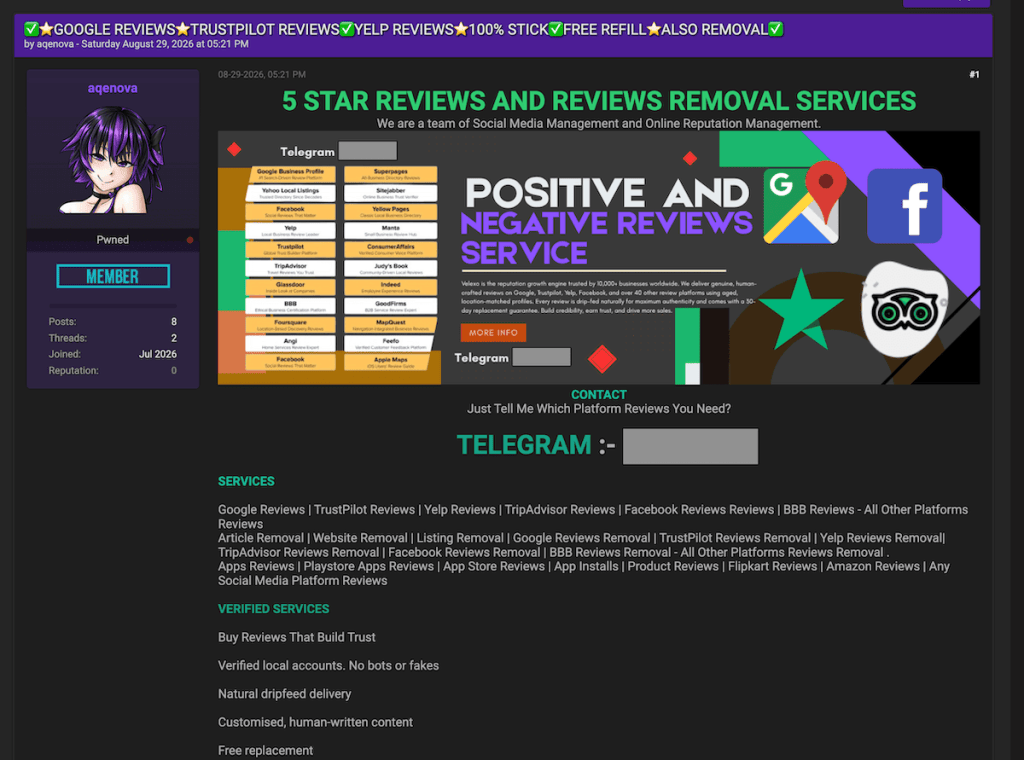
The report also describes advertised removal prices of roughly $100–$200 per review, with an Airbnb example near $1,100. It discusses AI-generated text and residential or mobile proxies. It does not establish that any named platform was breached, or that every advertised removal service works.
Why an authentic-looking account is not enough
The important distinction is between an account, an experience and a recommendation. A person can control a real account without having tried the thing they recommend. A polished paragraph can be easy to read while offering no evidence about delivery, returns or the product itself.
Consider a hypothetical store with dozens of glowing ratings and a vague returns page. The ratings answer “did someone praise it?” They do not answer “who receives the payment?” or “where would I send a defective item?” Those unanswered questions remain even when the average score looks excellent.
Likewise, the absence of complaints cannot tell you why they are absent. A young business may have few customers; a review page may be poorly used. Treat a clean-looking profile as one piece of information rather than a substitute for checking the transaction.
Check the purchase behind the score
Before paying, write down the specific risk you need to resolve. For a physical purchase, that might be delivery to your country, the actual return address or who pays return shipping. For a service, it might be cancellation terms and what the advertised price includes. Then look for evidence that answers that question.
- Compare like with like. Check that reviews concern the same business, domain and product. Praise for a similarly named company does not validate the checkout in front of you.
- Inspect the terms independently. Save the offer, seller identity, return conditions and order confirmation. These records are more useful in a dispute than an average star rating.
- Keep the decision separate from the sales pressure. If the offer disappears before you can identify the seller, let it go. Urgency adds no evidence.
Our online shopping scam guide explains the wider purchase checks. A Gridinsoft website reputation check can add context about a suspicious domain; it cannot authenticate the authorship of a review or guarantee delivery.
The useful lesson from this investigation is narrow: five stars are a claim to examine. Verify the seller and the transaction before letting that score decide where your money goes.
References
- Malwarebytes Labs. 5 stars for sale: Inside the underground fake review trade. November 2, 2026. Accessed November 3, 2026.