CefSharp.BrowserSubprocess.exe is normally a legitimate helper shipped with Windows applications that embed Chromium through CefSharp. It is not a Windows system file, and the same filename can belong to Razer software, a business app, a game launcher, or another unrelated program. Several copies can be normal. Judge each copy by its parent application, folder, digital signature, and behavior—not by the filename or process count alone.
What should you do?
- Several copies inside one recognizable app folder: usually expected; leave them alone unless the parent app is misbehaving.
- Application Error, exception, crash, or sustained CPU use: close, update, repair, or reinstall the application that owns the copy.
- A copy in an unrelated folder or running without a credible parent: preserve its path and process-tree details, then scan it and the PC.
What is CefSharp.BrowserSubprocess.exe?
CefSharp is a .NET wrapper around the Chromium Embedded Framework. Developers use it to place web content and browser-style interfaces inside desktop software. CefSharp’s API documentation describes a separate executable that can be launched for subprocess work and names CefSharp.BrowserSubprocess.exe as the provided default.[1]
The helper belongs to the application that installed it. Windows does not provide one universal system copy, so there is no single correct folder, file size, hash, or signer for every computer. A copy next to the files of an app you knowingly installed can be legitimate even if another product places its copy somewhere else.
| What you find | What it means and what to do |
|---|---|
| Several copies under one known application | Usually normal browser-process separation. Confirm that their paths and parent app agree, then leave them running. |
| A short CPU or memory spike while the app opens or updates | Let the application finish loading, wait a few minutes, and check again. |
| An error from a recognizable app folder | Repair the parent application. Do not replace the helper with a download from a file library. |
| A copy in a random user-writable folder with no matching app files | Treat it as suspicious. Record the path, parent, signer, and command line before scanning. |
| The process returns after every app is closed | Find the launcher or scheduled component that starts it. The visible helper may not be the root cause. |
Why are multiple CefSharp.BrowserSubprocess.exe processes running?
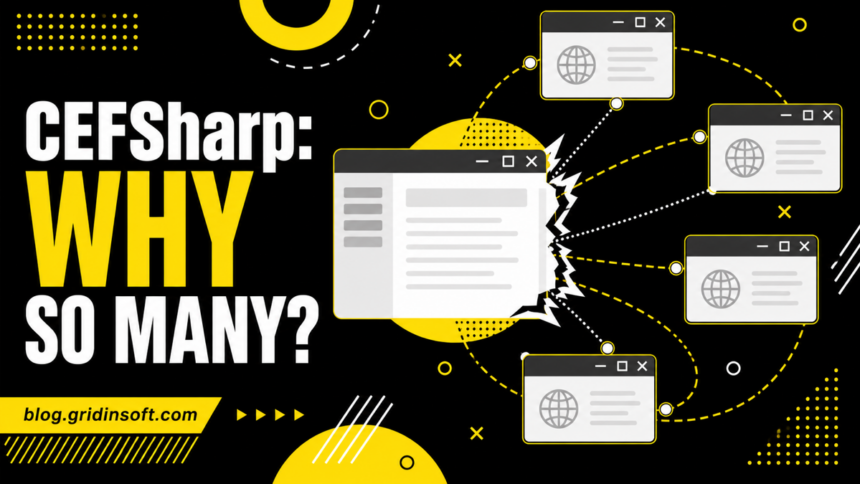
Chromium-based applications separate work into secondary processes so one renderer, GPU task, or utility failure does not have to take down the entire interface. CefSharp’s self-host documentation explicitly describes secondary roles such as GPU, renderer, and utility processes.[2] One desktop application can therefore create several helpers, and two unrelated applications can each ship their own set.
That architecture is also why ending one copy may close a panel, blank a window, or make the parent application relaunch the process. A high count is worth investigating only when it grows continuously, remains after the related apps close, or comes with sustained CPU, memory, disk, network, or crash activity.
Do not confuse this filename with every other Chromium helper. For example, Adobe CEF Helper.exe is an Adobe-specific component, while crashpad_handler.exe is commonly used for crash reporting. The same parent-app rule applies, but each filename has a different job.
How to identify which application owns the process
- Open Task Manager. On the Details tab, right-click a
CefSharp.BrowserSubprocess.exeentry and choose Open file location. Repeat this for more than one copy; they may belong to different programs. - Read the full folder. Look for a recognizable application name, version folder, main executable, and neighboring CefSharp or Chromium files. An isolated helper in a random temporary or roaming-profile directory deserves more scrutiny.
- Find the parent process. Microsoft Process Explorer shows process relationships, loaded DLLs, handles, and owning accounts.[3] The parent should make sense for the application directory you found.
- Check Properties → Digital Signatures. A valid signature from the application vendor increases confidence. A missing signature is not automatic proof of malware because legitimate developers do not sign every bundled component; combine it with the source, path, parent, and behavior.
- Close the parent app normally. Save your work, quit the application from its own menu, and wait. Helpers should normally exit with it, although an updater or background service may keep part of the product running.
The broader EXE safety checklist explains how the download source, signer, path, parent process, and scan result should agree before you trust an unfamiliar executable.
Why Razer software may show this process
Razer applications are one visible example in current search results, but CefSharp is not a Razer-only component. If Task Manager groups the helper under Razer Synapse, Cortex, Central, or another installed Razer app, open the file location and verify that the folder, parent executable, and signature fit that product.
Several Razer-associated copies do not prove an infection by themselves. Investigate when they continue consuming significant resources while the Razer app is idle, repeatedly crash, appear in two unrelated folders with conflicting signers, or keep returning after the whole product has been closed. Use Razer’s own updater or installer for repair; do not delete only the subprocess file.
How to fix an Application Error, exception, or crash
- Identify the owning app first. The error title or path matters more than the generic helper name.
- Close the parent application and reboot. This clears a stuck renderer and completes pending file replacements.
- Update the parent app from its built-in updater or official site. CefSharp files are versioned as a set. Mixing one downloaded EXE with older DLLs can create another startup failure.
- Use the app’s Repair option if available. In Windows 11, check Settings → Apps → Installed apps → the application’s menu → Advanced options. Traditional desktop programs may expose Repair or Change in Control Panel.
- Reinstall the owning app if repair fails. Back up app-specific settings, uninstall through Windows, reboot, and install a current package from the vendor. Do not copy a helper from a different program.
- Escalate a repeatable crash to the vendor. Record the application version, Windows version, exact error text, module named in Event Viewer, and whether the failure began after an update.
If the error appears only when one feature opens—such as a sign-in panel, store, updater, chat, or embedded help page—the broken component is probably inside the parent application. System-wide registry cleaners and random DLL download sites are not a safe fix.
How to handle high CPU or memory use
A brief spike while the interface loads can be normal. To test sustained use, save your work, let the application sit idle for five minutes, then sort Task Manager by CPU and Memory. Match the busy helper to its parent before ending anything.
- Close the affected panel or application normally and confirm whether the busy process exits.
- Reopen the app without optional overlays, extensions, or background panels when the product provides that choice.
- Install the latest application update and Windows updates, then retest during a real idle period.
- Use the vendor’s repair or clean reinstall procedure if one subprocess immediately returns to sustained use.
If several unrelated CefSharp applications are busy at once, check the system problem they share: low free disk space, graphics-driver trouble, security software repeatedly scanning the same cache, or an unstable network/web panel. Do not delete every same-name process across the drive.
When CefSharp.BrowserSubprocess.exe looks suspicious
Suspicion should come from conflicting evidence, not the filename alone. Stronger warning signs include a copy launched from an unrelated temporary or roaming-profile folder, no recognizable parent application, a misleading icon, an invalid signer where the surrounding product is signed, persistence after the supposed owner closes, or child activity such as encoded PowerShell, an unknown downloader, or unexpected browser-extension installation.
Before removing anything, record the full path, parent process, command line, signer, and file hash. Submit the file to the Gridinsoft Online Virus Scanner without running it again. If the copy is in an unrelated folder or returns without a credible owner, run a full Gridinsoft Anti-Malware scan to look for the launcher, scheduled task, bundled app, or other persistence that recreates the visible helper.
If the process path is wrong, the name imitates a Windows component, or high CPU started after an unknown installer, scan for hidden miners, services, startup entries, and bundled components.
Scan a suspicious CefSharp copyQuarantine confirmed detections, reboot, and scan again. If the file was legitimate but damaged, reinstall its parent application from the official source instead of restoring a mismatched helper from another app.
FAQ
Can I end CefSharp.BrowserSubprocess.exe?
You can end a copy as a temporary diagnostic step after saving work, but the parent application may lose an embedded panel, close, or relaunch it. Use the result to identify the owner; do not treat End task as a permanent repair.
Can I delete CefSharp.BrowserSubprocess.exe?
Do not delete a legitimate bundled copy by itself. The owning app may fail because its CefSharp executable and DLLs belong to one versioned package. Repair or uninstall the parent application instead.
Are multiple copies a virus?
No. Multiple copies are common when Chromium work is divided among renderer, GPU, and utility subprocesses or when several applications use CefSharp. Investigate only when the path, parent, signer, persistence, or resource use is abnormal.
Why does the process return after I close it?
An updater, tray component, background service, or still-open app panel may restart it. Use Process Explorer to find the actual parent. If no credible owner exists, scan the PC for another component that is launching the file.
References
- CefSharp Authors. “CefSettingsBase BrowserSubprocessPath Property.” CefSharp API documentation, accessed August 14, 2026. cefsharp.github.io
- CefSharp Authors. “SelfHost Class.” CefSharp API documentation, accessed August 14, 2026. cefsharp.github.io
- Russinovich, Mark. “Process Explorer v17.1.” Microsoft Sysinternals, March 5, 2026, accessed August 14, 2026. learn.microsoft.com