
AuditTeam offers its victims a vulnerability report after breaking into their networks. The catch is that its supposed consulting invoice arrives after file encryption. In research published on November 18, Kaspersky traced the group’s OpsAgent toolkit across dozens of organizations, exposing the machinery behind a ransom demand dressed as a security audit.
The report covers activity from January through at least October 2026, with observed victims in seven countries and territories. This is a new technical account of that campaign, not a claim that all those intrusions happened today. For a company receiving the note, the immediate task is incident containment and evidence preservation, rather than treating the sender as a legitimate auditor.
The report comes with a ransom demand
Researchers began investigating suspicious activity at an organization in Hong Kong on March 10. The tool they found resembled a penetration-testing framework: it could manage files, run commands, capture keystrokes and screenshots, and move traffic through compromised machines. That resemblance matters because authorized security testing also uses powerful remote tools. The ransom note reveals the difference in this case.
It addresses executive management and legal teams, presenting payment as remediation and threatened disclosure as public transparency. The criminals promise a vulnerability report and deletion of stolen data in return for an audit fee. Those are the attackers’ promises, not verified outcomes. More revealingly, the analyzed cryptor writes the note after encrypting files, even though the note itself concentrates on data exposure.
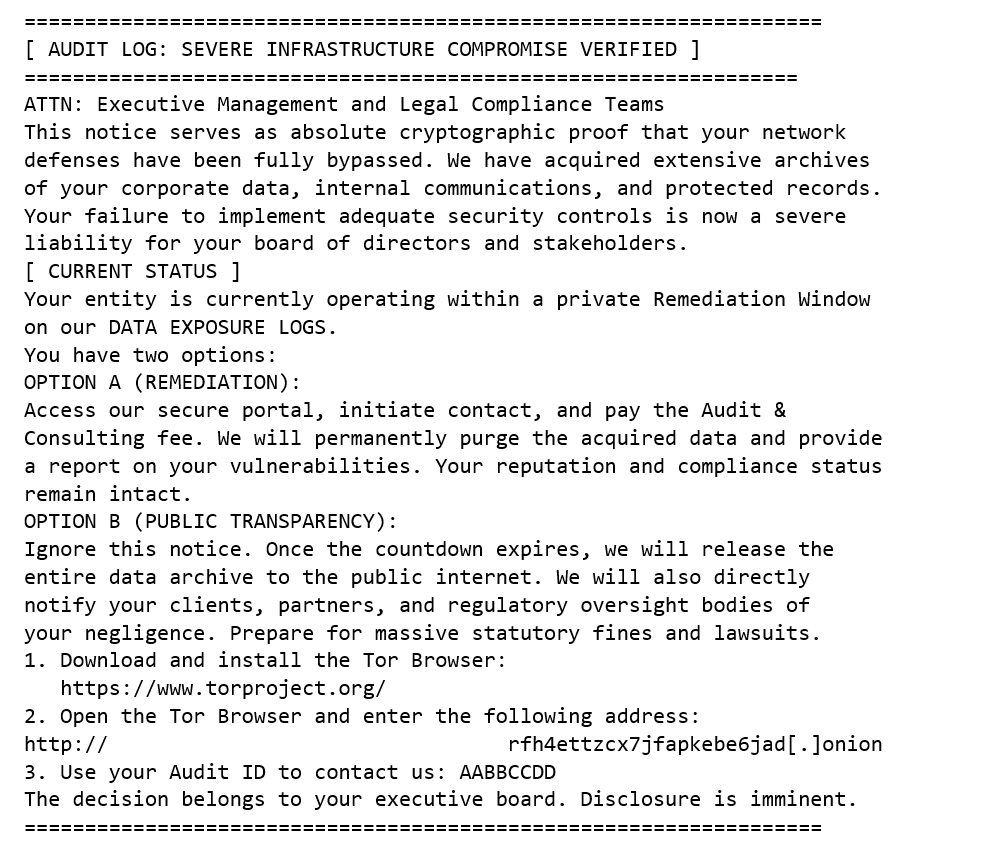
That sequence changes the response. A business should check both lost file access and possible data theft; restoring working files does not settle whether information was copied. The researchers observed infections in China, Finland, Hong Kong, Italy, the Philippines, Russia and Senegal. Additional countries named on the gang’s leak site are claims by the group, not an equivalent set of independently observed infections.
A signed antivirus driver turns against defenders
OpsAgent is only part of the operation. An additional module installs a digitally signed driver from Beijing Jiangmin Antivirus and uses it to terminate processes. The analyzed target list has roughly 220 entries spanning security software, monitoring agents, backup services and databases. A valid signature can help a driver load; it does not establish that the program installing or controlling it is trustworthy.
The encryption module separately stops database and backup services, removes shadow copies and encrypts files using AES-CBC or ChaCha20. Each file receives its own key. These are preparations to make recovery harder, not evidence that a victim’s off-network backups were necessarily destroyed. They also explain why responders should preserve security and service-stop telemetry outside the affected host wherever possible.
GitHub removal does not end the command channel
The implant can retrieve an encrypted command-server address from a public GitHub repository. That makes the repository a directory: the subsequent commands travel through the selected endpoint, including CloudFront subdomains. Blocking all CloudFront addresses would disrupt legitimate traffic, and its shared IP addresses are weak standalone indicators.
The repository was removed in November, but the researchers found newer Rust implants with GitHub lookup disabled in their configuration. Deleting the directory therefore cannot establish that every implant has lost its command channel. The Rust version can start with HTTP requests and switch to an ongoing encrypted WebSocket connection; it also adds interactive shells. Investigators need the actual implant configuration and endpoint evidence, not just the status of the old repository.
For a separate example of cloud-service abuse, our ShadowCloud investigation coverage explains backdoors using GitHub and SharePoint. That is a different campaign; sharing a legitimate hosting service does not connect the operators.
What an affected organization should preserve
For this case, useful leads include a newly installed kvcore.sys driver, unexpected syscache.dat files in the Windows cache paths listed in the research, and coinciding security, backup or database process failures. Names alone do not prove compromise: the driver belongs to a legitimate product, and a filename needs its path, hash and execution history. Correlate them with the note, command-channel traffic and process activity.
Follow the incident-response team’s containment plan: isolate affected systems, retain the note and logs, investigate the scope, and verify protected backups before restoring into a trusted environment. CISA’s ransomware guide supports network isolation and evidence preservation. A cleanup scan cannot decrypt files or reverse disclosure. If a Windows endpoint needs malware cleanup after containment and evidence collection, visible-payload removal may leave another module or persistence behind. Gridinsoft Anti-Malware provides a full-scan and threat-removal path; review detections and restart as appropriate, without treating a clean result as proof the intrusion is over.
Kaspersky also describes coding patterns suggestive of AI assistance. That is an assessment, not proof of an autonomous AI attack. The stronger finding is already concrete: an extortion crew combined a remote-control framework, defense disruption and encryption, then renamed the resulting ransom demand an audit.
References
- Vladimir Nestor. The forced audit: how AuditTeam’s OpsAgent framework masks ransomware as consulting. Securelist, November 18, 2026.
- CISA and partners. #StopRansomware Guide. Incident containment and recovery guidance; accessed November 18, 2026.