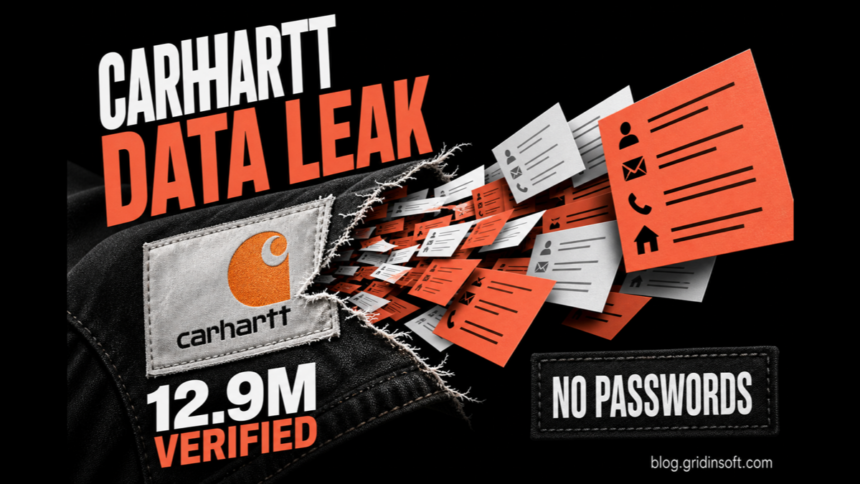
A published dataset attributed to Carhartt contains 12,933,413 validated account email addresses together with names, phone numbers, and physical addresses. Have I Been Pwned added the breach on August 25 after Troy Hunt removed millions of synthetic benchmark records, test accounts, deactivated aliases, and duplicate corporate addresses from an initial count of almost 25 million emails.
The practical risk is not a password dump. Passwords, payment-card numbers, and government IDs are not listed among the confirmed exposed fields. The risk is an address-rich phishing or impersonation attempt that quotes accurate contact details to make a fake Carhartt order, delivery, refund, or account-security message sound legitimate.
What the Carhartt breach evidence confirms
| Confirmed finding | What it means |
|---|---|
| 12,933,413 validated accounts | This is the filtered HIBP count, not the original nearly 25 million-email headline that included synthetic and test data. |
| Names, email addresses, phone numbers, physical addresses | A scammer can combine several accurate details in a convincing call, text, email, delivery notice, or paper letter. |
| No passwords in the HIBP field list | The published evidence does not establish a Carhartt password dump. A reused or old password should still be changed as a precaution. |
| Carhartt has not publicly confirmed the incident | HIBP and Hunt validated the corpus, but claims about the intrusion path, payment demand, or additional data remain unconfirmed by the company. |
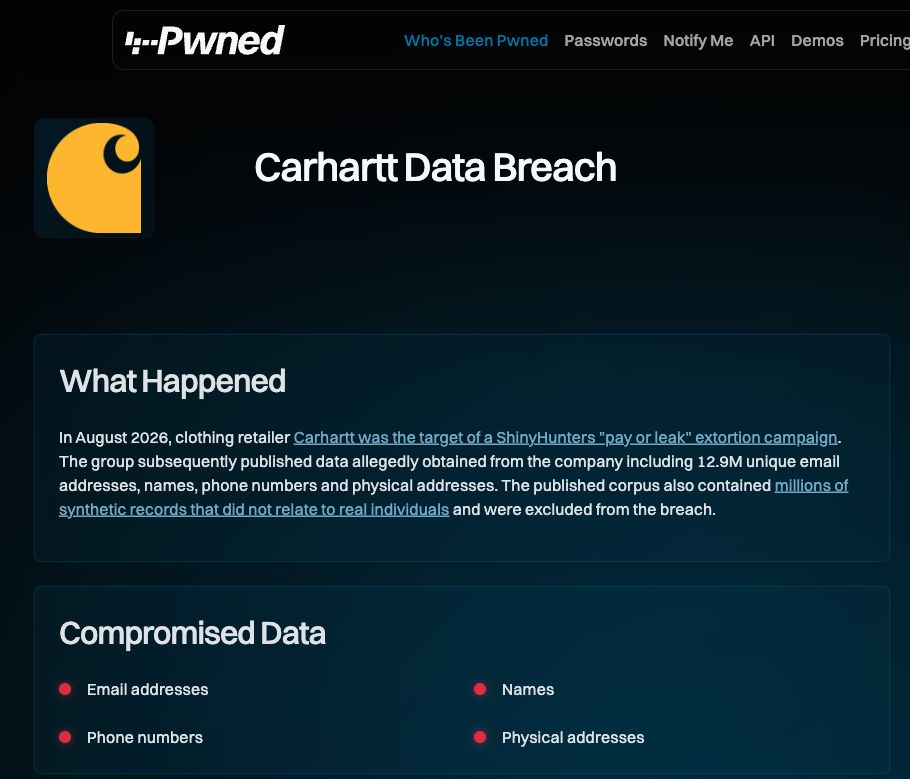
Hunt found strong provenance markers after filtering: Carhartt employee addresses, internal aliases, and email sub-addresses explicitly tagged for Carhartt shopping or checkout. His analysis supports that the remaining corpus came from Carhartt-related systems, while also showing why the first headline count was inflated.
How to check whether your account appears
- Open Have I Been Pwned by typing
haveibeenpwned.comyourself and search the email address you used for Carhartt. Do not use a link in an unexpected breach notice. - If Carhartt appears in the result, treat the listed contact fields as exposed. The result does not mean your password, payment card, or identity document was present.
- If Carhartt does not appear, your email is not in HIBP’s validated subset. That is useful evidence, but it is not a company guarantee that no other Carhartt-related record exists.
- Review saved Carhartt addresses, recent orders, account changes, and payment activity by opening the official site from a bookmark or typing its address manually.
Why contact and address data can be dangerous
An attacker who knows your name, phone number, email, and street address can make an ordinary scam unusually specific. A caller may cite your address and claim that a delivery failed. An email may offer a refund or ask you to “verify” an order. A text may say that a Carhartt account must be secured after the breach. None of those details proves the sender is Carhartt.
This is the same defensive problem seen after the SafePal customer-order breach: accurate shipping data increases credibility, but it does not make the requested action safe. Do not confirm extra information, install a support tool, read an MFA code, or move money because a caller already knows your address.
What Carhartt customers should do now
- Change a reused or old Carhartt password. The validated field list does not include passwords, but credential reuse creates a separate account-takeover risk. Use a unique password and enable MFA if the account offers it.
- Verify messages outside the message. Open Carhartt independently and use contact details published on its official site. Do not call a number, scan a QR code, or follow a link supplied by an unexpected sender.
- Watch for address-rich phishing. Treat delivery, return, refund, loyalty, and “breach compensation” messages as unverified until the order or notice appears in your real account.
- Inspect suspicious destinations before signing in. If a message points to an unfamiliar domain, do not enter credentials. A suspicious URL can be checked with the Gridinsoft Online Virus Scanner, but a clean automated result does not prove that a request is authorized by Carhartt.
- Respond to actual account activity. If an address, order, email, or payment method changed, reset the account from a clean device, end other sessions where possible, and contact Carhartt or the payment provider through known channels.
- Escalate signs of identity fraud. Unexpected credit, account-recovery, or address-change activity needs a broader response. Follow the identity-theft warning-sign checklist and preserve messages, dates, and transaction records.
Document-image exposure calls for a different response from contact-data exposure. The IDScan investigation guide explains how to verify a notice and choose US or Canadian identity-protection steps; Carhartt’s confirmed field list does not include government IDs.
Claims this evidence does not establish
- The evidence does not show that all Carhartt customers were affected.
- It does not establish exposure of passwords, payment cards, Social Security numbers, or government IDs.
- It does not prove that a message mentioning the breach is authentic; criminals can reuse public breach details.
- It does not confirm the exact intrusion path, the full contents of the original stolen archive, or any payment between Carhartt and the extortion group.
References
- Have I Been Pwned. “Carhartt Data Breach.” Added August 25, 2026; accessed August 29, 2026. HIBP breach record.
- Troy Hunt. “A Cautionary Tale About Data Breach Claims, Verification and Carhartt.” TroyHunt.com, August 26, 2026. Corpus validation analysis.