Ukraine’s Ministry of Internal Affairs (MVS) has warned about messages demanding a “fine for browsing websites.” Its October 4 notice describes a government impersonation lure that can lead people to a counterfeit site and requests for bank details, passwords or confirmation codes. The ministry’s key point is specific: there is no universal MVS fine for simply viewing websites.
The danger is the authority borrowed by the message. A recipient who treats a threat as an official decision may try to settle it through the supplied link, giving the sender control over where payment or verification happens. If you have already shared banking information or lost money, contact your bank through its official app or number immediately and ask it to secure the affected card and banking access.
A supposed penalty becomes a request for your data
The ministry’s guidance lays out the progression: a message appears to come from a state institution, alleges a browsing-related fine, threatens consequences for nonpayment and directs the recipient to a fake website. At the next step, the page may request card information, personal details, passwords or confirmation codes. These are warning signs described by the ministry, rather than a transcript of one captured victim’s session.
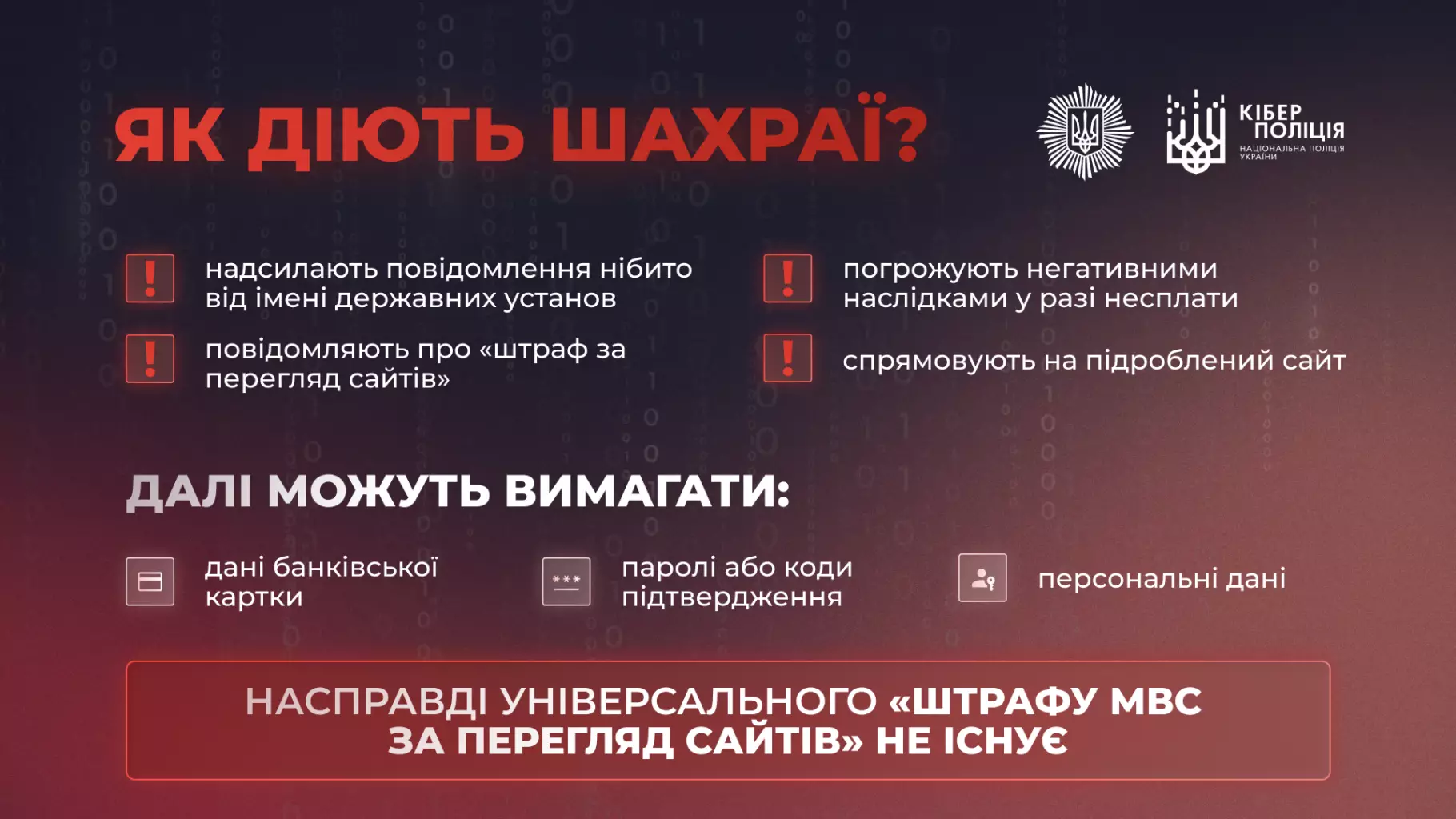
That change in the request matters. Paying a purported penalty and surrendering a banking password are different actions, even when a page presents them as parts of the same procedure. A confirmation code may authorize an operation or access that the recipient did not intend. The sender’s official-looking name cannot tell you what you are actually authorizing.
This is the same trust shortcut that makes fake bank calls about “reserve accounts” persuasive: the impersonator supplies both the alarming explanation and the proposed solution. Here, leaving the message’s link behind breaks that shortcut before the data request.
Check through a channel the message did not choose
If a demand concerns a genuine traffic fine, open an official service independently. In its separate June 4 warning about fake traffic penalties, MVS points to its web portal, Diia and the Driver’s Cabinet, as well as official apps. It also says the Patrol Police Department does not send fine notices to mobile phones. That statement concerns patrol-police notices; it should not be expanded into a claim that every possible government notification uses the same delivery method.
Use an official app you already know, or navigate from the relevant agency’s website. A copied crest, familiar colors or a link containing government-related words does not authenticate the sender. The issue is where the link actually leads and whether you can confirm the demand without following the path provided by the message.
Your response depends on what you handed over
For someone who opened the page but entered no data, the October 4 guidance says to close it and stop interacting. Opening a suspicious page alone does not establish that an account was emptied. If passwords, banking access details or payment information were submitted, tell the bank exactly what was shared, including any confirmation code, so it can address the relevant access or transaction.
MVS also recommends reporting the incident to police and Cyberpolice, and keeping the message, link, screenshots, sender contacts and payment records. Save these as evidence; do not reopen a suspicious payment page just to collect more. If the warning instead keeps appearing through browser notifications, our guide to fake police pop-ups covers that separate browser-permission problem.
The notice does not establish the scheme’s start date, identify its operators or give a victim count. The news is the ministry’s current public warning and its concrete recognition and response guidance. The useful decision is to verify outside the message’s payment path before a supposed fine becomes an account-security incident.
References
- Ministry of Internal Affairs of Ukraine. “Beware: Fake MVS fines.” October 4, 2026. Official warning and guidance.
- Ministry of Internal Affairs of Ukraine, based on Patrol Police and Cyberpolice materials. “Attention! Fake traffic fines.” June 4, 2026; accessed October 4, 2026. Official traffic-fine verification guidance.